Marie Curie Fellowship

It’s been a week of new adventures.  Last Monday my plane landed in Dublin and I began a new job at the Dublin Institute of Technology as a Marie Curie Research Fellow.  This is a two-year post funded by a generous grant from the European Union that will allow me to extend the research I began as a Fulbright scholar.  I spent several months last summer going the proposal, and met with success.

Many people helped with the proposal, including my mentor Dr. Nancy Stenson.  She has been a Marie Curie International Incoming Fellow (IIF) for the past two years… she told me of the IIF program, encouraged me to apply, and helped edit and refine my proposal.  Without her, I’d never have succeeded.  Jean Cahil, Jennifer Brennan, and Marek Rebow were also instrumental in the effort.  Colleen Dube, Pamela Eddy, Mike Murphy, John Donovan, and Brian Bowe provided valubale assistance as well.

Brian will be serving as my research supervisor for the next two years. Receiving this grant helped focus efforts in the college on the topic of research in engineering education. It lead to the formal establishment of CREATE (Centre for Research on Engineering, Architecture, and Technology Education, or something similar).

I’ll tell you about my recent adventures in an upcoming post….

Fulbright Programs in Europe/Euraisa — Upcoming Webinar

I received the following email announcement today, and thought you might be interested.  If you’ve ever considered applying for a Fulbright position, there’s no time like the present!

INVITATION TO JOIN US FOR A WEBINAR

Webinar Title: What’s New in Europe/Eurasia for 2015-2016
Date: Tuesday, March 11, 2014
Time: 2:00 PM – 3:00 PM EDT

Join CIES staff who work on the U.S. Scholar Program for a look at the large number of awards in the 2015-2016 competition available across Europe and Eurasia for scholars, professionals and administrators. Opportunities exist for teaching, conducting research or combining both.

Please be sure to register to reserve your seat for this webinar. The webinars are archived in order for you to review past sessions that you may have missed.

Sincerely,

Bill McShane
Program Officer, Fulbright U.S. Scholar Program
Institute of International Education (IIE)
Council for International Exchange of Scholars (CIES)
202-686-8665
wmcshane@iie.org

Architects’ Pot Luck

These days, wild, crazy fun among architects involves Pecha Kucha style presentations.  This is a high-speed format for sharing images and ideas.  With Pecha Kucha, each presenter selects/provides 20 images.  At the Pecha Kucha event, the slides are projected on a large screen in sequence for 20 seconds each.  The presenter talks, and the slides move on wether or not the speaker is ready.  It’s entertaining — in part because it’s actually quite difficult for the speaker to stick to the 20 second window.

This format keeps the speaker from droning on too long and it leaves time for more people to present.  It’s pot luck: everyone brings something to share and you can almost always find something you hadn’t expected but quite enjoy.

An architect from Williamsburg, Dale Weiss, organized a Pecha Kucha event at ArchExchange East last November and he has uploaded the representations to his (very elegant) website.

You can view my Pecha Kucha presentation, of urban reflections from Ireland, by clicking here.

Learning about Learning at Virginia Tech

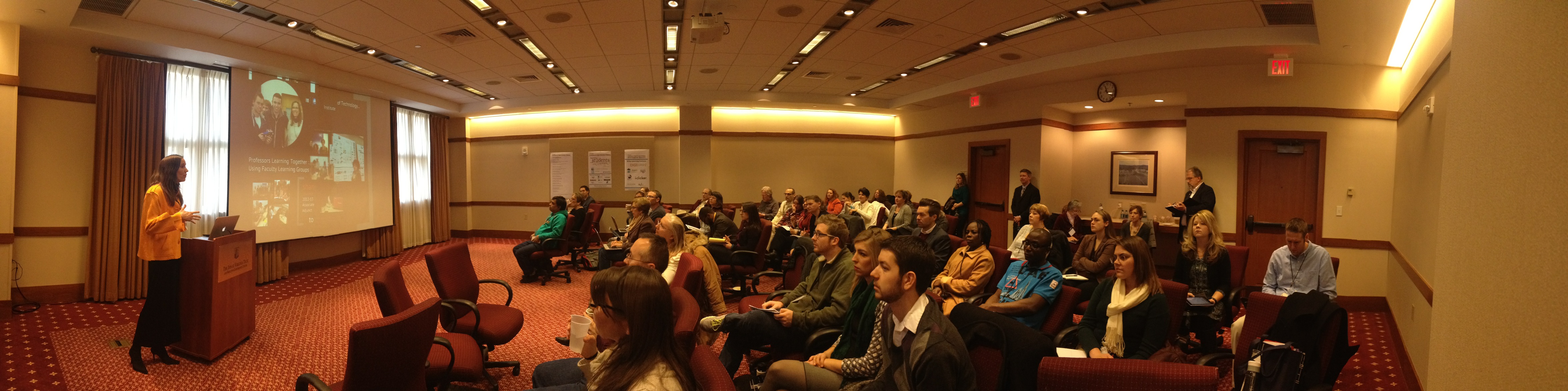
…to a pleasantly large group of colleagues.

Presenting at the Conference on Higher Education Pedagogy

Virginia Tech just hosted its sixth annual Conference on Higher Education Pedagogy (i.e., college teaching).  It was my second foray into this conference and it just keeps getting better and better.  The organizers manage to get sponsors to cover the entire cost, so there’s no registration fee.  That is truly amazing.

The conference gives me a chance to learn great new ideas (the sessions and keynote presentations were innovative and engaging), catch up with colleagues from around the country and world (with about 47 countries and as many states represented among attendees), visit my alma mater (I earned two architecture degrees from Virginia Tech), and even visit my family and childhood friends (Blacksburg is also my hometown).

I also took a quick jaunt over to Virginia Tech’s School of Engineering Education — one of two such schools in the entire world — to learn and to meet new colleagues.  Dr. Maura Borrego, whose research I’ve been citing in papers and grant proposals, provided a fabulous introduction to the program.  In addition, I got to meet several of her colleagues, including Dr. Marie Patretti who directs the undergraduate components of the engineering educate program, and Dr. Stephanie Adams who is Virginia Tech’s new Head of Engineering Education.  I even got to attend one of the Ph.D. classes in Engineering Education, taught by Dr. Vinod Lohani, and discuss assessment issues with the students.  They were discussing a paper that I’ve frequently cited as justification for continued research on outcomes of Problem-Based Learning.

I was very pleasantly surprised with the level of interest my colleagues had in the talk I delivered.  The audience was attentive and engaged and stayed after with lots of questions.  Thanks to the wonderful moderator who snapped great photos during the talk!

Fulbright Scholars Program: Calling New Applicants

Are you an aspiring Fulbright scholar?  This year’s call for applicants is open!

The competition for the Core Fulbright U.S. Scholar Program for the academic year 2015-2016 will be opening in a matter of days.  Be sure to consult the IIE/CIES website (www.cies.org) for complete award information.  Please also note that CIES will be opening its webinar series this Thursday (January 30) at 2:00 PM EST with “What’s Fulbright?,” a presentation on the Scholar Program in general [note from Shannon: you should be able to find this in the archives since it already happened]. That will be followed on Wednesday (February 5) at 2:00 PM EST with “What’s New?,” a presentation on 2015-2016 competition highlighting new awards, program innovations and other areas of interest.  As always, be sure to note that the competition deadline will be Friday (1 August 2014). We look forward to seeing you.
Best wishes,

Andy Riess, Ph.D.
Assistant Director, Outreach
Fulbright Scholar Program
Council for International Exchange of Scholars (CIES)
Institute of International Education (IIE)

ArchExchange

The Virginia chapter of the America Institute of Architects hosts a conference every November that is called “ArchExchange East.”  It’s a fabulous learning experience for me and my students.  Most of our department attends the event.  I’ve included photos of some highlights.

wiehr

Drawing (on) Gravity

Sometimes gravity is an architect’s friend.

In fact, architects can use gravity to human advantage in all sorts of ways.  In Ecology class today, I showed some diagrams of systems that use “thermosiphoning.”  That’s a fancy word referring to gravitation pull that moves fluids (like air or water).

The idea is that warm air (or water) rises and cold air (or water) sinks… because a  liquid is heavier and more dense when it is cold.

So, we can let gravity do the work if we think a system through.  Sometimes we need to move liquids in directions they don’t naturally want to go, and then we need to add electric pumps or fans to our systems.

Today, I showed my second year architecture students a tromp wall system as well as a diagram of an open loop solar hot water system.  In that type of system, you let the sun heat the same water that you will use to shower, wash dishes, or drink.

I also showed a few diagrams of basic heat exchangers… like the one in a car.  That one takes the heat from the combustion process and uses it to warm the air in the car without bringing in the “smog.”

The students were seeming to “get” the ideas, but they didn’t seem particularly jazzed up about them.  (I knew that because they were fidgeting and clearly wanted to text.)

To get them involved, I turned posed a problem for them to solve.

I asked them to pull out a sketchbook and combine the solar collector and the heat exchange into a single diagram.  They needed to figure out how you could use water with water with glycol (i.e., antifreeze) in it to collect the sun’s heat and then use that same liquid to warm the water for someone’s shower.

The challenge was to transfer the warmth into potable water without tainting it.  A couple of students caught on fast. After everyone had given it a try, I let them help each other.  More and more people got it.

At about the same time, I asked a four of the students who caught on quickly to draw their diagrams on the board and then explain how they worked to the class.  We all put our heads together to analyze the designs.

Gravitational Pull

cabins 2

Hampton University’s second year architecture students are learning about gravitational forces and lateral loads by designing post and beam structures using a simple kit of parts (and adhering to a lot of fairly complicated rules).

The intention of the assignment is for students to learn about cantilevering, stacking, and hinging.  They also have to respond to environmental factors and work together in groups to enhance the site design concept developed by another student in the studio.  You can see one of the site design models in the photos below.  The cardboard frames you see represent the structural systems of small cabins that nestle into the site design.

I’ve asked them to build the structures at such a large scale (1″=1′) so they can really get the feel of what the various structural components are capable of doing.  Once they achieve suitable concepts, they will model their frames in wood.

Fingers cross that that will happen by Wednesday!  Thanksgiving is just around the corner… only three weeks of classes left to go this semester… so much to learn, so little time.  They still have to have the interior space, design building skins, and illustrate their designs with diagrams and measured drawings.  All that, in addition to completing their Physics, Architectural Representation, Architecture History, and Architectural Ecology course work.  Whew!

Strolling Freemason

Hampton Roads is lovely this time of year!  Here are some snippets from my quick post-yoga walk through Norfolk’s historic Freemason district.

Full STEAM Ahead, Virginia!

Discussing STEAM subjects: Caroline Martin, Dr. Judy Stewart, Orlando Robinson, Dr. Michelle Claville, Romdon Roopchan, and Dr. Shannon Chance.

Discussing STEAM subjects: Caroline Martin, Dr. Judy Stewart, Orlando Robinson, Dr. Michelle Claville, Romdon Roopchan, and Dr. Shannon Chance.

Big things are happening in the world of STEM education in Virginia.  Two enterprising educators, Caroline Martin and Dr. Judy Stewart, have founded the Virginia STEAM Academy.  Their public, 4-year residential program in Science, Technology, Engineering and Applied Mathematics is set to open for its inaugural cohort of students in the fall of 2015.  Last summer, Judy and Caroline conducted a summer program to get the ball rolling.

They have been working on the Virginia STEAM project since November 2010, and I’m happy to say that I’ve had some level of involvement since February 2011.  Although I took a year away during my Fulbright fellowship, a Wednesday meeting  on Hampton University’s campus helped me catch back up.

I’m fascinated by two specific aspects of the planning Caroline and Judy are doing: (1) securing and preparing facilities on the former Ft. Monroe that will house 1000 high school students and 75 teachers (who will live on-site with the students) and (2) designing the curriculum to support quality learning and innovative teaching.  They are such innovative thinkers and they know how to get things done!
Their vision for the school is remarkably aligned with the research I’ve been doing on integrating design thinking into engineering curricula and on tracking learning outcomes that accrue as a result of hands-on, problem- and project-based learning.

This Academy is going to open a while new world of possibilities for Virginia and her citizens.  My sister, Heather , was lucky enough to attend the Governor’s School for Science and Technology in Roanoke when she was in high school.  However, the daily commute — an hour each way — was a real strain on her and the other three students from our county who attended with her.  This new residential school will take the burden of daily commuting away, allowing the students and teachers focus on learning and generating new knowledge.

I am thrilled  the school will be here in Hampton Roads, and just a stone’s throw from Hampton University’s campus.

This Academy offers an ideal setting for the study of history as well as STEAM subjects.