Meeting Grafton Architects: Irish Ladies Leading the Way!

img_2359-1

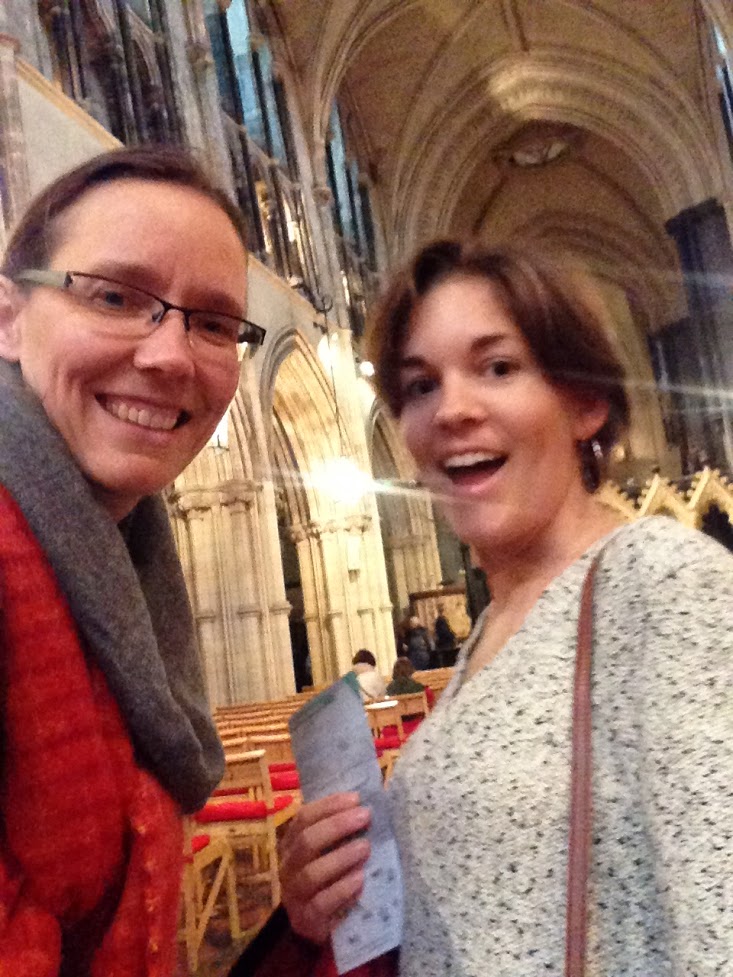
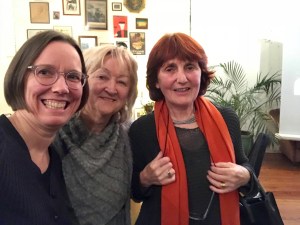
Shannon Chance with Shelley McNamara and Yvonne Farrell of Dublin-based Grafton Architects.

I finally got to meet Shelley McNamara and Yvonne Farrell, founders of Grafton Architects and designers of my home here in Dublin.

You may recall blogs I posted in October 2012 titled Hats off to Grafton Architects, a post about sun angles in winter, and a video clip I made shortly after moving into “my Dublin Castle.” I have attached my apartment tour which is quite goofy. In it, explained features unique to Ireland and the EU, but I called the water tank “electric storage.” That’s factually true, but here they use the term just for the wall heaters that heat bricks in the night, when electricity costs less, and radiate that heat our during the day.

I learned more about electric storage heat from my maintenance guy, Keith Brown. I posted a blog where he showed me how they work. I sure do miss Keith as he was able to fix anything, usually the way my grandpa would have! Pa grew up during the Great Depression and was quite thrifty! Keith, on the other hand, moved to Spain.

I, on the other hand, am not moving to Spain any time soon. But this flat is plenty warm and sunny.

I love every minute in this place, perched high in the Smithfield Lofts that Yvonne and Shelley designed back in 2006. Last night, I got to tell them how much I enjoy living here.
Grafton Architects

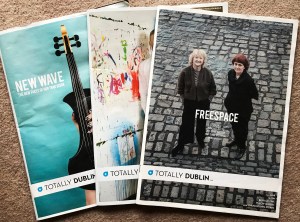
Covers from “Totally Dublin”

I had braved the lashing rain, trotting across town to pick up new specs at Ace and Tate and then over to Fumbally for an event produced by the magazine Totally Dublin, which ran a feature on them in January 2018 that I still have on my coffee table.

The talks weren’t starting on time. Or rather, Irish evening-time tends to run quite behind what the clock face shows. This event ran 8-10 PM, rather than the 7-8:30 PM published. In any case, I had time to grab a slice of cake and get psyched up to hear these amazing architects talk.

In the interim, I decided to hop across the room to tell Yvonne and Shelley that I’m a big fan and I love my home.
img_2125

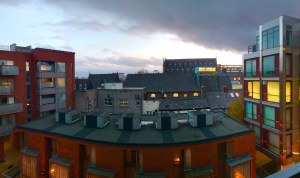
A Dickens Christmas in cozy Smithfield

I showed them the photo I took last week from my balcony, which I’d posted in an earlier blog.

They seemed delighted to hear their building was loved, as that construction process was rough, with the developer cutting corners and ultimately going out of business when the economy crashed. I’d been told that unfortunate story by my colleagues when I moved in and was glad to help these architects reconnect with their creation. Incidentally, any criticisms I’ve ever had of this building are due to poor workmanship and Ireland’s very strange fire codes.
img_2347

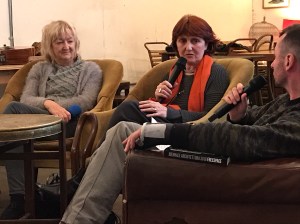
Shelley McNamara sharing insights

These architects are now world-famous. They curated the Venice Biennale this year, bringing Irish architecture and Irish design to the fore of the world stage. They dedicated the 2018 Biennale to “Freespace,” which I might describe as third-space, public space where everyone is welcome and treated with equal dignity and respect.

Last night, Shelley and Yvonne discussed their role in the Biennale and working together since they first met in architecture school at UCD where they graduated in 1974. Imagine, they entered in a class that was gender balanced at the end of the 1960s!

Consider that the year Shelley and Yvonne entered architecture school, women were not allowed to study this subject in many universities in the USA, including the University of Virginia (a place Yvonne and Shelley mentioned to me last night). UVA began admitting women in the year 1970. The institution had admitted a few women before this date because they had a medical school that needed nurses; my mom earned a Bachelors in Nursing there at UVA in the mid-60s.

What a revelation, to learn there was gender balance in architecture admissions here in Ireland at the same time there were 0% women and 100% men in architecture at UVA!

Yvonne and Shelley said they’d never experienced gender discrimination in their lifetimes as architects, designing buildings in Ireland, Peru, Italy, Spain, France…. That was quite inspiring to hear!

Yesterday evening also featured discussions with the photographer and artistic director of the magazine’s October cover piece on “The Bumbles” and discussion and performance by busker NC Lawlor, an Irish man reared in Manchester and now living and performing in many types of venues in Dublin. You’ll have to find him busking on Grafton Street if you want to hear him first hand!

Below are photos of the evening, along with pics I’ve snapped over time of my cozy flat.

Maria Carreira’s PhD viva on Learning Spaces in the University Context

Maria's viva 5What an honor to be part of the day a young scholar gets her wings, so to speak, by earning her PhD! Last week I travelled to Lisbon to attend the viva (i.e., PhD defense) of Maria Alexandre Bacharel Oliveira Carreira. I had met with Maria on both of my two prior visits to the Instituto Superior Técnico at the Universidade de Lisboa. I really enjoyed watching her work unfold.

This time, I was a member of her evaluation panel. I curled up with her thesis each night while I was in Brussels. Preparing for this panel event took many hours for me–but it took five years for Maria! During that time Maria gave birth to two children, but that didn’t slow her down much. She kept plugging away at her research.

She conducted extensive analysis of spaces that support teaching and learning. The title of her dissertation (which in Europe is called a thesis) is In-between Formality and Informality: Learning Spaces in University Context. The European term “viva voice” (meaning “live voice”) is so much nicer than the term “dissertation defense” used in the States.
Maria's viva 00After 2.5 hours of presenting her work and answering questions–posed by the panel of 6 experts (I myself had 40 minutes to talk about her work and ask questions of her)–Maria and her many family members and friends who had come to the event left the room. The panel discussed the merits of the work, deliberated, then invited Maria and the crowd back into the presentation room to pronounce her a PhD with distinction. We all went for a celebratory luncheon in the afternoon.

Once Maria has submitted the final version of her thesis, I’ll try to post a link. In the meantime, you may be interested to read two of the articles I have written that have to do with topics in her thesis.

The first is about how the design of school buildings can enhance learning and help us achieve environmental sustainability:


Chance, S. and Cole, J. T. (2014) “Enhancing Building Performance and Environmental Learning: A Case Study of Virginia Beach Public Schools ” City Public Schools. Book chapter from the book entitled “Marketing the green school: form, function and the future.

The second is about university buildings. It also discusses how buildings can promote learning, by serving as examples, modeling values, and getting people engaged. It’s about environmental sustainability and how LEED has become an example of organizational learning (i.e., a big organization that effectively learns from past experience, using it to improve future performance):

Chance, S. (2012) Planning for Environmental Sustainability : Learning from LEED and the USGBCPlanning for Higher Education, Vol. 41, No. 1, Oct-Dec, 2012.

Culture Night Dublin with Fulbright-ing Friends

Culture Night Dublin 2105 1Dublin Culture Night happens once a year, offering a glimpse into many cultural treasures this city has to offer. This year, I got to attend the event with my friends Amanda Wagstaff and Frank Daly.

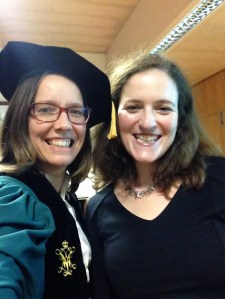
Amanda recently moved to Dublin as a Fulbright student for the 2015-16 academic year. She and I actually graduated from the College of William and Mary on the very same day in 2010–she with a Bachelor of Arts and I with a PhD in Higher Ed. Amanda is a studio artist who is using the archives at the Chester Beatty Library to generate inspiration for her own contemporary artwork. You can see Amanda’s past work on her website, Traipse.

Frank’s art and photography is viable on his website and his many Google+ photo albums.

The there of us kicked off our Culture Night explorations at Christchurch Cathedral, not far from my Smithfield residence, and then proceeded eastward to see several more sights. We took in dinner at the Queen of Tarts, Dublin’s stately Customs House, and a guitar concert at the Unitarian Church on St. Stephen’s Green.

Culture Night is just one of many ways to learn history in Dublin. I’ve included photos in the gallery below of several cultural events that happened around the same time:

  • a lecture on the Irish Civil War (hosted by the Smithfield-Stoneybatter People’s History club and held at in the backroom of the Cobblestone Pub)
  • a man in Smithfield preparing his horses and carriage for the All Ireland football match
  • the best places I know to sit and read about history (my friends seem to enjoy reading in these places, too!)

Expanding the Engineers’ Box

Fergus Whelan commented that I need to think outside this box....  Thanks to Frank Daly for the fabulous photo.

Fergus Whelan commented on this image that I need to think outside this box!  Many thanks to Frank Daly for the fabulous photo. My students, having sent his look many times before, certainly empathize with you!

In all corners of the globe today, companies are clamoring for skilled engineers. They want a larger pool of applicants who are creative, flexible thinkers prepared to address complex, emerging questions riddled with interrelated unknowns. Like industry, the sectors of healthcare, education, and government also have great need for well-rounded thinkers with strong engineering acumen.

Simply put: the world needs more people who can think across systems and see how things relate at multiple scales. We need people who can identify problems and create new solutions from the ground up. People who aren’t so closely bound to existing systems, ideas, and protocols that they can’t construct entirely new schemes for thinking and behaving.

Today, governmental organizations (like Science Foundation Ireland and the National Science Foundation in the USA) are working hard to address the shortfall in the number of engineers by generously funding education of, as well as research by, engineers and scientists. They seek better ways to teach and think about engineering and science.

The blogs I will be posting in the near future have to do with:

  • the way we think about and conceptualize engineering
  • how I think this needs to change
  • how architects and education researchers can help

Please note: I’m going to be explaining things that I’m trying to work out in my head and do this as if I’m speaking to a friend or relative who knows little about research. That means I may not be “100% right” in every explanation. But as you’ll see, that is a risk that must be taken for the sake of building knowledge. (It’s all part of this new “paradigm” for working and thinking that engineering needs to implement more widely… more on that to come!)

I do hope you’ll follow along on this research adventure, where I’m working to bring qualitative, social science research and design thinking into more facets of engineering education.  Yes, these are gutsy claims I’m making — particularly since I’m new to research and new to engineering.  Let’s see if I can live up to such promises….
Ecology Rocks! (Especially in a Flipped Classroom)

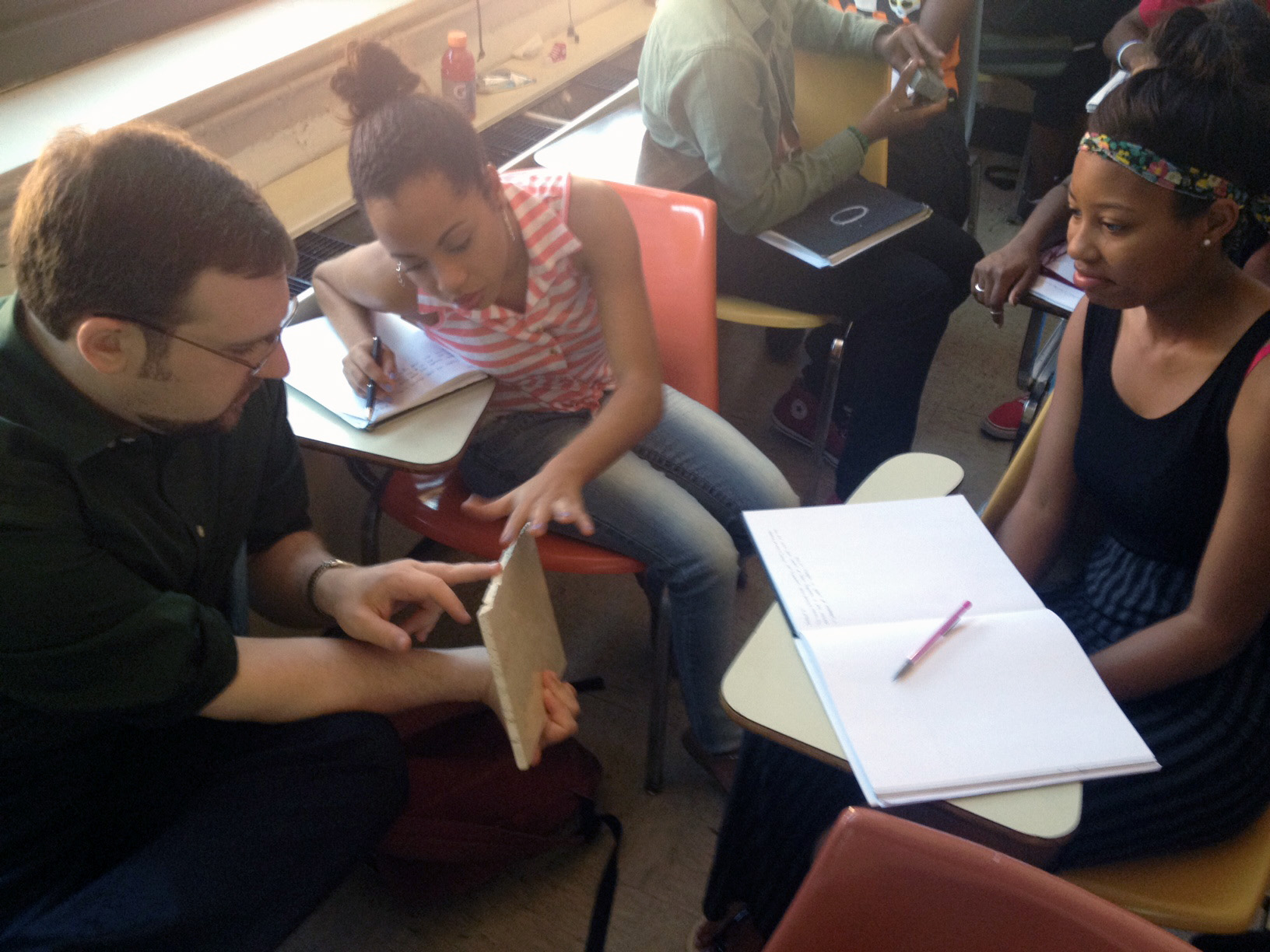
This group realized there was a fill material in the crevices of their "Roman Travertine" tile sample.

This group realized there was a fill material in the crevices of their “Roman Travertine” tile sample.

Today we discussed “natural factors” that affect architectural design, such as rock and soil composition. This tied directly to yesterday’s studio class on the HU Point. Today, I was using a technique known as the “flipped classroom” to teach Architectural Ecology. I learned about this technique during my Fulbright fellowship at DIT.

I had assigned my students to read a chapter before class. When they arrived, we started class with ten minutes of journaling.  I asked them to write about the aspect of the chapter they thought was most important to them regarding our site at the Hampton University Point, and to explain why.  I also asked them to identify a topic in the chapter that they didn’t fully understand and explain why/what they didn’t understand about it.

Journaling is my own way of assessing students’ level of understanding of the content.  After ten minutes, I collected journal papers then “flipped the classroom”.  Each student joined the other members of his/her learning group, discussed the issues of confusion they’d each identified, explained to each other what they understood (this is known as “peer teaching”), and researched information on line using their laptops and smart phones.

I circulated around the room, listening, observing,  pointing them in the right direction where necessary,  and making sure they were achieving accurate interpretations.

It became clear that soil and rock composition was the major topic of confusion, so I went ahead and distributed the rock samples I have on hand.  Each group got their own unique rock type to analyze, research, and introduce to the rest of the class. The students did a great job of staying on topic in their discussions, learning, and teaching leach other.

They made sense of sedimentary, igneous, and metamorphic rock. They began to understand issues of texture, particle size, expandability, drainage, and bearing capacity while they were talking among themselves with my guidance.

A member of each group presented findings to the class and we discussed overarching issues.

Then I projected the Prezi file on the screen, which I’d formatted using a table of contents so we could zoom directly into whichever specific issues were causing confusion. In this case, we needed to go over the soil classification pyramid a bit, but they had already developed pretty strong understanding through the group discussions and rock presentations.

Amazingly, everyone stayed engaged for 1.25 hours!

I didn’t have to nag students to pay attention.

By the end, they seemed to have very good understanding of all the content of the chapter.  I found I had ten minutes to spare at the end to bush on topics of my choice (ones I thought a student or two might still have misconceptions about).

I am loving this new, more interactive, way of teaching.

It’s called “flipping the classroom” because the content is delivered before class (in this case, through a reading), and class time is used to gauge accuracy and depth of understanding and to build upon that base.  It seems to be a much better us of time than presenting everything with equal emphasis, before assessing if the students already understand it!

Not everyone came into the class having read, unfortunately. This problem should correct itself in the future because each student gets a grade for each journal entry. They have to show basic understanding of the reading in order to earn points. They generally start seeing the importance of this after a day or two.

Constructing a Student-Centered Studio

The incoming second year architecture studio cohort at Hampton University.

The incoming second year architecture studio cohort at Hampton University.

Today I applyed what I learned about problem-based learning (PBL), group learning, and student-centered pedagogies while I was on my Fulbright fellowship at Dublin Institute of Technology. I met the students in my second year architecture studio for the first time. Studio looked unlike Day One of this class (ARC201) ever looked before!

We started outside, with team building activities and a name game. Then we formed the teams (i.e., learning groups) that we’ll use for the first five weeks of this semester.

Next, we conducted initial site analysis in a way that was much more engaging than normal. We held a “scavenger hunt” to identify qualities of our project site (the Hampton University Point) that have to do with water.  The students managed to generate a much more interesting list of factors than I’ve ever been able to get them to achieve before; 63 about water alone!

For Friday, each team (of three students) has two assignments due.

Assignment 1 is to draw a plan of our project site to an architectural scale to fill an 18″x24″ sheet of paper.

This problem prompt is pretty specific (close-ended), but it still leaves a number of variables for students to consider and make choices about.  I hope they’ll get a bit competitive and prove they have pride in their work!  I asked the groups to follow a standard PBL format in starting work on this assignment. I asked them to figure out:

  1. What is this assignment asking?
  2. What will we need to know to do this?
  3. What do we already know about this?
  4. What will we need to learn/find out?
  5. What resources will we need?
  6. Who will do what and when?
  7. How will we check for accuracy before it’s due?

Assignment 1 is more straightforward than you might expect for an architecture studio. However, it will lay groundwork for upcoming activities, and it will help me assess where the students are skills-wise and with regard to collaboration. The second assignment is much more open-ended.

Assignment 2 is to make a beautiful object that reveals the essence of water.

I asked the groups to start by watching one of the YouTube videos listed below, and assume that the astronaut/scientist had made the video in response to this assignment. I asked the students to consider the questions above (which are intended to foster “self-direcetd learning”) and to bring to our next studio meeting a final, beautiful object as well as at least three study models that investigating the “essence of water”.  I’ve got my fingers crossed!

The students were more  active, engaged, and enthusiastic about learning than is typical on Day One of this course and I have high hopes for this new method of teaching.

NASA: Amazing Experiments with Water in Zero Gravity – YouTube

NASA: Amazing Experiments with Water Balloons in  – YouTube

Powerscourt Gardens


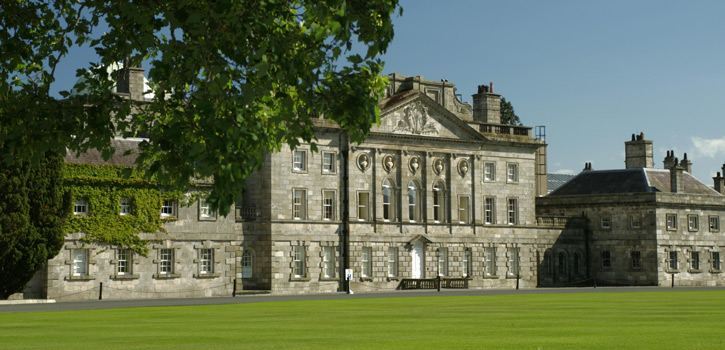
Powerscourt country house  (downloaded from www.powerscourt.ie).

Powerscourt country house (downloaded from http://www.powerscourt.ie).

Visiting the Powerscourt house, garden, and waterfall–located south of Dublin–makes a nice outing from the city.  Some coach companies offer a day trip here, but you can save a lot of money if you just take Dublin bus!  The interior of the house is a bit disappointing, as it was gutted by fire. But the exterior, garden, and nearby waterfall are glorious.

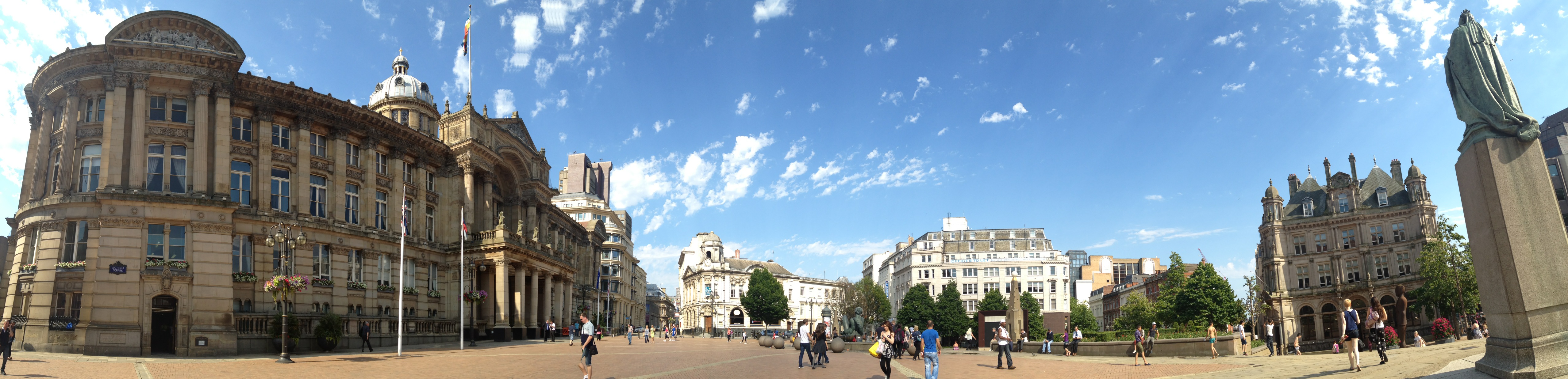
Dreaming of Birmingham

Birmingham UK 4

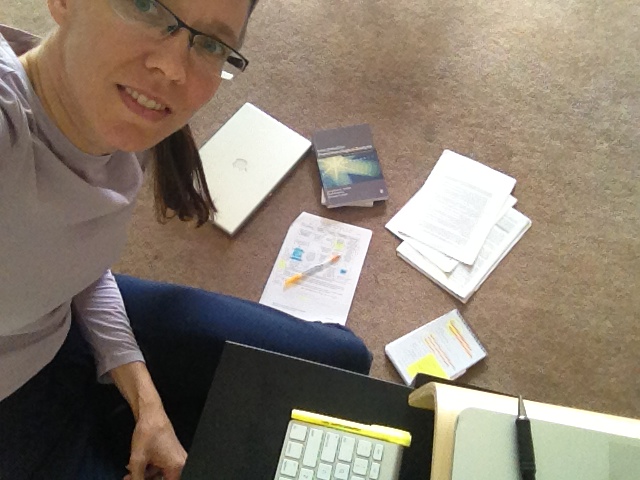
Shannon burried in books and papers.

Shannon swimming in books and papers.

I’ve been buried in books and papers for days.

I’m working overtime on a research proposal… trying to find funds to return to Dublin so that I can follow up on findings I’ve made and keep learning new research skills by working with experts and doc students here.

The last time I got to go outside and explore was last week in Birmingham.  Wikipedia explains that Birmingham is:

city and metropolitan borough in the West Midlandsof England. It is the most populous British city outside the capital London with 1,074,300 residents (2011 census), an increase of 96,000 over the previous decade.[2] … A medium-sized market town during the medieval period, Birmingham grew to international prominence in the 18th century at the heart of the Midlands Enlightenment and subsequent Industrial Revolution, which saw the town at the forefront of worldwide developments in science, technology and economic organisation, producing a series of innovations that laid many of the foundations of modern industrial society.[5] By 1791 it was being hailed as “the first manufacturing town in the world”.[6]

I’ll share pictures of that city today, in all its splendor….

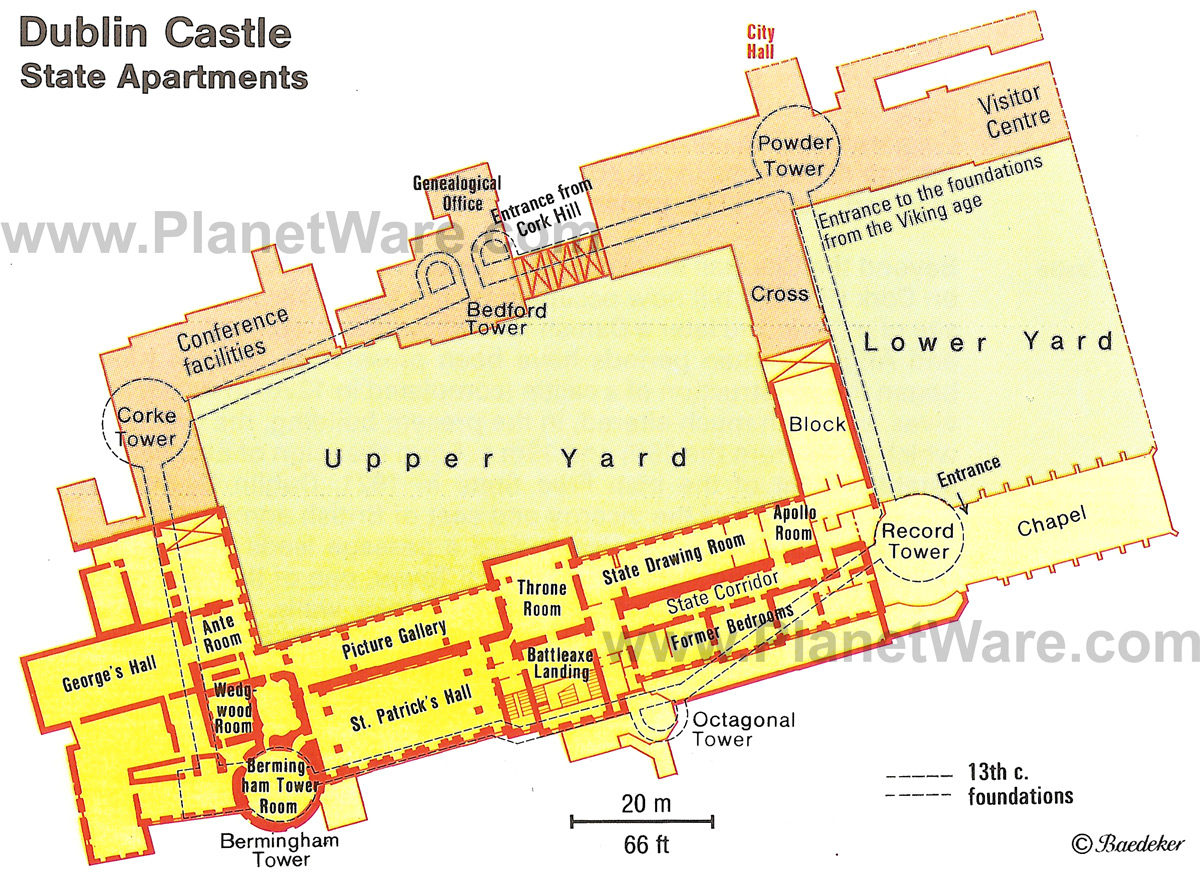
Dublin Castle

Here’s what Dublin Castle looks like….

Fulbright events were held in the Throne Room, Picture Gallery, an St. Patrick’s Hall.

Undercover in Rome

Many thanks to Daisy for inspiring me to draw so much on my trip to Rome… we have always been very productive at sketching when we travel together. In this post, I’ve included photos of one of our many dinner outings.

On my last  night in Rome, Daisy and I headed over to Trastevere–stopping for a glimpse of the basilica (dedicated to Santa Maria, where mass was in session) before heading on to our favorite dinner spot.  As is generally the case when Daisy and I are traveling with architecture students, we  brought our sketchbooks along to discuss.

I’ve included photos of Daisy’s beautiful work, that caught the attention of our waitress.  She studied every page!

Daisy’s area of expertise is architectural representation, as is evident in her drawings!  Mine, on the other hand, is educational research… that’s what I presented to Daisy’s students in the lecture I delivered.

As a result of our exchange, I woke up inspired to draw on my last day in Rome.

It was hot, hot, hot, though.  I had to sketch quickly to keep ahead of the heat!  By the afternoon, the sky opened up and the rain poured down.  Thankfully our fore bearers built plenty of sheltered spots in Rome that have lovely views!  I made three sketches on my parting day–two are shown below.