Constructing our Reality

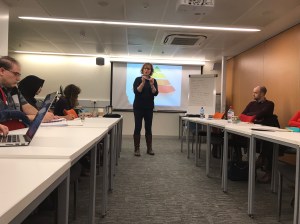
Last week I got to talk with a group of 60+ architecture students and faculty about design thinking, student development theory, and my Fulbright research… as well as how they connect to what we do in our department at Hampton University.  Moments like these help us reflect on what we are.  I hope they will also encourage my compatriots to explore ideas about what we want to become.

My current research is situated in the constructivist paradigm.  What does that mean?

Well, my research ideas and techniques are founded on the principle that we humans construct the world around us — including the things we see and touch, how we know, and what we know — and that we are able to generate new knowledge.

By discussing such topics, and considering collectively what it means to “design” and to “know” and to “learn,” we can become more international, purposeful, and effective in the things we do each day.

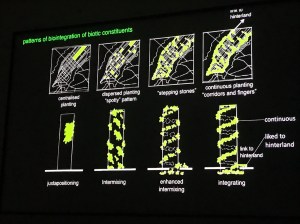
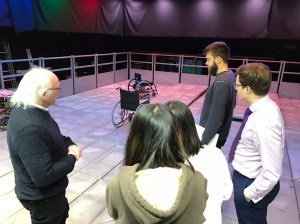
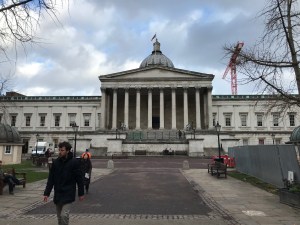
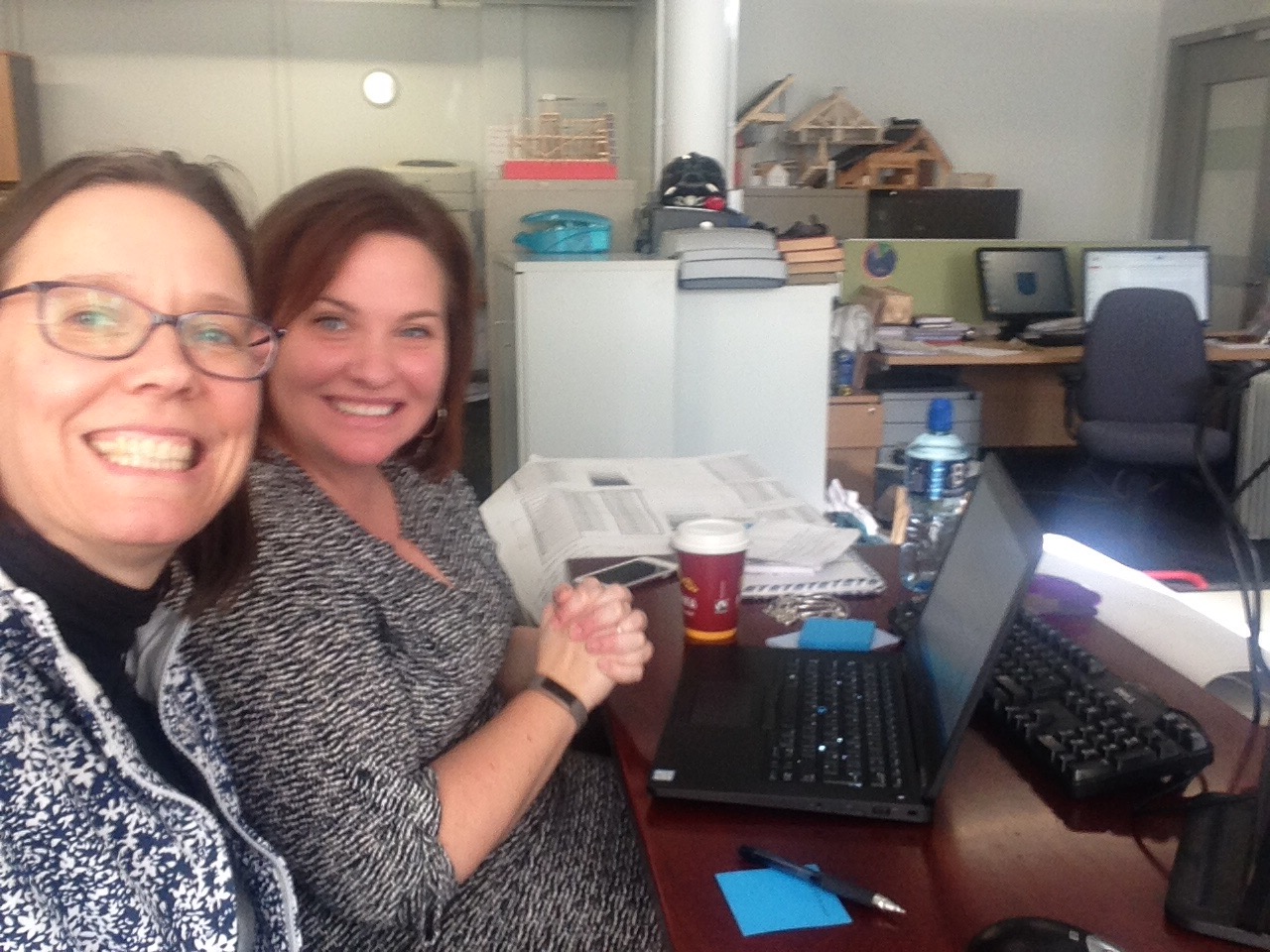
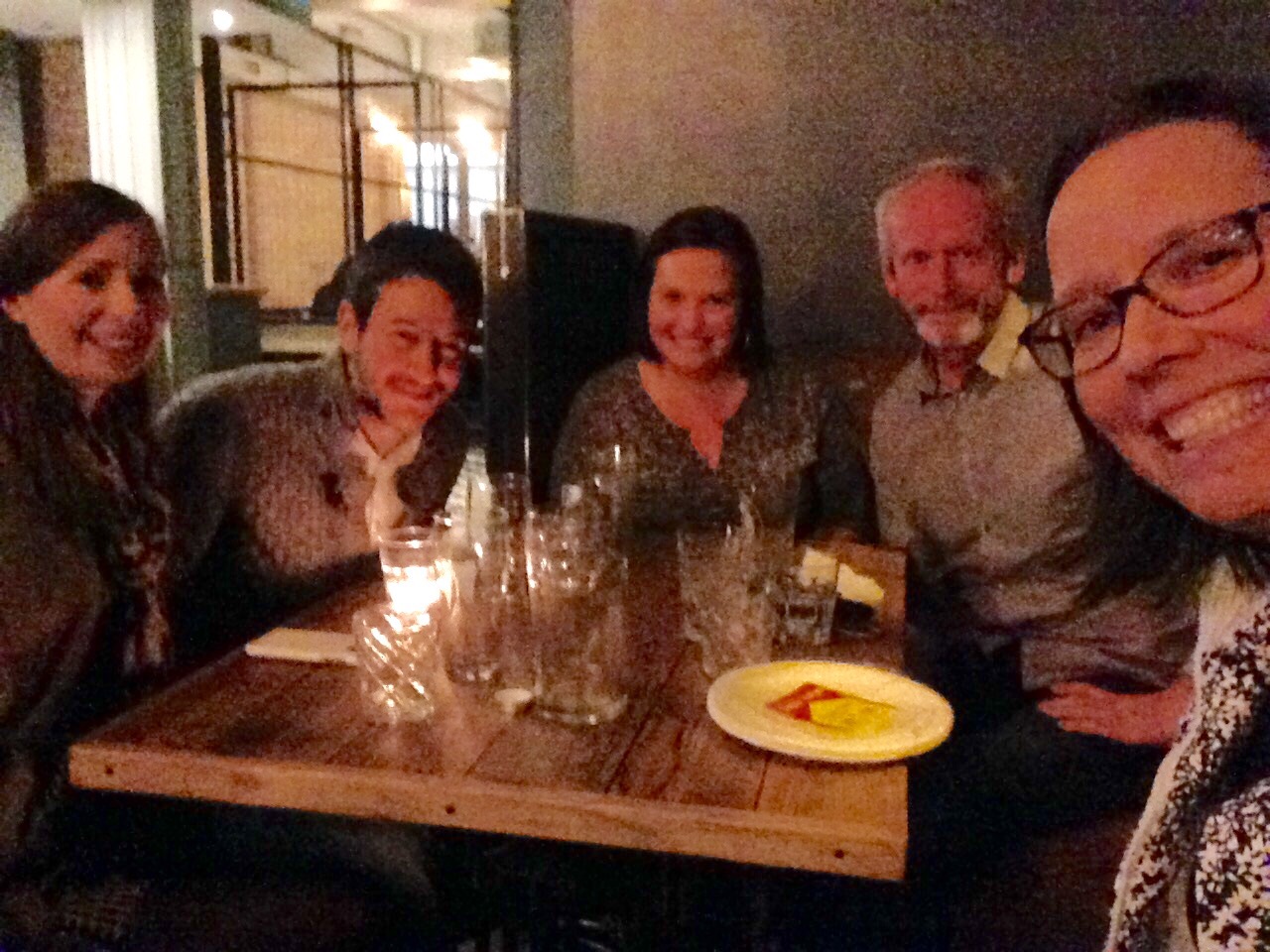
One of our students, Rhama Mohammed, snapped some photos during the talk and loaded them into our Facebook page (I’m posting copies here).  This provides a little glimpse of our department’s reality… surrounded by teachers (unfortunately, we don’t have images of any students in the crowd)… and a highly animated presenter.

Testing Theory in Practice

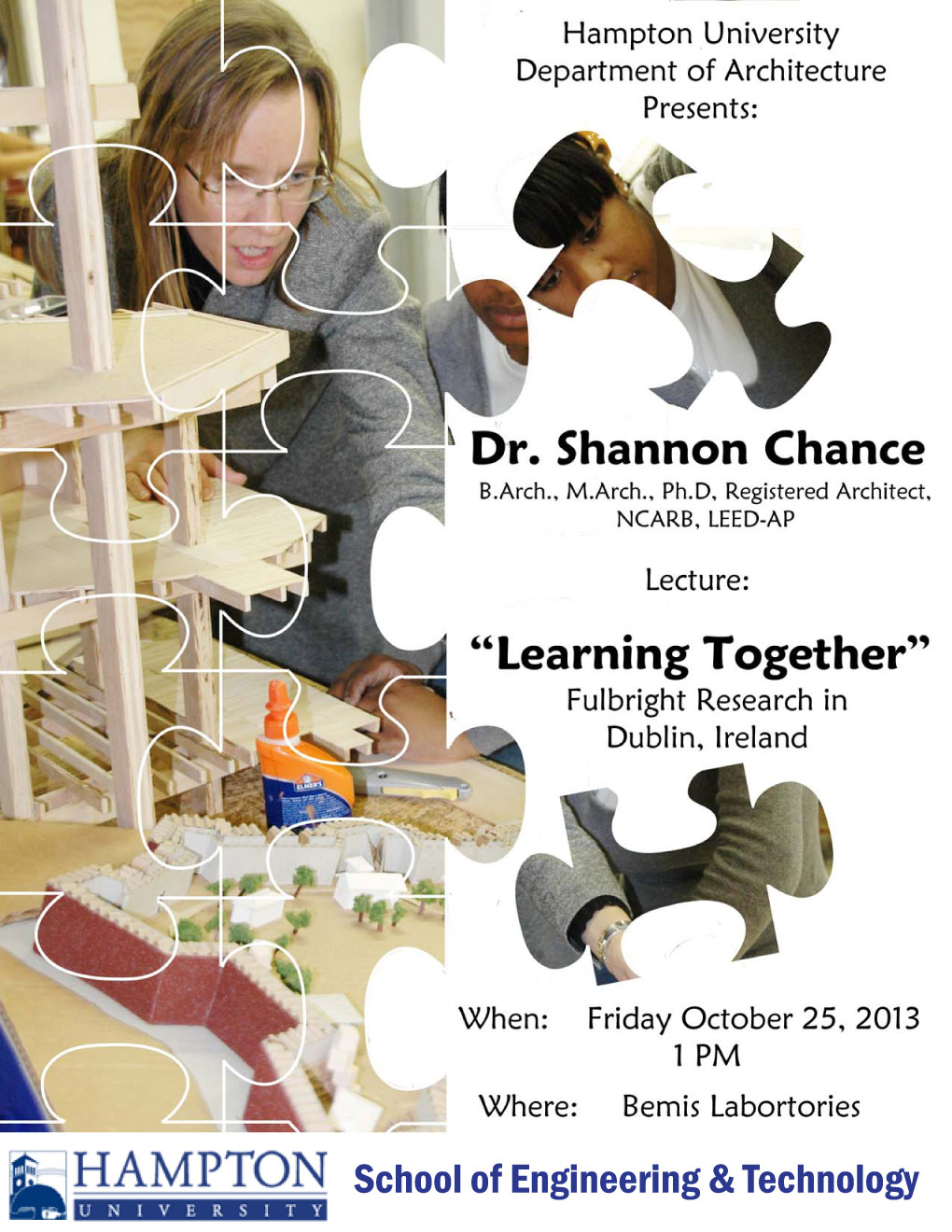
Yesterday I got to share some of my Fulbright research as part of the weekly lecture series hosted by the Hampton University Department of Architecture.  It was a great way to catch up with the advanced students and introduce myself to the first year group.

The students were highly attentive, very receptive to learning about epistemology and cognitive development theories, and interested in hearing about how I am using  data from student blogs  to test existing theories.

The faculty seemed genuinely interested, too.  At the end, though, there was no time for the faculty to ask questions… the students had so many questions that I finally had to cut things short and send them off to their studio classes.

At the start of the lecture, I had asked the students to pull out their smart phones and look up this blog site.  As a result, they had many questions about what I’ve found in applying the new methods in the second year studio and sustainability classes I teach.

I also passed around the catalog from my photography exhibition, so they could see some of the artwork I created in Ireland.  I also encouraged them to look up pages about my adventures in Greece, Portugal, Belgium (which I still need to post more about), France, and of course, Ireland.

Lecture poster (produced by HU student Samuel Morgan).

Lecture poster (produced by HU student Samuel Morgan).

Ecology Rocks! (Especially in a Flipped Classroom)

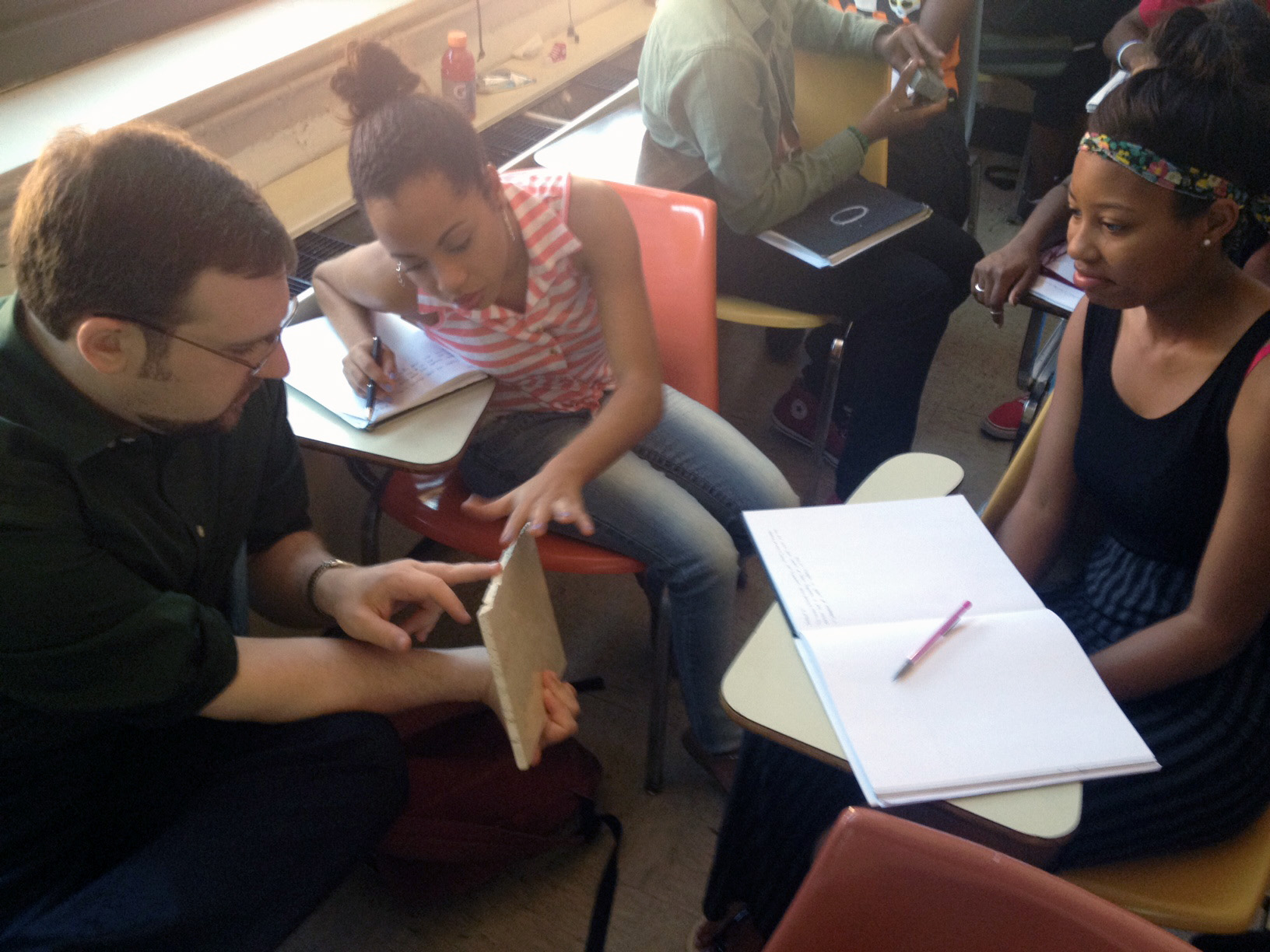
This group realized there was a fill material in the crevices of their "Roman Travertine" tile sample.

This group realized there was a fill material in the crevices of their “Roman Travertine” tile sample.

Today we discussed “natural factors” that affect architectural design, such as rock and soil composition. This tied directly to yesterday’s studio class on the HU Point. Today, I was using a technique known as the “flipped classroom” to teach Architectural Ecology. I learned about this technique during my Fulbright fellowship at DIT.

I had assigned my students to read a chapter before class. When they arrived, we started class with ten minutes of journaling.  I asked them to write about the aspect of the chapter they thought was most important to them regarding our site at the Hampton University Point, and to explain why.  I also asked them to identify a topic in the chapter that they didn’t fully understand and explain why/what they didn’t understand about it.

Journaling is my own way of assessing students’ level of understanding of the content.  After ten minutes, I collected journal papers then “flipped the classroom”.  Each student joined the other members of his/her learning group, discussed the issues of confusion they’d each identified, explained to each other what they understood (this is known as “peer teaching”), and researched information on line using their laptops and smart phones.

I circulated around the room, listening, observing,  pointing them in the right direction where necessary,  and making sure they were achieving accurate interpretations.

It became clear that soil and rock composition was the major topic of confusion, so I went ahead and distributed the rock samples I have on hand.  Each group got their own unique rock type to analyze, research, and introduce to the rest of the class. The students did a great job of staying on topic in their discussions, learning, and teaching leach other.

They made sense of sedimentary, igneous, and metamorphic rock. They began to understand issues of texture, particle size, expandability, drainage, and bearing capacity while they were talking among themselves with my guidance.

A member of each group presented findings to the class and we discussed overarching issues.

Then I projected the Prezi file on the screen, which I’d formatted using a table of contents so we could zoom directly into whichever specific issues were causing confusion. In this case, we needed to go over the soil classification pyramid a bit, but they had already developed pretty strong understanding through the group discussions and rock presentations.

Amazingly, everyone stayed engaged for 1.25 hours!

I didn’t have to nag students to pay attention.

By the end, they seemed to have very good understanding of all the content of the chapter.  I found I had ten minutes to spare at the end to bush on topics of my choice (ones I thought a student or two might still have misconceptions about).

I am loving this new, more interactive, way of teaching.

It’s called “flipping the classroom” because the content is delivered before class (in this case, through a reading), and class time is used to gauge accuracy and depth of understanding and to build upon that base.  It seems to be a much better us of time than presenting everything with equal emphasis, before assessing if the students already understand it!

Not everyone came into the class having read, unfortunately. This problem should correct itself in the future because each student gets a grade for each journal entry. They have to show basic understanding of the reading in order to earn points. They generally start seeing the importance of this after a day or two.

Constructing a Student-Centered Studio

The incoming second year architecture studio cohort at Hampton University.

The incoming second year architecture studio cohort at Hampton University.

Today I applyed what I learned about problem-based learning (PBL), group learning, and student-centered pedagogies while I was on my Fulbright fellowship at Dublin Institute of Technology. I met the students in my second year architecture studio for the first time. Studio looked unlike Day One of this class (ARC201) ever looked before!

We started outside, with team building activities and a name game. Then we formed the teams (i.e., learning groups) that we’ll use for the first five weeks of this semester.

Next, we conducted initial site analysis in a way that was much more engaging than normal. We held a “scavenger hunt” to identify qualities of our project site (the Hampton University Point) that have to do with water.  The students managed to generate a much more interesting list of factors than I’ve ever been able to get them to achieve before; 63 about water alone!

For Friday, each team (of three students) has two assignments due.

Assignment 1 is to draw a plan of our project site to an architectural scale to fill an 18″x24″ sheet of paper.

This problem prompt is pretty specific (close-ended), but it still leaves a number of variables for students to consider and make choices about.  I hope they’ll get a bit competitive and prove they have pride in their work!  I asked the groups to follow a standard PBL format in starting work on this assignment. I asked them to figure out:

  1. What is this assignment asking?
  2. What will we need to know to do this?
  3. What do we already know about this?
  4. What will we need to learn/find out?
  5. What resources will we need?
  6. Who will do what and when?
  7. How will we check for accuracy before it’s due?

Assignment 1 is more straightforward than you might expect for an architecture studio. However, it will lay groundwork for upcoming activities, and it will help me assess where the students are skills-wise and with regard to collaboration. The second assignment is much more open-ended.

Assignment 2 is to make a beautiful object that reveals the essence of water.

I asked the groups to start by watching one of the YouTube videos listed below, and assume that the astronaut/scientist had made the video in response to this assignment. I asked the students to consider the questions above (which are intended to foster “self-direcetd learning”) and to bring to our next studio meeting a final, beautiful object as well as at least three study models that investigating the “essence of water”.  I’ve got my fingers crossed!

The students were more  active, engaged, and enthusiastic about learning than is typical on Day One of this course and I have high hopes for this new method of teaching.

NASA: Amazing Experiments with Water in Zero Gravity – YouTube

NASA: Amazing Experiments with Water Balloons in  – YouTube

Dreaming of Birmingham

Birmingham UK 4

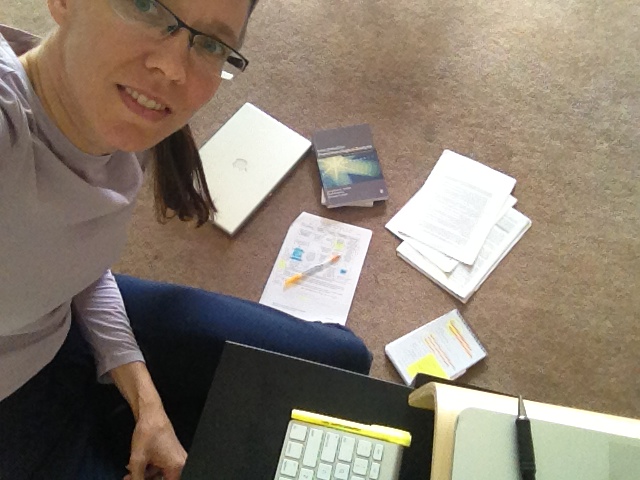
Shannon burried in books and papers.

Shannon swimming in books and papers.

I’ve been buried in books and papers for days.

I’m working overtime on a research proposal… trying to find funds to return to Dublin so that I can follow up on findings I’ve made and keep learning new research skills by working with experts and doc students here.

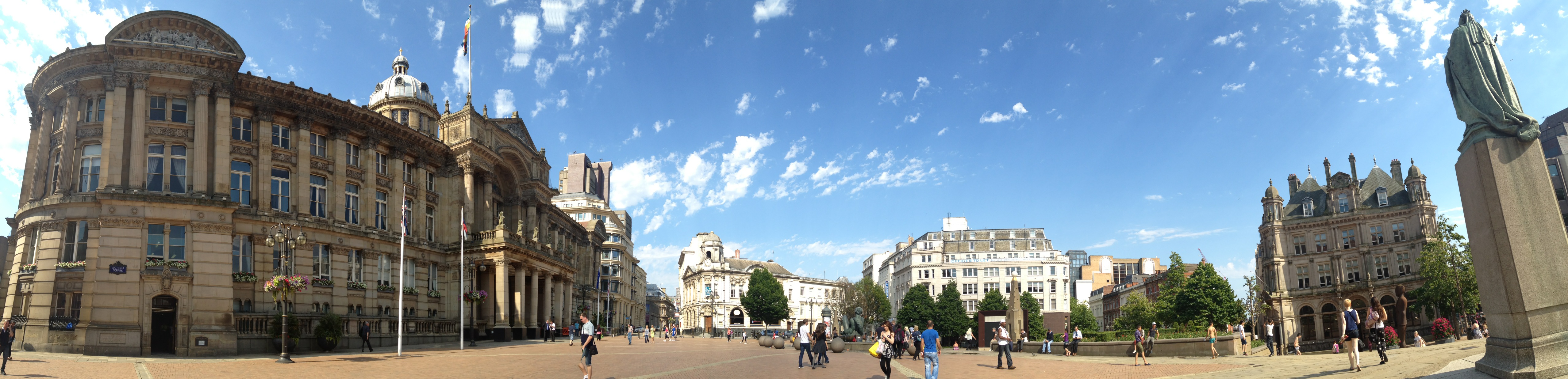
The last time I got to go outside and explore was last week in Birmingham.  Wikipedia explains that Birmingham is:

city and metropolitan borough in the West Midlandsof England. It is the most populous British city outside the capital London with 1,074,300 residents (2011 census), an increase of 96,000 over the previous decade.[2] … A medium-sized market town during the medieval period, Birmingham grew to international prominence in the 18th century at the heart of the Midlands Enlightenment and subsequent Industrial Revolution, which saw the town at the forefront of worldwide developments in science, technology and economic organisation, producing a series of innovations that laid many of the foundations of modern industrial society.[5] By 1791 it was being hailed as “the first manufacturing town in the world”.[6]

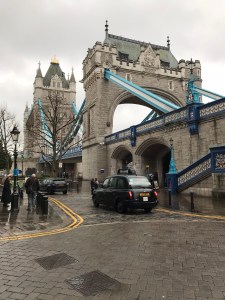
I’ll share pictures of that city today, in all its splendor….

MOOCs, TED, and Online Courses

I’ve been following the development of online education and MOOCs, in part because I hope someday soon there will be a way for me to earn a certificate or degree in structural engineering using an online format.  I’d love to learn from the very best professors in the field! The tools for assessment are developing beautifully.

Salman Khan’s TED talk, about the Khan Academy, blew my mind. What this man is achieving and offering to society is absolutely amazing.

I’ve been intrigued to learn, also by watching TED videos, about Corsera‘s new achievements. Five of Corsera’s programs were recently endorsed for meeting the standards of university coursework.

The image below illustrates what I’d already heard: college costs six times more than it did the day I started.  This spike began while I was in college, and I faced mid-year tuition hikes. How do students in the US manage to repay their loans?

TED’s website explains:

Daphne Koller is enticing top universities to put their most intriguing courses online for free — not just as a service, but as a way to research how people learn. With Coursera (cofounded by Andrew Ng), each keystroke, quiz, peer-to-peer discussion and self-graded assignment builds an unprecedented pool of data on how knowledge is processed.

I recently received a request via email to share some images with you — I’ve included a thumbnail below that you can click to view.

Hi Dr. Chance,

I wanted to reach out to connect with you about a graphic that I helped create which takes a closer look at MOOCs and their recent growth in the education space.

I came across this post on your site: shannonchance.net/2012/11/13/whats-a-mooc-and-can-it-save-humanity/ – and given that you might have an interest in the topic, I wanted to see if you’d be interested in taking a look and/or sharing the piece with your readers. If so, let me know and I’d love to pass it along!

Thanks,
Allison M.

Engineering at Minho

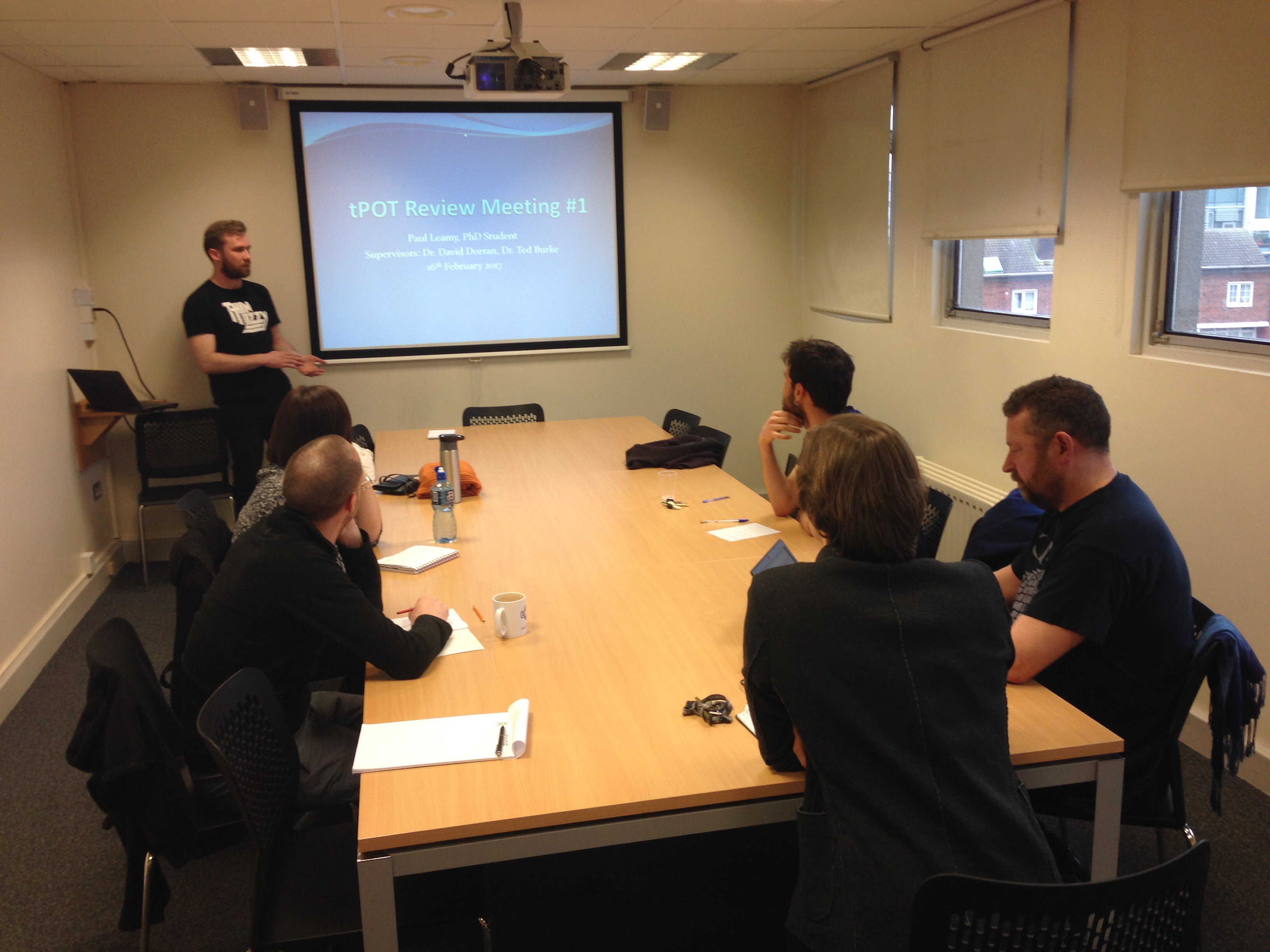
Seminar with engineering teachers from the University of Minho who use PBL.

Seminar with engineering teachers from the University of Minho who use PBL. (It was very cold in the room; everybody is huddled for warmth!)

These photos are from my trip to the Guimarães campus of the University of Minho — to visit engineering professors and tour the Department of Production Systems, at the university’s Engineering School.

My primary host there, Natascha van Hattum-Janssen, has been working as a Senior Researcher, Research Centre in Education. She has amassed quite an impressive record of publications. Her husband, Ferrie van Hattum, is a Polymer Engineer and has been serving as the Course Director of the Product Design degree program of the University of Minho, although both of them are now relocating to an institute in the Netherlands.

Natascha and her colleagues organize the annual PAEE symposium. The PAEE website explains:

The Department of Production and Systems of the University of Minho, the Research Centre for Education of the University of Minho, the Iberoamerican Association of Engineering Education Institutions (ASIBEI) and the Curriculum Development Working Group of SEFI – the European Society for Engineering Education – aim to join teachers, researchers on Engineering Education, deans of Engineering Schools and professionals concerned with Engineering Education, to enhance active learning approaches in Engineering Education through workshops and discussion of current practice and research.

The Fifth International Symposium on Project Approaches in Engineering Education PAEE 2013 will take place in the Netherlands and is hosted by the Eindhoven University of Technology. 

I served as a paper reviewer for this year’s conference and I hope to attend an PAEE event in coming years.

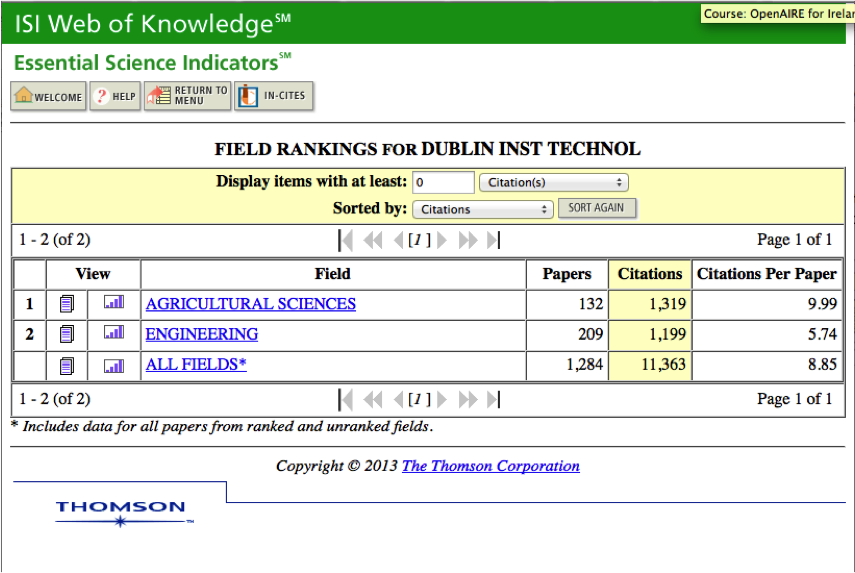
DIT in Top 1% in the World for Engineering Research!

For the first time ever Dublin Institute of Technology (DIT) has been listed in Essential Science Indicators. More impressively, the institution achieved a listing in the top 1% in the world in the areas of Engineering and Agricultural Sciences (which includes Environmental Science)!

I’m hoping that my efforts here contributed in some small way to this achievement — I’ll have to see if any of the conference papers I’ve authored with DIT colleagues while I have been a Fulbright Scholar here at DIT  counted in this ranking.

Apparently, DIT now outranks Trinity College Dublin with regard to Engineering research!

DIT research ranking, May 2013

DIT research ranking, May 2013

A Week in the Life of a Fulbright

This past week has been fairly typical of what I do as a Fulbright Scholar here in Ireland.  I thought you might be interested to see what a typical week is like, work-wise:

PBL Credits in Águeda

Past projects made by students...

Projects that students made in past years at the engineering school in Agueda.

I misunderstood the credit allotment for projects at Escola Superior de Tecnologia e Gestão de Águeda.  As it turns out, the project design courses carry credits in keeping with architecture design courses in the States.  Jose sent me this explanation:

Hi Shannon, 

Good to hear from you, and thanks for sharing your blogpost.
I am afraid, though, that you didn’t get the project dynamics right. Projects are awarded, on average, 6 ECTS, which is more than they get for each of the supporting courses (we call them that, too), which tend to have 3ECTS each. At the end of the semester, the groups of students have to write a report and there’s a public discussion of their work, before a panel that includes the project supervisor and, usually, an external member (from another HE institution or from industry). Students get individual grades for their project work. 
 
In fact, the number of credits associated with project work (exclusively, not including the supporting courses) in the program is roughly 30% of the total number of credits.
 
Cheers,
 
José