Halloween Hitchcock

Psycho at the National Concert Hall. It was amazing! The orchestra was always on cue with the footage. If you haven’t viewed the trailer on YouTube, you really should.

Seeing Psycho last night at the National Concert Hall was a phenomenal experience. The RTE Concert Orchestra brought Hitchcock’s film to life in an extraordinary way. And the space was enough to make this architect’s heart stir.

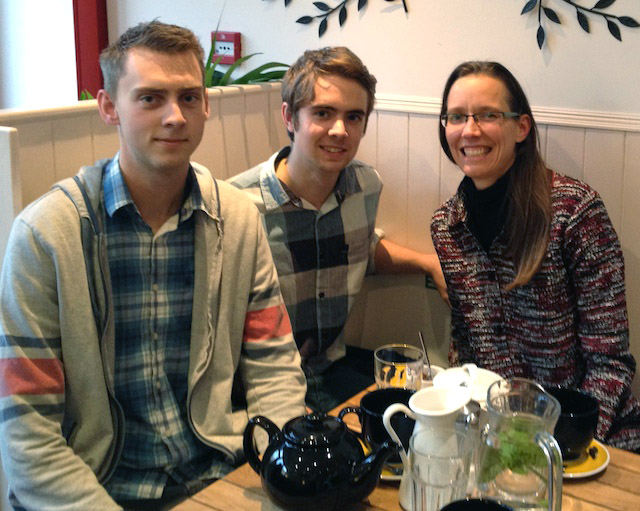
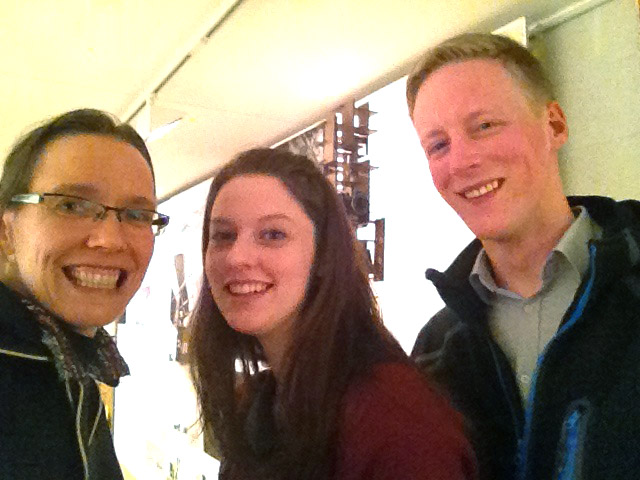
And the best part of all? I got to attend the event with three amazing people: Trish Long (Vice President & General Manager of Walt Disney Studios Motion Pictures, Ireland), her husband Paddy Woodworth (who, among his many activities, has taught at Dartmouth), and Grainne Humphreys (Director of Dublin International Film Festival). Grannie travels the world visiting film festivals this time of year. Unfortunately, for her, that means that she’s always working–at least just a little–when she attends a cinematic event. I, on the other hand, viewed this film with entirely fresh eyes. I’ve never seen it so vibrant before.

I truly enjoyed spending the evening with these three people and meeting their friends Steve (who runs the Grand Canal Theater) and Brendan (an architect). They are all very fun and remarkably down-to-earth. I hope to secure their company again soon.

The National Concert Hall in Dublin is a wonderful space.

Thanks, Trish and company, for including me!


Eden Morning

I’m mourning the loss of Eden.  Last night ended Daylight Savings Time in Ireland for the year. The shift to Dark Evening Time is a sad event for me each year.

It’s particularly poignant this year, because I’m living so far north that the days will be very, very short soon.  Perhaps fortunately, I’ll be home for the very shortest of days this year, and I’ll get to eek out a little more sunlight than I would here.

I spent the entire sunny day yesterday working at home and needed a change of scenery. So, to help address my doldrums, I headed out for breakfast.

Since I can’t seem to find Sunday brunch in my neighborhood, so I wandered down to Temple Bar and found myself in Eden. Yum!

Eden: spatially wonderful!

Eggs Benedict, Eden style. What more could a girl want?

Eden prides itself in Irish cuisine fused with European flair.  Funny, eh?

The Irish referred to “going to see the Europeans” when we headed out for Greece. They see themselves as different from the continent… and thus not entirely European.  In my book, they’re so similar to US American, that we actually maybe a closer match. (Please, please, please vote sensibly my countrymen. Don’t succumb to inaccurate claims and smoke-and-mirror budget proposals.)

I’ve heard two people (one an emigrant from the US) say Ireland may well become the 51st state.  It seems to align more and more with US culture every day. Although if we loose Obama, there will be a wider gap in values between the Irish and US ethos.

I’ve attached snapshots from breakfast (Eden is a very nicely designed place) and from my walk home… flip through them and pretend you’re here walking with me… imagine the smell of Guinness wafting through the air as you stride down the River Liffey.

Learning from Architecture Students

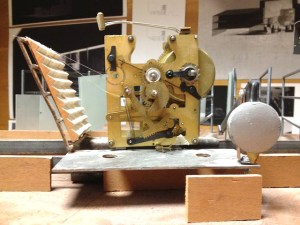
Funny that Gavin and I discussed diagramming gears  (an idea I brought up over lunch), then this model popped up at the Cork students’ exhibition.

I never know where I’ll end up when I leave the apartment.  Yesterday, after scintillating lunch conversation about Gavin’s thesis and a book proposal I am trying to develop, I hustled back across town to meet with architecture student leaders Colin and Andrew to discuss where our interests overlap.

They asked such great questions about the way we teach at Hampton University and the research I’m doing here. And, they asked me to be part of a day-long Schools of Thought symposium that they, the students, are organizing for the DIT School of Architecture.  In a couple of weeks, I’ll talk on the topic “Student-Centering Architectural Education: Revamping the Way We Learn and Teach.”
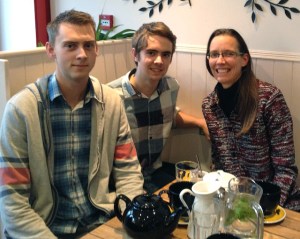
Andrew, Colin, and me at the Sab Inn Cafe (it’s the one I refer to as the Hungarian restaurant but the students call the red cafe). The owner gave us complimentary desserts to go with our tea! He’s such a doll!

I’ll get to help spread innovative ideas–that have been implemented by Gavin and his colleagues–with the architecture faculty and students.  I’ll also share the things Michael Seymour and I found in our survey of student preferences.

Colin and Andrew mentioned I might want to stop by the “darc space gallery” where the School of Architecture at Cork was exhibiting fifth year projects.  Finding that gallery was harder than you’d think.  Google had it listed as being on South Great George’s Street, but it’s actually clear across town on NORTH Great George’s Street.

I hung in there, and when I finally arrived I found beautiful graphics, interesting design proposals for Istanbul (they reminded me very much of the work I did in architecture school in the early 90s), and many wonderful people to talk with.

Their primary teacher for the fifth year, Jason O’Shaughnessy, studied at the Architectural Association in Edinburgh, Scotland when Peter Eisenmann and Daniel Libeskind were teaching there (I was working on my Master’s at Virginia Tech at the time). Any way, the influence of Eisenmann and Libeskind is quite clear in the students’ work.  They say the spent the four years leading up to this designing buildings with very typical sorts of programs, such as schools.

Jason O’Shaughnessy actually insisted that I guess his last name.  It took a while, but I finally succeeded. His only clues were that it was “the most Irish last name,” and that I was on the right track with O’Sullivan. Whew!

I had a ball talking with Helen (who works in TV and film production in Dublin) and David (an architecture student from the DIT).

During the event, I particularly enjoyed speaking with David (a DIT student who I heard speak several weeks ago as an opening act for the featured lecturer), his girlfriend Helen, and another colleague of David’s from the DIT.

They expressed astonishment when I said I could happily live here in Dublin for the rest of my life.  People here have no difficulty conceiving of emigrating OUT, but they don’t assume others would want to immigrate IN.  That, despite the fact that hundreds of thousands of people did just that–move in–during the Celtic Tiger (and most stayed, happily).

Thanks to the Irish for Halloween!?!

Thanks to the Irish for Halloween, and to Michelangelo Buonarroti for the ceiling of the Sistine Chapel, says The Week magazine.

It notes that Wednesday is “Halloween: Brought to the U.S. by Irish immigrants fleeing the potato famine.” Oddly, Halloween is the USA’s “second-largest commercial holiday, with Americans spending an estimated $6.9 billion annually.”

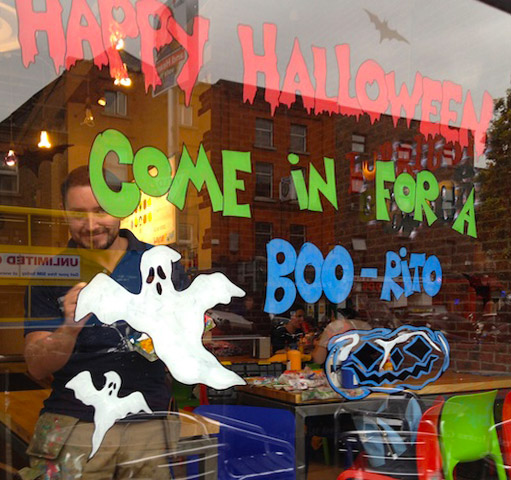
that  Gearing up for Halloween in Dublin. Photo by Shannon Chance.

But let’s also not forget Thursday, Nov. 1, is the “500th anniversary of Sistine Chapel ceiling unveiling. …Julius II inaugurated the chapel on All Saints’ Day with a solemn Mass in 1512.”

That is the same day as Halloween.  (It’s the Catholic Churches’ version of Halloween–and the version celebrated in Italy today.)

Michelangelo painted the entire ceiling in just four years. It was frustrating, backbreaking work.

There’s a really amazing website with a 3D version of the chapel that lets you spin around as if you were there.  You shouldn’t pass up seeing this fantastic, interactive model.

Image from the Interactive Sistine Chapel Garden of Eden website. Please check it out!

Dave Chance’s Two Other Winners

Yesterday, I posted images of three of the winning HRACRE development projects that Dave photographed.  Today’s I’m sharing images of the two other projects that won awards; including the AECOM project that the jury praised so highly in its statement.

Praise from the HRACRE jurors for the awards package submitted by the team that included Hourigan Construction, AECOM architects, and Dave Chance Photography.

Lake Taylor Transitional Care Hospital designed by PF&A. Image copyright Dave Chance Photography.

The highly-praised award proposal submitted by Hourigan Construction for the team’s work on AECOM‘s Norfolk Headquarters. Photo copyright Dave Chance Photography.

Added Value–What Happens When You Blog Instead of Tape Record

Máirtín sent me some updates to our conversation today, after reading the blog.  This is the kind of conversation and cultural exchange that I think the Fulbright program is all about.  These are Máirtín’s words:

Order here: Bungalow Bliss. Mairtin downloaded this image from Flicker.

Diane Hamilton (Guggenheim) was the wealthy American that brought Liam Clancy to America, who later appeared on a 20 minute slot on the Ed Sullivan Show in 1961. They achieved fame as ‘The Clancy Brother’s & Tommy Makem’.

It wasn’t just womens’ names, the tradition was that the first child would be called after the mother’s people, giving us names like Bradley, Harrison, Stewart, Rawson, Carroll, and so on and so forth as first names.

This tradition comes from the Ulster Presbyterians, or now Ulster Scots, from the North. There is an Ulster Scots Heritage Park between Strabane and Omagh in Co. Tyrone. In an intersting link to the Blue Ridge Mountains many of the Ulster Scots had the first name ‘William’ after William of Orange, William the Third of Great Britain, victor of the Balltle of the Boyne. So many of them lived in the mountains this is believed to be the origin of the term ‘Hill Billies’.

This is the Book, believed to have brought more shame to Ireland than @Ulysses’.

Bungalow is a Hindi word. In my opinion is that the Irish bungalow is a vernacular version of the traditional cottage. When John Ford made ‘The Quiet Man’ in the west in 1951 he was looking for a perfect Traditional thatched cottage to act as John Wayne’s character’s house ‘White O’Morn’. They found one near Maam Cross. When they were finished, they paid the owner a wedge of money, who used it to build a new house, and demolished the original. What is left has been pilfered by souvenir hunters.

Mairtin sent this image of Dan O Herlihy. IMBD says “Dan OHerlihy, Actor: RoboCop. Irish-born Dan OHerlihy decided not to follow in his father’s footsteps, forsaking the life of an architect in favour of the acting.”

I also meant to say that another famous (kind of) architect who became an actor was Dan O Herlihy, from Wexford, who qualified as an architect from UCD and went to Hollywood to become an actor. His most famous role is probably ‘The Old Man’ the head of the evil OCP Coproration in ‘RoboCop’ (1987). I hope you’ve seen it, if not I can lend it to you; a biting satire of Reagan era economics.

He is the father of Lorcan O Herlihy, a well known Los Angeles based architect.

The Director of ‘What Richard Did’ is Lenny Abrahamson, who also directed ‘Adam & Paul’ and ‘Garage’. Very good, but not ‘Feel Good’. Don’t watch on a Sunday night when you have the fears……

Dave Chance–My Award Winning Photographer

Praise from the HRACRE jurors.

I’ve got to brag about my Dave today.

He’s a stupendous photographer. And very dedicated to his craft. To get brilliant architectural photographs, he’s up at sunrise nearly every day.  Literally, he’s on site, at the building, when the sun peeks over the horizon.

He can tell you exactly where the sun’s rays will fall at any given point in time.

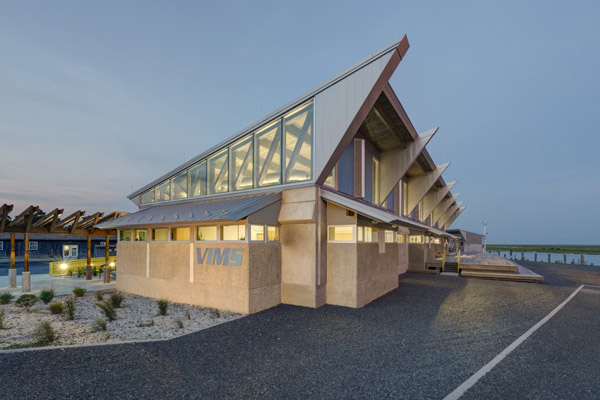
Dave’s award-winning photo of Via design architectsVIMS ESSL building on the Eastern Shore of Virginia.

And the hard work pays off. For him and his clients.

Last week, Hampton Roads Association for Commercial Real Estate (known as HRACRE) hosted it’s annual awards gala. It gives prizes in 12 categories. FIVE–count em–FIVE of the projects that won awards used photographs by Dave Chance Photography.

At last year’s gala, the speakers emphasized the central role photos play in awards selection. They said the quality of the photos and the entry applications/awards packages has been on the rise.

See what they put in print this year, about one of the projects Dave photographed?  I am so proud!

The new Judicial Center in Portsmouth, Virginia. Designed by HBA and photographed by the one and only Dave Chance.

The new Portsmouth Housing and Redevelopment building. Designed by Via design architects and captured by Dave Chance Photography.

Awash in Culture–and Wishing I’d Hit Record!

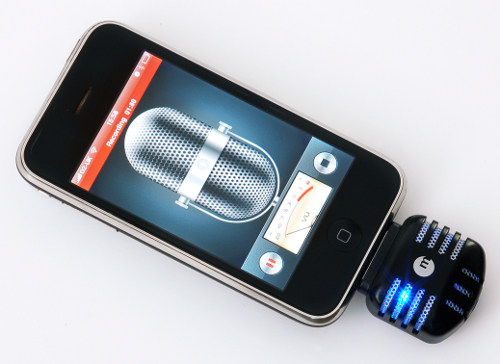
I actually had a voice recording device on me today, but I hadn’t set it up.

I was in Linenhall for a quick, half hour coffee meeting. So, I didn’t think to ask to record until the conversation was too good to stop for something as odd and pragmatic as setting up the iPhone.

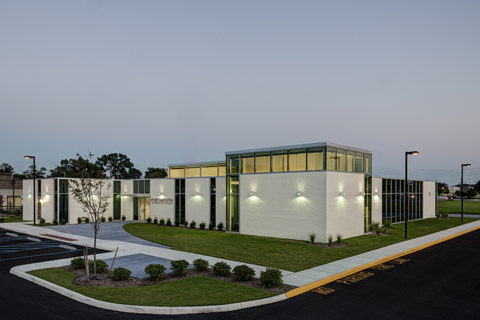
I was meeting Máirtin D’Alton (the architect who lead a tour I attended during Open House Dublin, I’ve included a photo to spark your memory).

Following the Tour, I suggested/recommended/fairly much insisted on him for a position at DIT. Sima took my advice, and he’s been working for an hour a week in the 4th year architectural technology studio ever since.

Of course, he’s giving more time than an hour a week to the cause.

He’s being very conscientious in the role–he showed me the prep work he’d done for today.  (I always like to know it’s working out well after I recommend someone!) His prep work must have taken hours.

And, he was also part of a studio crit yesterday that lasted from 9am-7pm. Whew! How exhausting!

He still made time to meet me for coffee before studio today. And, our conversation today was fascinating!  I made a few notes on my phone at the end. They’re below, in rough form but interesting nonetheless.

Typical Irish bungalow. This one located near Killaney. (Photo © Brian Shaw.)

.

Bungalows have been the norm for single family detached housing in Ireland–past and present. You’ve been able to buy plan books. There are lots of versions of bungalows out there but they all have basic rectangle with simple hip or gabled roof. They’re getting more complex roofs now. They used to be situated with the gable end toward the SW to capture breeze and solar energy, but by now many town councils have regulated they should face street. Hedgerows have been removed to allow roads to be widened. This has changed the composition of Irish towns greatly. They don’t reflect nature or the social fabric the same way as in the past.

The Irish fascination with the TV show “Dallas” lead to over abundance if houses mimicking that style, especially in the north.

.

New-fangled bungalow in Tralee, used as a B&B. Downloaded from property listing website.

We discussed WalMart’s development strategy and how this plays out with IKEA around the globe and with Carrefour and the like in France. In France, the big box stores on outskirts have strangled small businesses, much like in the USA.  (IKEA has been getting big press for plans to go green lately, but they really must address the longevity and up-cycling of their products. Their solar lights are very poor quality and they break with little use.)

.
Irish traditional music was almost dead in the 1960s. A Guggenheim sister came and did recordings (i.e., qualitative research).  She brought a group to NYC (she had a close relationship with one of the group). The group was set to play for two minutes on a TV show, but due to a cancellation they ended up with 20 minutes to play. They resorted to playing tunes their mom had taught them. This show brought out American enthusiasm; it was wildly popular in the US. This sparked a revival of traditional music on Ireland. (Interestingly, Fulbright Ireland has a big role in preserving Irish language today.)

Image by John Moore / Getty Images / AAP, from the article Totally green: IKEA pledges to switch to 100% renewable energy by 2020.

.
Regarding names: it was popular in the north to use the mother’s last name (surname or family name) as the child’s first name. That’s how names like Kelly and Shannon would have started bring used as first names.
.

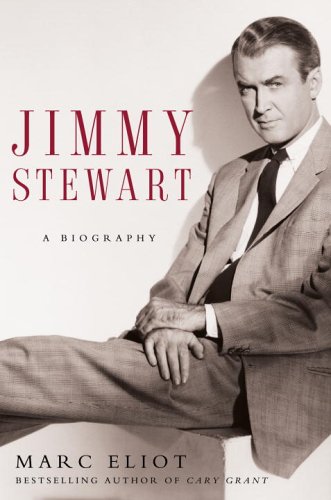
Jimmy Stewart biography.

In our discussion, I posited that architectural pedagogy is becoming more relevant to society while the architecture profession is becoming less and less relevant (the irony is that education has a big role to play in instilling the types of values that are causing this demise, as well as instilling a sense of curiosity and engagement that makes architecture grads so valuable to other fields).

.

Mairtin told me that Jimmy Stewart studied architecture at Princeton. He then bagged it, and went into acting. He played in a film set in the Shenandoah Valley, that Máirtin watched last weekend.
.
…Máirtin has offered to show Esther Serchi and me some important sights on the outskirts of Dublin, while she’s visiting in a week.

Guesses?

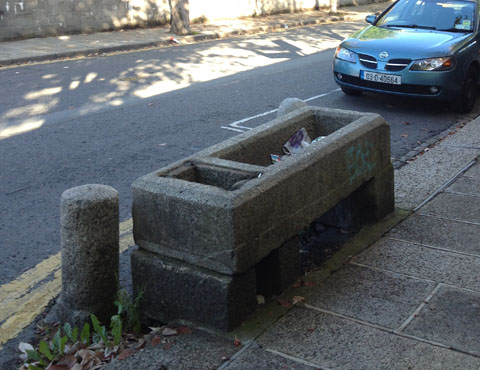
You see a lot of these around Europe. They look a lot different in Rome and Switzerland, though, where they’re still in use. Any guesses what they’r for?

This one is located near the Marsh Library in Dublin 2.  It looks so sad and unappreciated. I saw another one in a similar state the other day (in Kilkenny, I think).

I’m going to bed now (it’s 12:33 AM), but I’ll send you a gold-star cookie if you guess right while I’m asleep!

Can you figure it out?

Glimpses of Grennan Castle

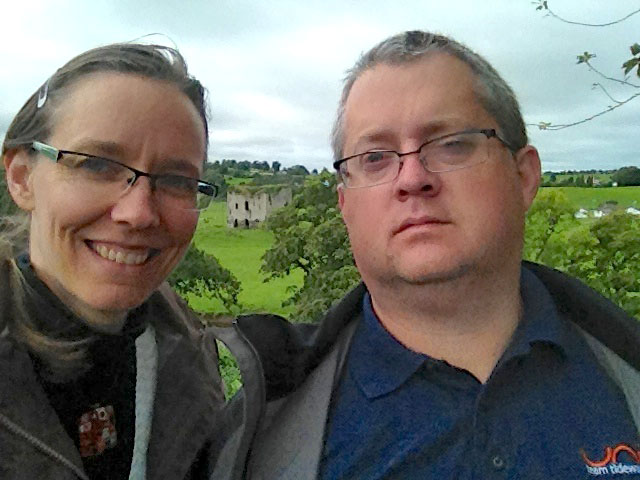
Shannon and Dave–hot in the pursuit of abandoned castles. We stopped to admire Grennan Castle from a far.

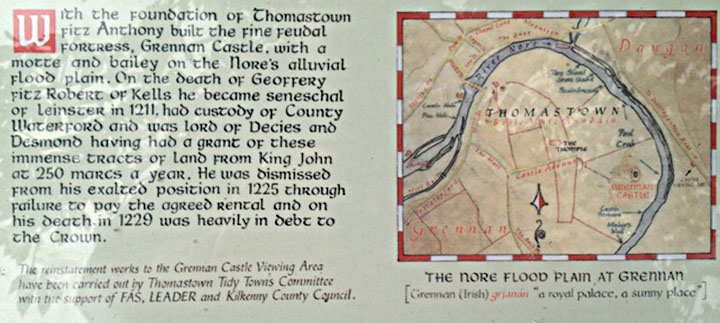
We didn’t get inside Grennan Castle, but did catch a glimpse on one of our castle-hutting-near-Killkenny days. This castle was constructed in the year 1210.

Abandoned Ireland looks like a fabulous site. It includes photos from the inside of Grennan Castle, and explains:

“Grennan Castle measures 20 metres x 13 metres and stands 20 metres tall, the walls at their base are 2.5 metres thick. The ground floor contains three barrel vaulted chambers with an entrance to the second floor on the south side by a staircase built hidden into the thickness of the wall. At the top of the staircase is just a gaping opening down to the floor below. This opening was originally covered by a trapdoor, hence with the trapdoor raised the castle was almost impenetrable.”

Abandoned Ireland also notes that “In 1650 Cromwell’s troops called to the castle. The siege lasted only two days, the garrison marched out leaving all their weapons behind them and promised to never again oppose English rule.” It wraps up by stating, “Grennan Castle survived in good repair until the early 1800s.”

You can click on this image to see a larger version.

You can click on this image to see a larger version.

Grennan Castle in the distance.