In 2015, sub-section 2.2 of my MSCA IF proposal on “Effectiveness of the proposed measures for communication and results dissemination”, in the Impact section, identified strategies for “exploiting” or “valorizing” possible business ideas stemming from the proposed work, as well as disseminating results and findings to academics, and communicating the value of research to non-academic audiences.
2.2 Effectiveness of the proposed measures for communication and results dissemination
Table 4: Integrated plan for data collection, outreach, and training (by host and partners)
Exploitation strategy.
To meet global challenges, engineering must become more flexible, creative, and socially responsive4, 5, 6. Dr. Chance’s work will help transform the culture of engineering education and track outcomes. Results will facilitate publication of a book and possible spin-off businesses in consulting both addressing Question Q5) What knowledge of epistemology and design thinking can help educators support student development?
There is global demand for dramatic changes in engineering today, but education leaders don’t yet know what to do. Dr. Chance and Prof. Tyler have fresh, innovative ideas that are based on their prior work. Their body of work can provide a solid foundation for this EF project. So far the thrust of modernization in engineering education has been to implement Student-Centered and Problem-Based Learning (PBL). Similar pedagogies have been used to teach architecture since the Renaissance and engineering is fostering a healthy new focus on teamwork. Bridging the best practices from these fields and supplementing them with research is essential. Collaboration among architecture and engineering educators is crucial for knowledge transfer. R&D Dr. Chance leads as an EF will reach:
2nd level students (via outreach to STEMettes in the UK for girls ages 11-22, RoboSlam robot-building workshops in the UK and Ireland, and Perspektywy Education Foundation in Poland for supporting girls in STEM)
3rd level students (through new UCL undergraduate engineering modules and Perspektywy mentorship programs)
3rd level teachers (through new UCL post-graduate modules that exploit Dr. Chance’s research) (see also Table 4)
Exploitation activities will embed research findings (collected and/or generated by Dr. Chance) into project briefs and module descriptors. The new MSc programs will have tremendous positive impact. This MSc program (to be launched in 2016) will be unique. It will be the world’s first and only Masters-level program designed to help university tutors upgrade their teaching skills across the realm of engineering topics. (DIT is launching an MPhil to train engineering education researchers, and Aalborg offers an MSc in Problem-Based Learning.) UCL’s program has broad appeal and a captive audience, since every new university teacher in the UK must earn at least one credential in teaching and learning. Two other avenues for exploiting Dr. Chance’s research findings are the creation of new programs for Creative Industries Federation and the possible creation of a business to help organizations (universities, businesses, and corporations) design and implement more effective education and training programs.
Public engagement strategy.
Dr. Chance will encourage public interest and involvement through engineering activities and communication. During the EF, Dr. Chance will advise multiple organizations—assisting some with program evaluation, strategic vision, and grant-writing support—and conducting engineering events for various age groups. In the UK, Dr. Chance will make public presentations through Creative Industries Federation (CIF) and STEMettes. Activities for STEMettes will include STEM projects (for 50+ girls) plus one or more RobSlam robot-building workshops (for 20+ girls). Dr. Chance will seek opportunities to make school presentations, become a MSCA Ambassador, and deliver public talks. Communication activities involve attracting the attention of news outlets. Dr. Chance will write one or more articles for Perspektywy Magazine. To help attract attention of TV, radio, and newspapers in the UK, Dr. Chance will attend UCL workshops in media relations for researchers. A 2014 workshop she took on this topic helped gain recognition for her work and as a result she was quoted in an Irish Timesarticle on women in STEM. She will continue to build public relations skills using UCL’s exceptional resources. She will maintain an educational blog to increase public understanding of research topics and activities.
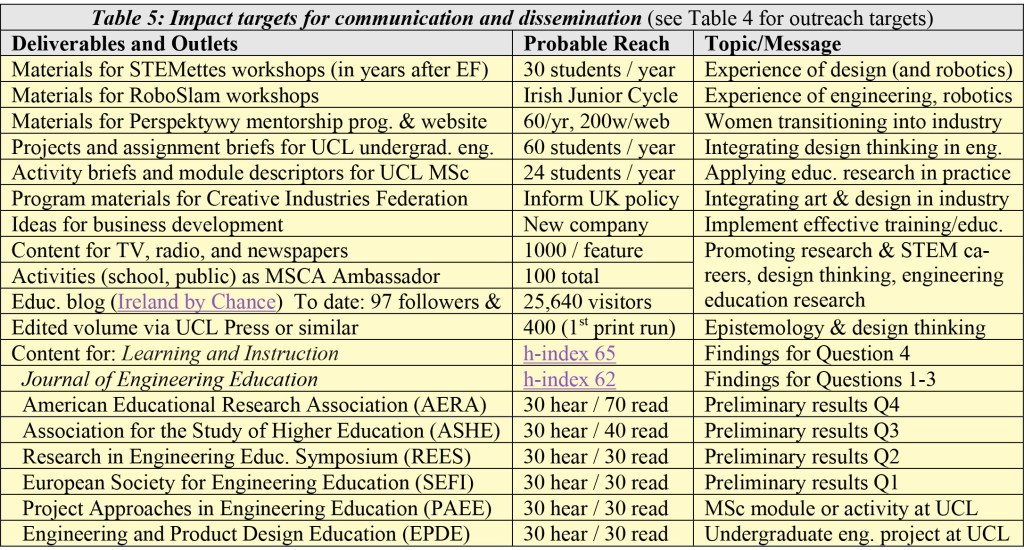
Table 5: Impact targets for communication and dissemination (see Table 4 for outreach targets)
Dissemination strategy.
Dr. Chance will disseminate research findings to international audiences via conference papers, journal articles, and publication of a 100,000-word handbook for educators with a comprehensive new set of resources on epistemological development and design thinking (addressing Q5). Its planning, compilation, and editing will take 2-2.5 years. It will likely include 10 chapters of new primary research by leading experts in various aspects of epistemological development and design thinking, 8 chapters summarizing and synthesizing existing theories and literature in new ways, and an introduction and conclusion by Dr. Chance. She will seek funds to support an invitational symposium on the book’s topics to recruit specific experts internationally. This will facilitate knowledge generation and prompt submittal of high-quality chapters. Her work will help overcome a current problem, identified by Dr. Bill Williams (a probable co-editor for the book), wherein EER journals published in the USA almost exclusively cite US scholars. Trans-Atlantic authorship can help. She will recruit a 3rd editor as well.
Dr. Chance has the goal of publishing results of Research Questions 1-4 in two of the world’s top-ranked journals in EER and higher education. These ask: Q1*) To what extents do design and pedagogy influence women’s choice to study engineering at third-level? Q2*) Among women, to what extents do design-based pedagogies prompt more sophisticated epistemologies than traditional teaching formats? Q3*) How do women experience engineering over time, from early design projects to entering industry? Q4*) Among men and women, to what extents do design pedagogies prompt more sophisticated epistemologies than traditional teaching formats? She is targeting Learning and Instruction (impact factor 3.585, SJR 2.907) and the Journal of Engineering Education (impact factor 2.059) for publication. Dr. Chance aims to present preliminary findings at three top-tier conferences (AERA, ASHE, and REES) where she will also network internationally. She will assemble teams of peers to co-author conference papers on educ. design (for SEFI, PAEE, EPDE, see Table 5); leading these teams will develop her skills.
Envisioning the impact your your future work poses quite a challenge. You nearly need a crystal ball! I hope that reading the draft of the Impact Section of my 2015 proposal (unsuccessful that year, but successful when modified in response to reviewer comments and re-submitted in 2016) will provide you ideas and inspiration for crafting your own plan of action.
In this post, I share subsection 2.1, on “Enhancing research- & innovation-related skills & working conditions to realize potential of individual”. In this subsection, I also show how the proposed work aligns with European policies and priorities.
Hopefully, your proposed sponsor/PI can help you brainstorm ideas for increasing the impact of your work. It may be difficult to get feedback from a proposed PI during August (when you’re probably working on the proposal) since most European academics are out-of-office. Try talking this through with some people in your field of study if the PI isn’t available.
MSCA logo — Marie Curie had huge impact on science and life at a global level. This funding program celebrates her accomplishments and her perseverance.
2 IMPACT
2.1 Enhancing research- & innovation-related skills & working conditions to realize potential of individual
The training Dr. Chance can receive UCL is essential. It will provide management and innovation skills necessary for her to lead research teams on behalf of the EU. At DIT, she is successfully developing expertise in phenomenological research. Via a new fellowship at UCL, she will tackle ever-bigger challenges. She will master new research skills (developing statistical expertise to amplify the power of her qualitative results) and new transferrable skills (from global leaders in research). She will gain new exposure to industry. Her current projects at DIT are carefully aligned with policy foci of FP7 IIF, which is geared toward transferring knowledge into Europe by bringing foreign researchers here. Through FP7, Dr. Chance has been bringing—from the US to DIT—international perspectives and knowledge of curriculum design, program evaluation, architecture and design education, as well as various frameworks and procedures for conducting educational research. In order to grow and excel in research, she and DIT’s CREATE research group must develop a wider skill set. This will enable them to manage large-scale projects for education and industry in the EU—training that Prof. Tyler and UCL can readily provide. New skills, essential for Dr. Chance to garner a large-scale competitive grant to lead an independent research team, are:
Managing multiple projects and budgets, gained by exposure to a well-established research management system.
Preparing and submitting applications for complex, larger-scale grants with multiple partners.
Creating new programs at 2nd, 3rd, and post-graduate levels and rigorously assessing them.
Conducting large-scale surveys and learning to analyze them with new techniques to extend generalizability.
Supervising PhD students and learning to secure funding for their research.
Operating within the industrial sector and learning to focus research on questions relevant to industry.
Communicating STEM topics to target audiences via events and public media, and compiling/editing books.
Horizon 2020 recognizes these types of need, supporting ongoing development of experienced researchers through policies and EF programs. The EU seeks to enhance “international cooperation in research and innovation” through a strategic approach that tackles global societal challenges. The EU seeks to develop/deploy effective new solutions to achieve “excellence and attractiveness in research and innovation” and ensure its own economic and industrial competitiveness. By leveraging interdisciplinarity in innovative ways, this project will deliver great benefit to UCL, DIT, Dr. Chance as a researcher, partner institutions and engineering education globally. It will also benefit the EU—economically, socially, scientifically—by addressing problems described in section 1.1 and through:
Improved pedagogies for engineers that attract additional engineers from a larger, more diverse pool of people.
Perfecting phenomenology as an approach for EER and extending its generalizability across the EU via surveys.
Building resources to recruit and skills and train new scholars in engineering education to research EU problems.
Cross-pollinating and coordinating educational offerings among engineering education centers in the EU.
As a result of this EF, UCL’s new CEE will reap benefit from the US and Irish perspectives, connections, and skills that Dr. Chance will bring. Dr. Chance will connect UCL’s CEE with DIT’s CREATE research group and intends to return to CREATE following the EF, to transfer critical knowledge back to DIT—bringing new credentials and crucial new skills. She will help CREATE gain formal status as a research center, secure large-scale grants, and attract emerging scholars to Ireland who can learn new research skills and generate new knowledge for society.
This project addresses the focus of H2020 EF and all six key Indicators for promoting and monitoring Responsible Research and Innovation defined by the European Commission: (1) public engagement, (2) gender equality, (3) science education, (4) open access, (5) ethics, and (6) governance. This proposed work supports many 2015 key initiatives of the Innovation Union, including: (1) promoting excellence in education (through MSc, undergrad projects, outreach, and dissemination) and skills development (of both Dr. Chance those she transfers knowledge to); (2) delivering the European Research Area (5 keys explained below); (3) focusing EU funding instruments on Innovation Union priorities (e.g., societal challenges related to STEM); (3) promoting openness and capitalizing on Europe’s creative potential (increasing creativity by using design thinking in engineering); (4) spreading the benefits of innovation across the Union (through collaboration and outreach in four EU countries); (5) increasing social benefits (supporting students in STEM); and (6) pooling forces to achieve breakthroughs (creating European Innovation Partnerships). The secondment supports IU Commitment #2B to support “knowledge alliances” between education and business and #7 to increase involvement of SMEs. Dr. Chance’s research supports Europe’s Flagship Initiative for Youth on the Move by developing modern education systems to deliver key competencies and make education more relevant to young people’s needs. It addresses all 5 key prioritiesof the European Research Area:
1) More effective national research systems (by strengthening UK and Irish research through UCL and DIT).
2) Improved trans-national cooperation (through cross-border links, research agendas, and coordinated offerings).
3) A more open labor market for researchers (providing training crucial for Dr. Chance to base all research in EU).
4) Gender equality/mainstreaming in research organizations (research to support female students, conducted about and by women, which incorporates all 9 recommendations on research content listed in the EU’s gender toolkit).
5) Optimal circulation, access, and transfer of scientific knowledge (via diverse dissemination, communication, and outreach, including an open-access book—part of IU Commitment #20 and Point 5 of ERA Communication 2012).
In all my MSCA-IF proposals, my National Contact Point (NCP) advised me to present in charts to break things up visually and make it easier for reviewers to comprehend crucial messages.
Members of one of the Facebook groups to which I belong (Marie Curie Individual Fellowship 2020) raised questions about the Tables I’ve presented from the 2015 example proposal. The discussion we’ve had might be of use to others beyond this group, so I’m sharing it below:
MC: Thank you for your apportation, it is very usefull, but I have a question: you use very much charts, it is a way to use more space with a smaller letter, but I think that in the last MC calls, the use of charts to incluide relevant information about the project that is not included in the rest of the proposal is not allowed, isn’t it?
Me: I am not sure what the current rules are for this program, you’ll need to confirm that using the guidelines. I know they changed the rules for some MSCA calls to clarify that you cannot put huge blocks of narrative text in just to fit more using the smaller font.
Applicants had been pushing the limits too far.
CB: The guidelines say that “Tables are only for illustrating the core text of the proposal. As such, they cannot be used to contain the core text itself.” Is this new from this year? I know that in past editions you could use tables for training activities/ communication activities etc. and I was doing the same this year. I am introducing the table in the core text but putting details in the table. Am I doing wrong?
OH: The Net4mobility+ 2020 guidelines document states precisely which sections should (or recommended to) appear as tables. I’m just following those instructions. In sections 1.2.2.; 2.2.1; 2.3 I’m using tables with almost no text outside the table. I hope that’s a good choice 🤷♂️
SB: Well the last year evaulator’s guide explicitly says that if they see such a thing they have to report it and the comitee will ask the applicant to copy it to the main text with the proper font size. Then everything over 10 pages will get lost. And the guide also says that we should not do it. So it is risky to use only tables for core text. Of course it depends on the evaulators.
For clarity’s sake, I’m noting that all tables in this 2015 example proposal were at the same size and style font as the entire rest of the document: Times New Roman 11 point. Because I also evaluate proposals for the EC, I know from experience that it’s really difficult and stressful to read tables that use tiny font–some applicants (have the nerve to) use 8pt Arial Narrow and think evaluators will be able to see it. It’s not a good idea.
I have, myself, advocated for stricter regulations regarding font size and style. My advice to applicants is to keep everything very easy on the eye. Try to keep evaluators from getting tired and frustrated due to your formatting. Use small graphics where possible to help snag their memory when discussing your proposal during the review week (so much to keep in one’s mind during that time).
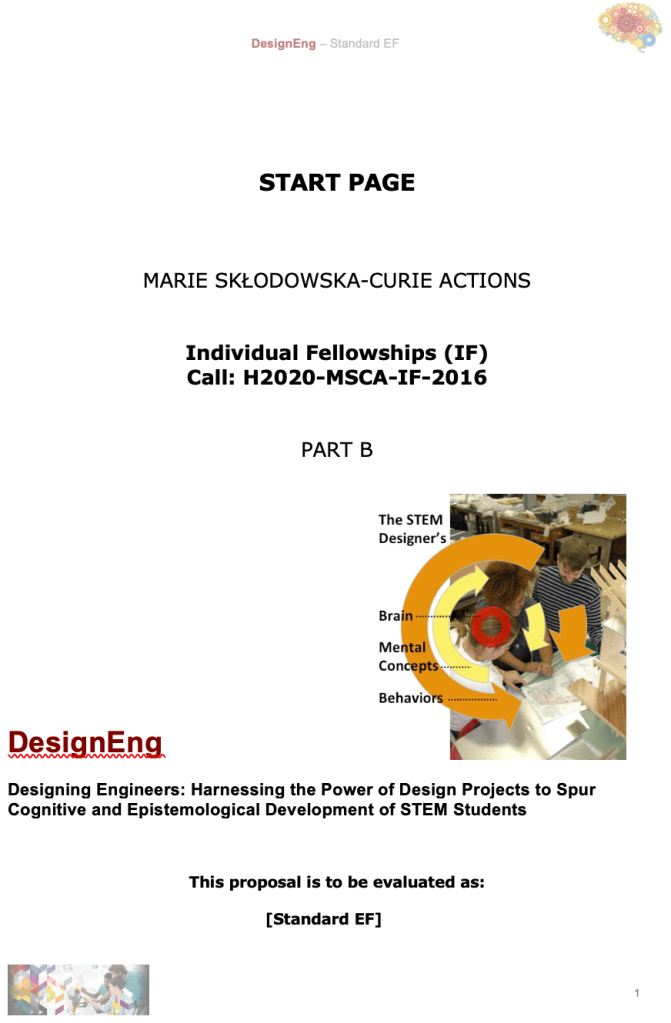
I managed to place small graphics into the header and footer of my (successful) 2016 proposal as well as on the cover page, which I had not done in prior proposals. I’ve included that cover page below.
I also embedded small thumbnail graphics in two of the tables to project a sense of the outreach activities proposed and the supervision team.
I discovered this was possible by evaluating MSCA COFUND proposals; I highly recommend serving as an expert evaluator to gain wide perspective on possibilities. I learned more about what to do and what not to do in seeking funding. Anyone can register as an expert on the Participant Portal.
In today’s post, I share subsection 1.3 of the MSCA Individual Fellowship proposal submitted in 2015–it’s on “Quality of the supervision and the hosting arrangements.”
As the 2015 call allowed for a chart highlighting the capacity of the host organization to support my development, I’ve included that chart in the blog as well (down at the bottom).
Although this 2015 submission was unsuccessful, I revised it based on evaluators’ comments and the revision was funded in the 2016 call.
1.3 Quality of the supervision and the hosting arrangements
Qualifications and experience of the supervisor(s). Prof. Nick Tyler has unique expertise to support Dr. Chance’s development into an independent researcher. He has implemented EER findings4 and has supervised 17 PhD completers and as many post-docs. He is currently part of the UK Royal Academy of Engineering’s Engineering Education hub. He is advising universities in Argentina, Colombia, UK, and Japan in renewing their approaches to education. From 2003-13, Prof. Tyler headed UCL’s Department of Civil and Environmental Engineering. During this period, he developed new educational approaches to combat problems, introducing a new curriculum based on detailed analysis of quality and gender4. It was launched in 2006 and graduated it first students in 2009; this provides a valuable case study and a wealth of experience that can be transferred to other engineering programs. For this work, Prof. Tyler’s group received the inaugural Athena SWAN Silver awarded to an engineering department.
Prof. Tyler’s successes—in project management, social science methodologies23, diversity and inclusion research24, and book publishing25—support a portfolio of £20 million in research that is funded by research councils, industry, and government. His CV features well over 70 publications. Prof. Tyler has been named a Fellow of multiple organizations, including the UK’s: Institution of Civil Engineers; Royal Society of Arts; Transport Research Foundation; and most recently the Royal Academy of Engineering. Most noteworthy, however, is his 2011 appointment, by Her Majesty the Queen, as a Commander of the Most Excellent Order of the British Empire (CBE) for services to technology. The CRUCIBLE research center he directs will provide Dr. Chance a plethora of research consultants. It involves experts, from all eleven faculties at UCL, who conduct interdisciplinary research.
Prof. Tyler’s experience is well aligned with the proposed project. At the outset of the EF, Professors Tyler and Chance will create a Career Development Plan. They will meet frequently as part of larger research meetings, and will hold EF-specific meetings twice monthly to monitor progress and quality. They will conduct formal milestone assessments every six months. Throughout, Prof. Tyler will provide strategic advice on data collection, analysis, methodologies, gender and diversity, engineering education pedagogies, UCL’s culture and curricular innovations, and the creation of design projects. He will assist/mentor Dr. Chance in dissemination and outreach activities and budgetary matters, help her gain ethics approvals, and help with the recruitment of research participants. She will learn highly effective techniques by observing his team meetings, grant writing, and project management activities.
1) Its design-focused civil engineering programs achieved notable successes among women, meriting more study4.
2) Dr. Chance will be well integrated into UCL’s organization. She will work in UCL’s new Centre for Engineering Education (CEE), which is physically located in the office of the Dean of Engineering at UCL. She will collaborate closely with the Vice-Dean for Education, staff members of the CEE, and the Centre’s two co-directors.
3) CEE has been set up to support training and two-way transfer of knowledge. Formally launched in April 2015, it brings together UCL’s Institute of Education with its Faculty of Engineering Sciences. CEE hosts a bi-weekly “Engineering Education Seminar Series” on topics central to engineering education. These seminars facilitate conversation among educators, professional bodies, and industry about how to attract and nurture engineering talent. Dr. Chance will participate fully in these sessions and will deliver seminars early and late in the Fellowship to familiarize her colleagues with the topics at hand. Industry representatives also attend these sessions.
3) CEE is establishing industry partnerships. These include Creative Industries Federation (CIF), which advocates integrating art and design in industry and has already expressed great interest in Dr. Chance’s research proposal.
4) UK policy requires all new 3rd level teachers to study pedagogy. As such, CEE will launch a new Masters program in 2016, geared toward practicing engineers and people who teach engineering. Dr. Chance will help create activities and module descriptors for this program—an ideal platform to exploit her research findings.
Career development.
UCL provides a healthy research environment as evidenced in its HR Excellence in Research Award from the European Commission (see also Section 3.2-3.4 and the Capacities Charts). UCL publicizes all successful promotions, including those by researchers, and has clear promotion procedures for research staff. UCL offers open training and development programs to all staff; as detailed above, Dr. Chance will make use of UCL’s Professional Development Programmes (PDPs) on: 1) Academic & Researcher Development, 2) Financial & Resource Management, 3) Leadership & Management, and 4) Project Management. She will also attend courses and events offered through VITAE, designed to help researchers realize their full potential, such as Vitae Connections for Supporting Open Researchers and the Vitae Researcher Conference. Based on the Vitae Researcher Development Framework, Dr. Chance’s fellowship at UCL will focus on building skill in areas: B3-Professional and Career Development, C2-Research Management, C3-Financial, Funding and Resources, and D2-Communication and Dissemination. Her training will also include: a) conferences on gender/technology; b) writing/submitting proposals to Irish, UK, and EU Research Councils, Horizon 2020, and Science Foundation Ireland; and likely c) serving on an evaluation panel for Horizon 2020, the Irish Research Council, or similar. She is registered as a CORDIS expert.
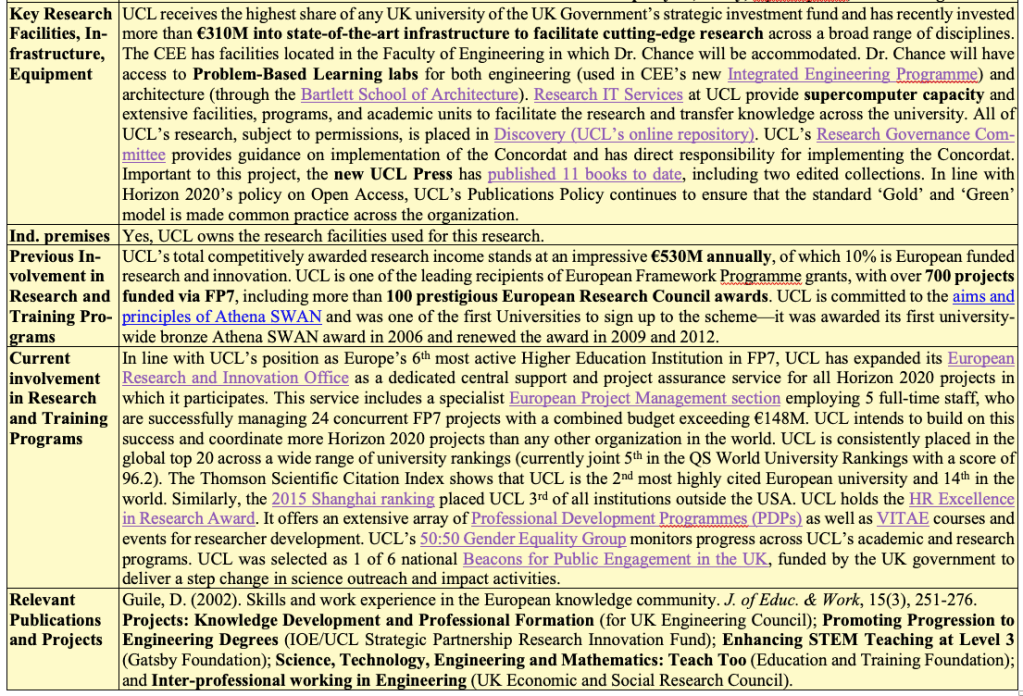
Capacities Table
The following table appeared in the Appendices and thus it didn’t count against the page limit. It was restricted to a single page. I included a second page with the three possibilities I had identified for secondment, but I ended up omitting them in my resubmission.
Note that because I made no mention of a secondment in the resubmission, I wasn’t allowed to add one later. Had I mentioned one in any form (I was told by my Project Officer later when trying to add one in), I could have altered the destination. I wasn’t allowed to add one later, however, as I hadn’t mentioned one in the 2016 proposal. Adding one after acceptance would have required a new formal review of the project. I don’t like to over-complicate things, yet I did manage to work closely with a non-profit organization (Engineers Without Borders UK) while I was in London, and produce research of value to them.
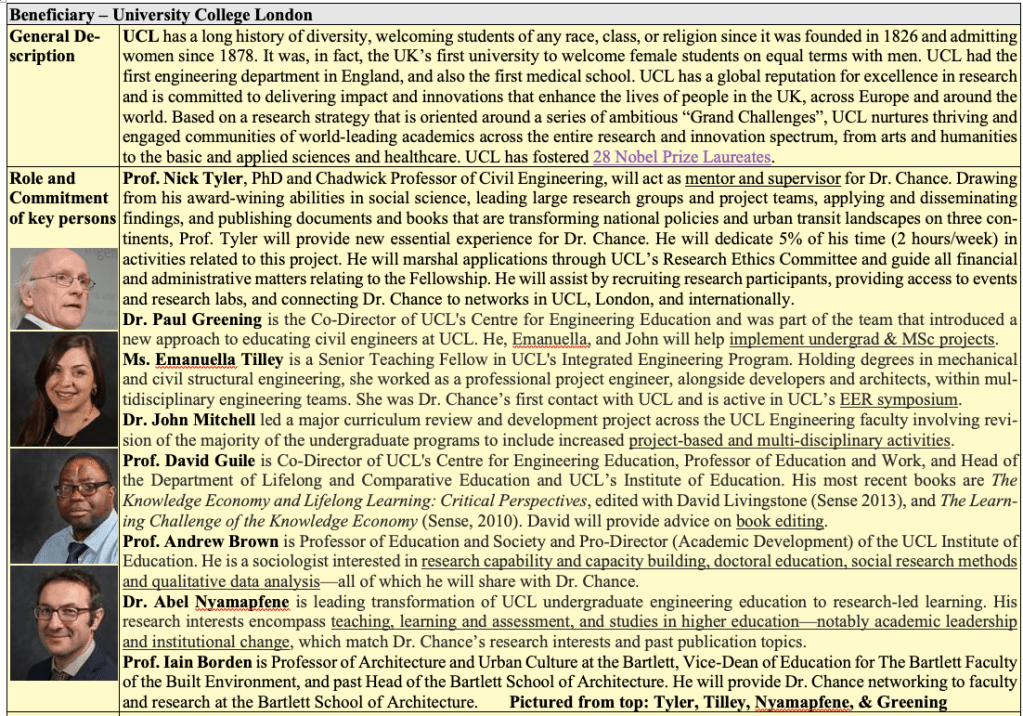
Top half of the capacities table.
You’ll see I tried to personalize this chart by including photos of the people I’d be working with because I wanted to highlight the diversity of this team. Plus I managed to make a fairly nice graphic arrangement to add appeal to the page! By the time I started the Fellowship, Paul, Greening had moved to a different university so I worked with the Vice Dean for Education, Prof. John Mitchell–as well as the rest of this group. By the time I arrived to start my MSCA-IF, UCL had brought a new full-time researcher on board who isn’t pictured above, so I got to work with the brilliant Dr. Inês Direito as well.
This was a truly amazing team to work with!
The research facilities and supports at UCL are world class, as the bottom half of the Capacities Table illustrates:
In this post, I share subsection 1.2 on “Clarity and quality of Transfer-of-Knowledge/training for development of the researcher in light of the research objectives” of an MSCA Individual Fellowship proposal submitted, unsuccessfully in 2015. I revised it based on evaluators’ comments provided in a previous blog. The revision was funded in the 2016 call. This blog provides one sub-section of the “Excellence” section, the section that has to do with the researcher and the design and merit of the work being proposed.
Please note that my home institution, formerly known as DIT, changed its name to TU Dublin (Technological University Dublin) while I was in London doing my MSCA-IF.
1.2 Clarity and quality of Transfer-of-Knowledge/training for development of the researcher in light of the research objectives
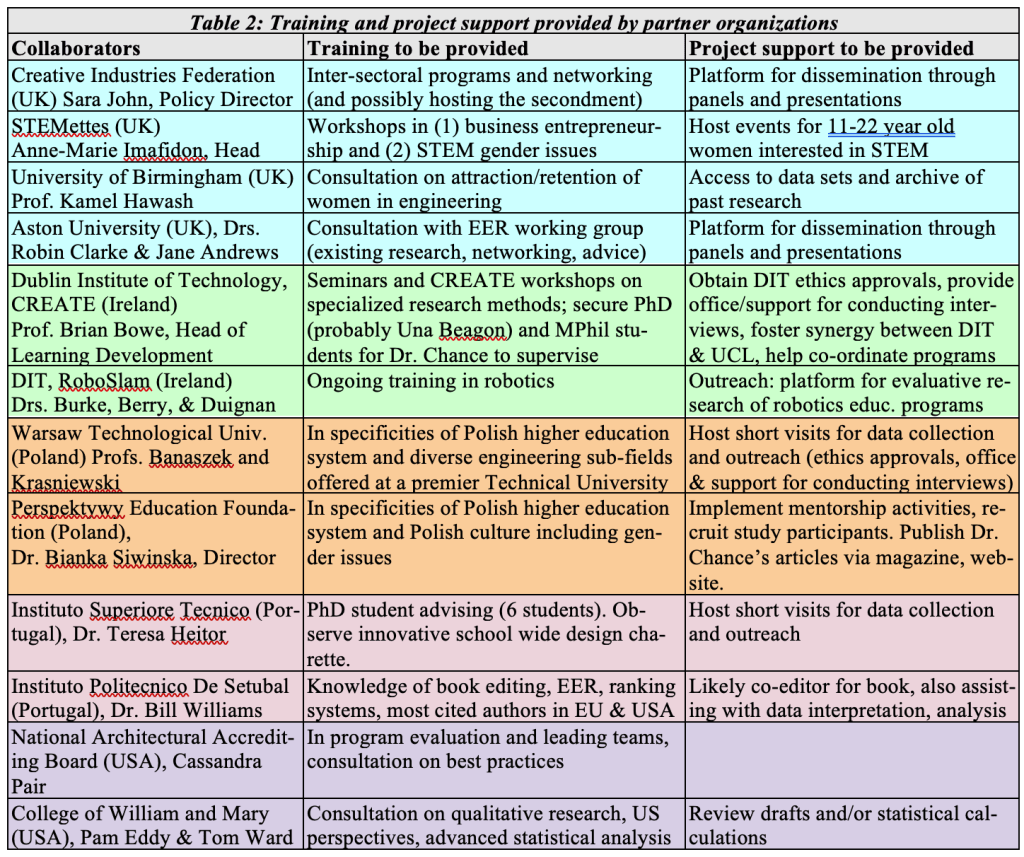
UCL offers crucial knowledge, models, and training programs (see 1.3 & Capacities). At UCL, Dr. Chance will build on her solid foundation in the emerging field of EER by developing new research and management skills and by catapulting her work well beyond her already notable capabilities. Working under the expert supervision of Prof. Nick Tyler, a global leader in research productivity, she will develop specific, crucial new skills in: quantitative and qualitative social science research, project organization and leadership, financial management, grant writing, and PhD supervision. This training will have enormous positive impact on the research career of Dr. Chance and will positively impact UCL, UK and Irish EER, and a host of project partners across the EU (see Table 2). Specific stretch-goals for the EF period are: (1) publishing two articles in the highest-ranking journals in EER and higher education, (2) leading the production of a seminal new guidebook for educators, and (3) securing grants to establish an independent research team, recruit/train new researchers (see Implementation).
Dr. Chance’s career goals are to permanently base her research operations in Ireland and to spearhead research teams via European Research Council and industry funding. She possesses many of the skills necessary to do this, however she and CREATE need specific experience in securing and managing large-scale research grants, conducting advanced statistical procedures using statistical modeling tools, and using programs like SPSS. To gain crucial experience, Dr. Chance needs mobility out of DIT for a period so she can work alongside extremely high-research producers and in industry. A three-month secondment will develop her understanding of what this sector needs and how it uses social science research and education programs. It will help exploit her research more fully.
Table 2: Training and project support provided by partner organizations.
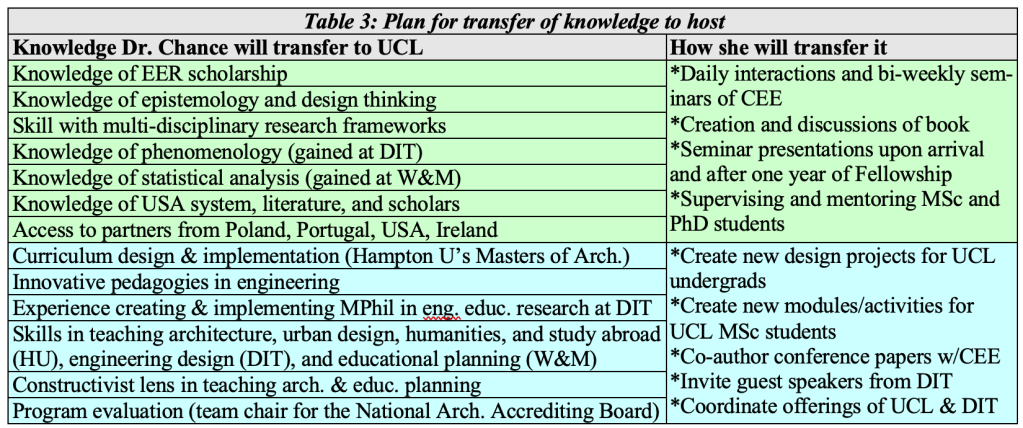
As an EF, Dr. Chance will spearhead two-way transfer of knowledge between UCL and Dublin Institute of Technology (DIT, her current employer), and will coordinate EER efforts between the two. This will enhance her leadership and project management skills. She will transfer to UCL specific knowledge gained at DIT regarding phenomenological research methods, design of a new Master of Philosophy degree in EER, and implementation of engineering design projects. Dr. Chance will transfer crucial knowledge back to DIT through ongoing exchange and her planned return to DIT at the end of the EF—at which point she aims to lead a new research strand for DIT’s CREATE research group via grant funding secured under Prof. Tyler’s mentorship (details in CV). She will apply to organizations like the European Research Commission (ERC) for large-scale Starter Grants. Her new research and project management skills will render Dr. Chance more competitive in accessing this type of large-scale funding, and her support network (from UCL, DIT, and industry) will provide valuable assistance. Her work will support DIT’s evolution into Ireland’s first Technological University and help grow CREATE into a full-fledged research center. UCL is a global leader in the training of researchers, and Dr. Chance will take full advantage of its excellent Professional Development programs. She enjoys this type of learning and is committed to completing a wide range of Researcher Development and Leadership and Management programs at UCL. She will participate in either Springboard Women’s Development Programme (researcher cohort) or Taking Control of Your Career. Both of these run over the course of a year. She will definitely take Writing Targeted Grant Proposals and 4 specific Financial and Project Management courses (see 3.3). She will watch the schedule for Quality Papers, Writing a Peer Review, Leadership in Action, Professional Skills for Research Leaders, Effective Delegation, and Breakthrough Conversations and will complete as many as possible. If Writing a Book is offered upon arrival, she will take it.
Table 3: Plan for transfer of knowledge to host
New collaboration opportunities will open for the host institution, notably a new symbiotic relationship with DIT that will further enhancing UCL’s successes in engineering education pedagogy while also adding to CREATE’s record of producing quality phenomenological and phenomenographic research. Dr. Chance’s work will include clarifying and refining a distinctive niche for each institution, and positioning each for maximum impact. To UCL, Dr. Chance will bring existing international connections, as well as an engaging new research project that includes R&D of educational activities. She will help infuse practice and pedagogy at UCL with findings from her research.
In this post, I share the subsection 1.4 on “Capacity of the researcher to reach and re-enforce a position of professional maturity in research” of an MSCA Individual Fellowship proposal submitted in 2015. In this section I include the CV, to show how I tailored it to support the application. I’ve had a non-standard career path, with engineering education research (EER) being something I’ve tried mastering late in my academic career, so I used the CV to show what I am doing, why, and how it builds on my past experience. I aimed to show how things about my record that might first appear to be weaknesses can also be framed as strengths.
I also needed to provide very clear justification for receiving a second MSCA IF. I had to show it would be a good investment.
1.4 Capacity of researcher to reach and re-enforce a position of professional maturity in research (see CV)
Since completing a PhD in Higher Education (with an honors designation and her School’s Award of Excellence), Dr. Chance has transitioned her career focus from teaching to research, and been selected as:
Fulbright Core Scholar to Ireland in Engineering Education (2012-13)
Scholar in Residence for the University of Oregon’s Study Abroad program in Rome (2013)
Fulbright Inter-Country Lecturer to both Portugal and Belgium (2013)
Marie Curie International Incoming Fellow to Ireland (2014-16) where she learned phenomenological methods.
Dr. Chance has a long history teaching architecture and supervising Master’s thesis students (at Hampton University). She has evaluated architecture programs at the highest levels (having served on seven teams of the US National Architectural Accrediting Board, and having chaired a team in 2015). She coordinated university accreditation activities at Hampton U. She has taught educational planning (at William and Mary) and Problem-Based Learning and design projects in engineering (at DIT). She has developed curricula (for Hampton and DIT). A focus on diversity and inclusion has always formed a part of her research efforts, dating back to her first conference paper in 2000. Over time, Dr. Chance has demonstrated scholarly productivity through completion of: 37 peer-reviewed conference papers, eight peer reviewed journal articles, seven book chapters, two thesis design projects, a PhD dissertation, and an edited volume. She has delivered 87 academic lectures in Europe, USA, and Asia. For all research and grant-funded projects, Dr. Chance pursued projects that she conceived. All research lines—including her PhD research—were separate from her advisors. This attests to Dr. Chance’s capacity for independent thinking/research. Google Scholar now lists her h-index at 4 [note: I’m happy to report it’s now at 7, but I wish I could get it to climb faster], above the average among full professors in social science (3.67), political science (3.43), and law (2.83), according to the London School of Economics. Her work has been cited in over 36 publications (excluding self-citations). She is now requesting approvals from publishers to upload more of her articles on freely accessible sites so as to extend the reach of her work. Her citation index is on an upward swing.
Dr. Chance’s foundation in phenomenology and statistics give her a strong base for EF research to be conducted. Due to the novel hybrid topic and innovative approach she is proposing to use in future work, Routledge publishers recently asked her to submit a book proposal on epistemology and design thinking. She was interested in—and has committed to—the book idea. However, if she secures EU funding, she would prefer to opt for the UCL Press instead of a profit-driven publisher. UCL Press (see Capacities Chart) will ensure the content is as openly accessible as possible, as per EU policy. Over time, Dr. Chance has steadily accrued skills that will enable her to conduct pioneering and truly groundbreaking research and spearhead the development of a seminal new book.
The value of Europe’s IIF investment will be hugely increased if the IIF study is followed up by an EF that brings the discipline to a whole new level. The innovative, pioneering, and ground-breaking findings from the IIF can be harnessed and brought to use in the EF study, creating the potential to revolutionize teaching methods and to fast track a new generation of creative and challenging engineers. It is imperative that immediate action is taken to address the dangerous shortfall of engineers that precipitates the EU’s low number of patent filings and top tech companies, and lagging industry R&D. We must protect and enhance the EU’s reputation for producing quality goods. Whereas the IIF focused on bringing skills from the USA, developing curricula and phenomenological research skills, the EF will focus on: 1) achieving more powerful, substantial and tangible findings (by enhancing phenomenology with quantitative data), 2) disseminating the findings globally, and 3) equipping Dr. Chance with the necessary skills to manage complex large-scale research projects and teams. The EF study will be conducted in a completely new arena of the discipline; one that will have tangible and far-reaching effects on the teaching of engineering in Europe. The most common route for European researchers to develop these skills is through taking an intermediate step between the IIF and an ERC Starter Grant via a nationally funded project. However, due to the fixed-term of the MSCA contract, Dr. Chance is not yet eligible for all of Ireland’s grant programs. Yet she is firmly committed to life and citizenship here, and to basing all her future research operations in the EU. The proposed EF work is significantly different from the IIF in scale, complexity, and range of exploitation activities. It also includes extensive training in research management that only a world-class research institution like UCL can provide. UCL is truly unique in that it has achieved success in engineering diversity and retention. This work is of such a standard that is has been recognized by MIT4. This new educational methodology needs further study, development, and promotion. The EF will equip Dr. Chance to establish an independent research team at DIT leading the new research strand on epistemology and design thinking.
Attached CV
4 CV OF THE EXPERIENCED RESEARCHER
In this portion of the 2015 proposal, I started by listing my degrees, earned in the USA. I provided reviewers with the text below to put things in context before listing my Employment History (Research Positions, Teaching Positions, Professional Practice), Professional Registrations, sentences on Invited Lectures, Supervising Activities, Organization of Conferences, and lists of Professional Memberships, Special Recognition, Grant-Funded Projects, and Publications.
I’ll provide an example of the list of Peer-Reviewed Journal Articles at the end here, as I inserted info to help them assess my reach and impact.
Note that in the text below, I highlighted specific qualities asked for in the guidelines: Independent Thinking, Leadership Skills, and Results of some past projects. It’s important to use the specified words as it makes evaluators’ work easier. They are very busy people and you want to make it easy for them to find evidence to base their scores upon.
Dr. Chance is uniquely qualified for this interdisciplinary study. In the last two decades, working in the USA, she taught in two different institutions—one with a special focus on diversity and the other a research-intensive institution. Educational research is her second career. Her focus on research began with PhD studies (2006-10), her introduction to the field of engineering education research as a Fulbright Fellow (2012-3), and development of phenomenological research skills at DIT (2014-now). Results are now beginning to accrue from Dr. Chance’s current Marie Curie research studies. Preliminary results have revealed a promising new stream for investigation—overlaps of design thinking and epistemological development. As a result of the IIF, Dr. Chance is on track to produce at least: 3 journal articles, a book proposal, a book chapter, 10 conference papers, and 6 grant applications (with 3 of them funded to date at €2-10k). She benefited tremendously from IIF supervisor Prof. Brian Bowe’s phenomenological expertise, EER connections, and work chairing the 2015 Research on Engineering Education Symposium (REES). Through ongoing career planning and networking, Dr. Chance identified further training needs and career development opportunities. She discovered a number of surprising findings and developed an innovative stream of research for detailed study and development into a book. As an IIF, she gained acceptance in EER and has made the successful transition into a new research career. She identified sources of funding that she can target in the future; DIT has agreed to host her should she get future funding in place. As a result of participating in a 2015 EER conference and working group, Dr. Chance secured an exciting opportunity to join UCL, a world-class research institution. After the conference, she attended CEE’s launch and organized meetings for CREATE and CEE to come together to share ideas. So, as a direct result of successes in the first phase at DIT, she was presented with the opportunity to help plug DIT into a much bigger community—most notably the embryonic UK and Ireland Network on Engineering Education to be launched 6 November 2015. By making such connections, Dr. Chance realized she needed to develop a set of specific skills in order to get to where she aims to be in five years [note: they want to see your trajectory and goals, but I feel these were a bit too lofty], having: secured an ERC grant [note: this was an admirable goal, and MSCA fellows win these awards at higher rates than non-fellows, but it’s still out of my reach–I’m focusing now on strengthening my publication record to get here], published a widely respected book [note: I broaden this option in the final proposal to book or special focus issue–I delivered two of special focus issues during the fellowship], and be leading an independent research team [note: I’m doing this one to some degree now, but my collaborators aren’t on my campus]. She is on track to apply for ERC funding and this fellowship at UCL will help her achieve these aims by providing strategic management and research skills and giving her time to recruit new members to her research team and secure ERC funding (or help them secure MSCA IF funding) for future training at DIT. A potential candidate is [name removed], an engineer from Spain who is interested in earning a PhD in EER who Dr. Chance has been mentoring informally.
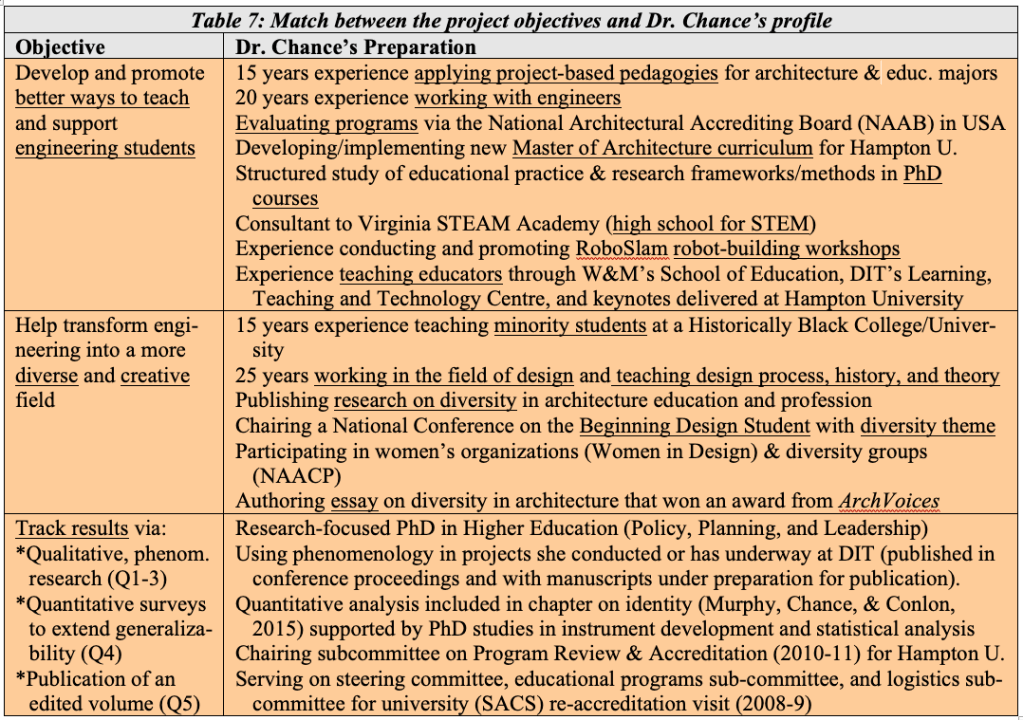
Table 7: Match between the project objectives and Dr. Chance’s profile
Independent Thinking. Dr. Chance has authored 5 opinion/editorial columns, expressing her independent views on: (1) Architectural registration and its diversity vortex published by Crit Magazine; (2&3) HU: Forerunner in architectural diversity and HU to host national diversity conference published regionally by American Institute of Architects; (4) Architect—Visionary or order filler?, published by the US Department of Housing and Urban Development; and (5) Green aesthetic: Seeing beauty in clotheslines and weeds in Virginia’s Daily Press.
Leadership Skills. Dr. Chance chaired the 20th National Conference on the Beginning Design Student and serves on the organization’s steering committee. She has headed Construction Administration for a $7 million library and managed grants from the US Department of Education ($75k) and the ROTCH Foundation ($20k). She has planned and managed 10 study-abroad programs (6 to Europe, 4 to Africa) and secured ongoing support from charitable foundations. She has received formal leadership training (through both the 4-H youth organization and William and Mary university). She provided leadership to the City of Portsmouth (Virginia) as a Commissioner of Architectural Review (2002-5), also serving as Vice- (2004) and Acting-Chair (2005). Within the Port Norfolk Civic League (1999-2009) she served as President, Recording Secretary, Corresponding Secretary, and Stabilization Chair. As a member of the international Congress on the New Urbanism, she served as Accessibility Taskforce Chair (2006-10), Session Organizer (2006-10), and Panelist (2009, 2010), advocating for accessibility and universal design.
Results of 3 Major Projects
Results of dissertation research (using quantitative methods). Dr. Chance’s dissertation investigated the use of the LEED® Green Building Rating system by higher education institutions (HEIs). It tracked implementation of LEED® over time and helped assess the degree to which HEIs have been meeting the program’s stated goals, particularly in the areas most critical for environmental sustainability. Dr. Chance used MANOVA and multiple regression analyses to identify Energy and Atmosphere as the most important category in predicting overall ratings achieved by HEIs—indicating that this category, which is expensive to achieve but is most important for controlling climate change, also carries incentive because it most influences ratings. The study contributed new understanding of both the organizational learning that has resulted from refining LEED and how such rating systems can be used to generate and apply new knowledge. Dr. Chance presented the study to NASA scientists at Langley Air Force Base. The project resulted in several publications—including an article in Planning for Higher Education that garnered 800+ downloads the first week it was posted on the Society for College and University Planning’s (SCUP’s) Massive Open Online Course (MOOC). The original work received the Outstanding Dissertation Award from the International Society for Educational Planning (ISEP) in 2010.
Results of PBL research (using qualitative, phenomenological methods). During her nine-month Fulbright fellowship, Dr. Chance developed a range of foundational skills in qualitative research: conducting semi-structured interviews; identifying invariant meaning units; and developing descriptions to capture the essence of specific phenomena. Prior to arriving in Ireland, Dr. Chance had only basic coursework in qualitative research methods, and no experience with phenomenological research. She knew CREATE had expertise in phenomenology and also provided highly valuable examples of organizational learning. As a Fulbright she collaborated with colleagues from CREATE to research what motivated engineering educators to change the way they teach. During data analysis, Dr. Chance distilled a model for creating change in engineering education that is transferable and can help others facilitate change. Findings of the study have been published in two conference papers and a book chapter to date.
Results of identity research (using mixed-methods approaches). As a Fulbright fellow, Dr. Chance spearheaded quantitative components of an exploratory, mixed-methods study conducted with Drs. Mike Murphy and Eddie Conlon. She drew from past experience, using new skills in combination with existing skills, to develop survey instruments, analyze data using t-Tests and Chi-Squared procedures, and describe the sense of identity reflected by DIT engineering and technology students. Results indicated that, when choosing engineering, design and other hands-on aspects of education had been important considerations for many DIT students. These design and hands-on aspects appeared to be even more important to (the small sample of) women than to men in their degree choice. The resulting book chapter was recently published by Springer, ensuring dissemination to a wide audience.
Peer-Reviewed Journal Articles
CHANCE, S.M., Mitchell, J., & Duffy, G. (in press). Using architecture design studio pedagogies to enhance engineering education. International Journal of Engineering Education. h5-index 16. SJR h-index 30.
CHANCE, S.M., & Bowe, B. (in process). Phenomenological study of how women experience collaborative learning in engineering education.
CHANCE, S.M., Duffy, G. & Bowe, B. (in process). Understanding lectures’ experiences of group learning in engineering.
CHANCE, S.M. (Nov. 2012). Planning for environmental sustainability: Learning from LEED and the USGBC. Planning for Higher Education, 41(1). h5-index 9. Cited by 1.
Seymour, M.W., & CHANCE, S.M. (2010). Assessment Formats. International Journal of Learning, 17(10), 137-154. h5-index 5. SJR h-index 6.
CHANCE, S.M. (2010). Strategic by design: Iterative approaches to educational planning. Planning for Higher Education, 38(2), 40-54. h5-index 9. Cited by 10.
CHANCE, S.M., & Williams, B. (2009). Assessing university strategic plans: A tool for consideration. Educational Planning: The Journal of the International Society for Educational Planning, 18(1), 38-54. Indexed in the H. W. Wilson Education Index. Cited by 14.
Fisler, J., Agati, H.A., CHANCE, S.M., Donahue, G.A., Eickhoff, E.J., Hack, A.E., Gastler, S.E.K., Lowder, J.C., & Foubert, J.D. (2009). Keeping (or losing) the faith: Reflections on spiritual struggles and their resolution by college seniors. College Student Affairs Journal, 27(2), 257-274. Cited by 5.
CHANCE, S. M. (2008). Proposal for using a studio format to enhance institutional advancement. International Journal of Educational Advancement, 8(3/4), 111-125. SJR h-index 4. Cited by 1.
CHANCE, S.M. (2004). Architectural registration and its diversity vortex. Crit: Journal of the American Institute of Architecture Students, 58, 36-40.
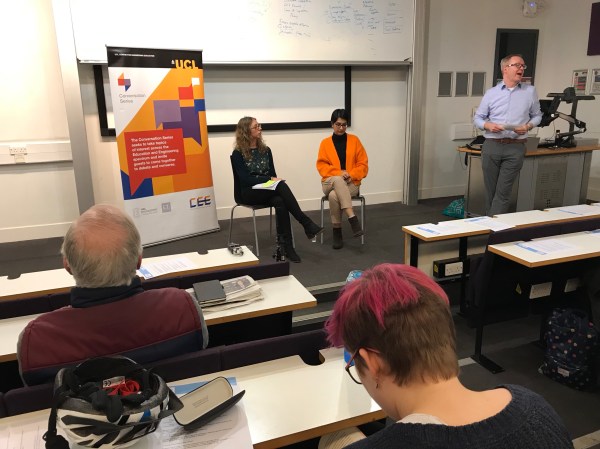
Shannon Chance and Abel Nyamapfene about engineering education research (EER) at UCL.
If you are interested in finding a new job or fellowship in engineering education research (EER) then please visit the EER Jobs & Opportunities page I’m hosing on this blog. I update it regularly as I become aware of new jobs, grants, conferences, and learning opportunities.
For instance: If you want to get more involved with engineering education research (EER), I recommend consulting the following sites. The sites can link you to all sorts of EER jobs, grants, fellowship, and funding calls. I’ve created this page for people who would like to work in the field of, or study how to do, EER.
Assisting local REES hosts in publishing the proceedings of the REES conferences.
Organizing and publishing special focus journal issues showcasing research conducted for dissemination at REES that carries the research findings far beyond the confines of the REES meeting itself.
Today, REEN received good news from one of our Board members, Professor Jonte Bernhard from Linköping University’s Department of Science and Technology in Norrköping, Sweden. Jonte and I are the two European Representatives on REEN. Every continent (except Antarctica) is represented on our Board.
Jonte happily announced:
the EJEE special issue based on REES 2015 in Dublin is now finally published online (individual papers have been published earlier) as vol. 44, issue 1-2: https://www.tandfonline.com/toc/ceee20/44/1-2
A major goal is to get engineering students to engage–especially in dealing with tough, complex, and wicked- or ill-structured problems, the way I observe architecture students do:
Two articles deal with spatial perception, an area where the Dublin hosts of REES 2015 have developed expertise with the help of expert Professor Sherly Sorby:
I have a grant-funded training fellowship and my activities are designed to build skills in specific areas, organized around the six “work packages” outlined below. This blog summarizes my academic achievements from February 2018.
Work Package 1: Qualitative Research
Analyzed data for a policy paper to improve women’s access to STEM education in Ireland. Located relevant policies from Poland to use as precedents and translated them into English with the help of Google Translate.
Emerging Findings of a Longitudinal Study of Middle Eastern Women’s Experiences Learning Engineering Abroad
A model for spurring organizational change based on faculty experiences working together to implement Problem-Based Learning
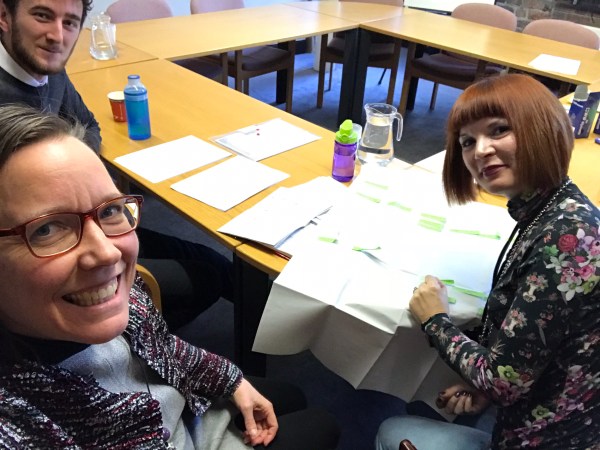
Met with UCL’s Dr. Inês Direito to discuss how I can help with a future qualitative research study of women at UCL.
Brushing up on research methods.
Collected follow-up interviews in Ireland (with 2 Middle Eastern and 1 Irish student) and connected with researchers in Portugal who will collect interview data to add to the Portuguese data I’ve collected with Dr. Bill Williams.
I continued work on IEEE ToE’s upcoming special focus issue on social-cultural diversity. I saw one manuscript through to completion and worked closely with the Administrative Editor and Chief Editors to help our team of guest editors get the schedule moving forward, since work had stalled. I’m hoping for publication in August 2018, if we can keep our momentum going.
I only promised one special focus issue in my grant proposal–but why not aim to deliver two?
Work Package 4: Outreach (including Peer Reviews)
I drafted and submitted a 1000-word entry for The SAGE Encyclopedia of Higher Education on the topic of Problem-Based Learning and its use in engineering disciplines.
Reviewed ten proposed activities for a new children’s book by Usborne Publishing called “Scribble Engineering” and submitted an evaluation to the publisher.
The Editor in Chief of the IEEE Transactions on Education (ToE) appointed me to the journal’s editorial board, so now I’m a full Associate Editor with a three-year term. In this job, I’m giving feedback to the Editor as to which manuscripts to forward though the peer review process and I’m managing the peer review process for one new manuscript each month.
Working with the Research in Engineering Education Network (REEN) in February involved a sub-committee meeting to edit guidelines and application forms for people interested in hosting a future Research in Engineering Education Symposium (REES, in 2021, 2023, or 2025). Our next symposium will be held in Cape Town, South Africa July 10-12, 2019. I also attend the monthly online meeting of REEN and followed up by contributing to the REEN Discussion Forum on LinkedIn, inviting colleagues to join the discussion.
Meeting with Civil Service professionals in Dublin.
Work Package 5: Research Training
During this fellowship, I aim to develop skills in supervising PhD students and post-graduate level research teams. This month, I met face-to-face with four of the six Irish Civil Service professionals who I’m sponsoring in the training module they are taking related to policy and research.
Met with Prof. Rao Bhamidimarri, VP of London South Bank University, about the engineering education center he runs, the STEM secondary schools he created, and PhD thesis projects I may be able to advise.
Work Package 6: Management
Met with my supervisor, Prof. Nick Tyler, for my one-month probationary review and to keep my Career Development Plan up to date.
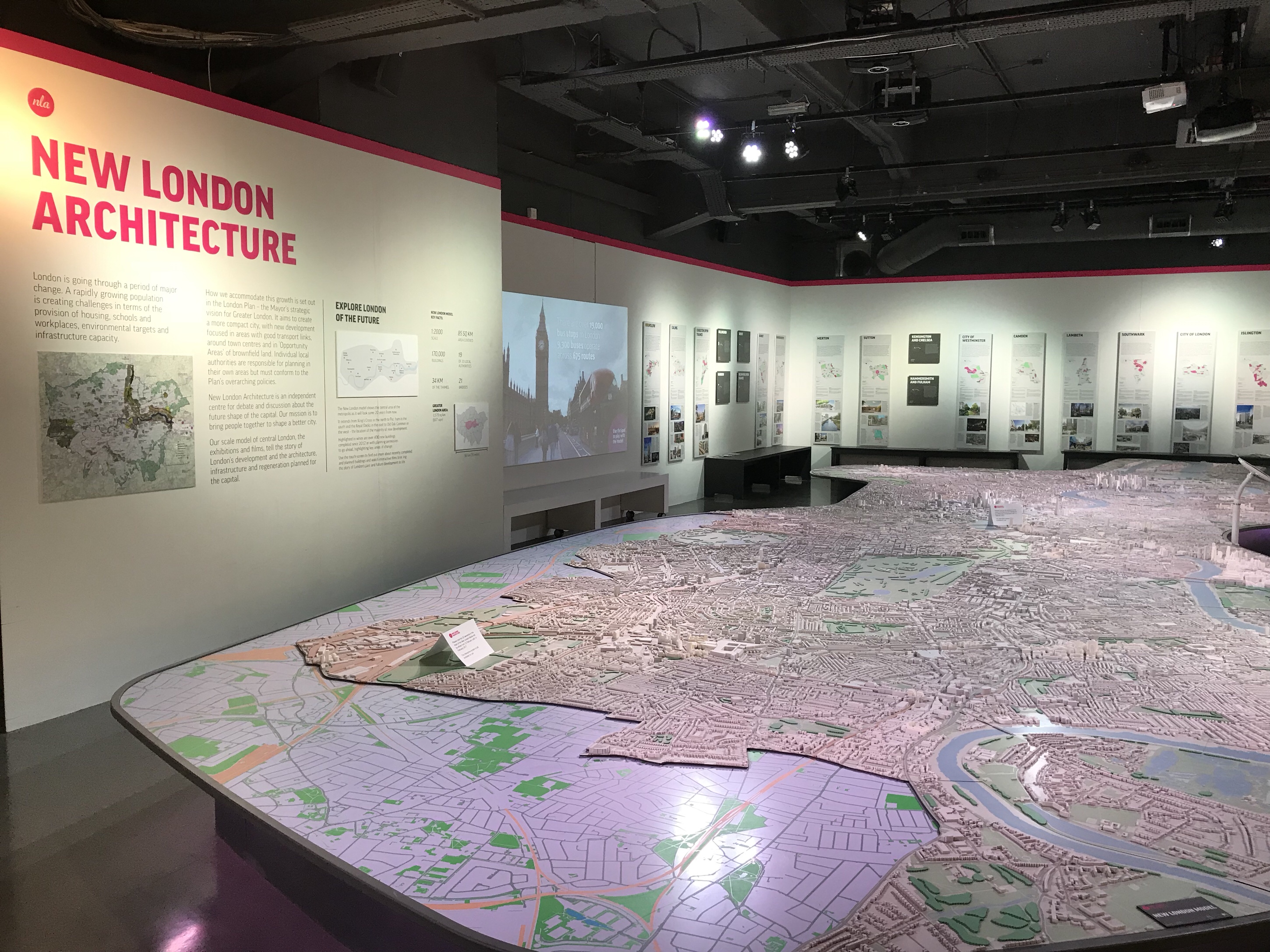
Studying urban design at London’s Building Centre.
Ongoing professional development:
Attended lectures at the Bartlett School of Architecture:
Fabio Gramazio of ETH Zurich and Gramazio Kohler Research
Jeremy Till, Head of College and Pro-Vice Chancellor at Central Saint Martins, University of the Arts London
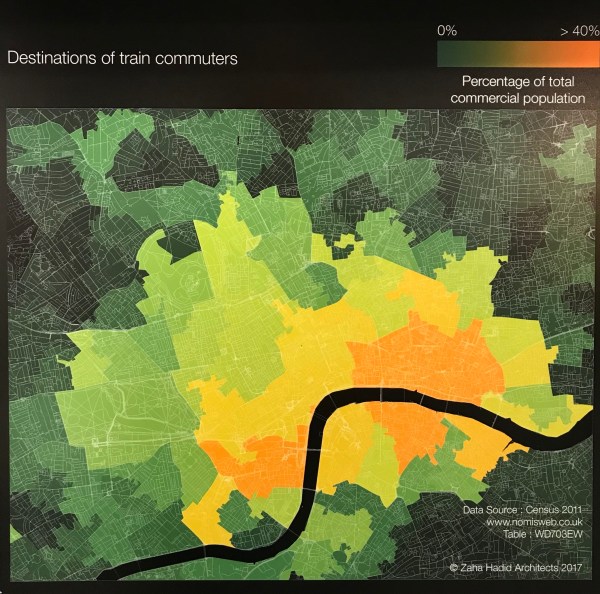
Transit maps at the Building Centre.
Visited and studied at:
The Building Centre‘s exhibitions on walkability in London, development plans for the city, and winners of an architectural design competition on extensions to existing homes in London
I had a bit of time left over for fun and adventure. I joined the UK’s Art Fund, which provides free or reduced entry prices at about 240 cultural sites in the UK. I also:
Using comp time, I took a three-day weekend in Paris to visit two lovely retired linguistic professors, Prof. Nancy Stenson from the University of Minsseota and Prof. Arthur Spears from CCNY. It was my first time through the Chunnel and my first time to meet Arthur, a friend of Nancy’s from grad school!
Professors Arthur Spears, Nancy Stenson, and Shannon Chance in Paris
Cheered on my partner, Aongus Coughlan in completing his coursework (in health, safety and legal aspects of building construction in the UK) and securing necessary certifications. He found a job after a grueling one-day search—he CVs emailed on Monday, interviewed on-site Tuesday, accepted a job offer on Wednesday!
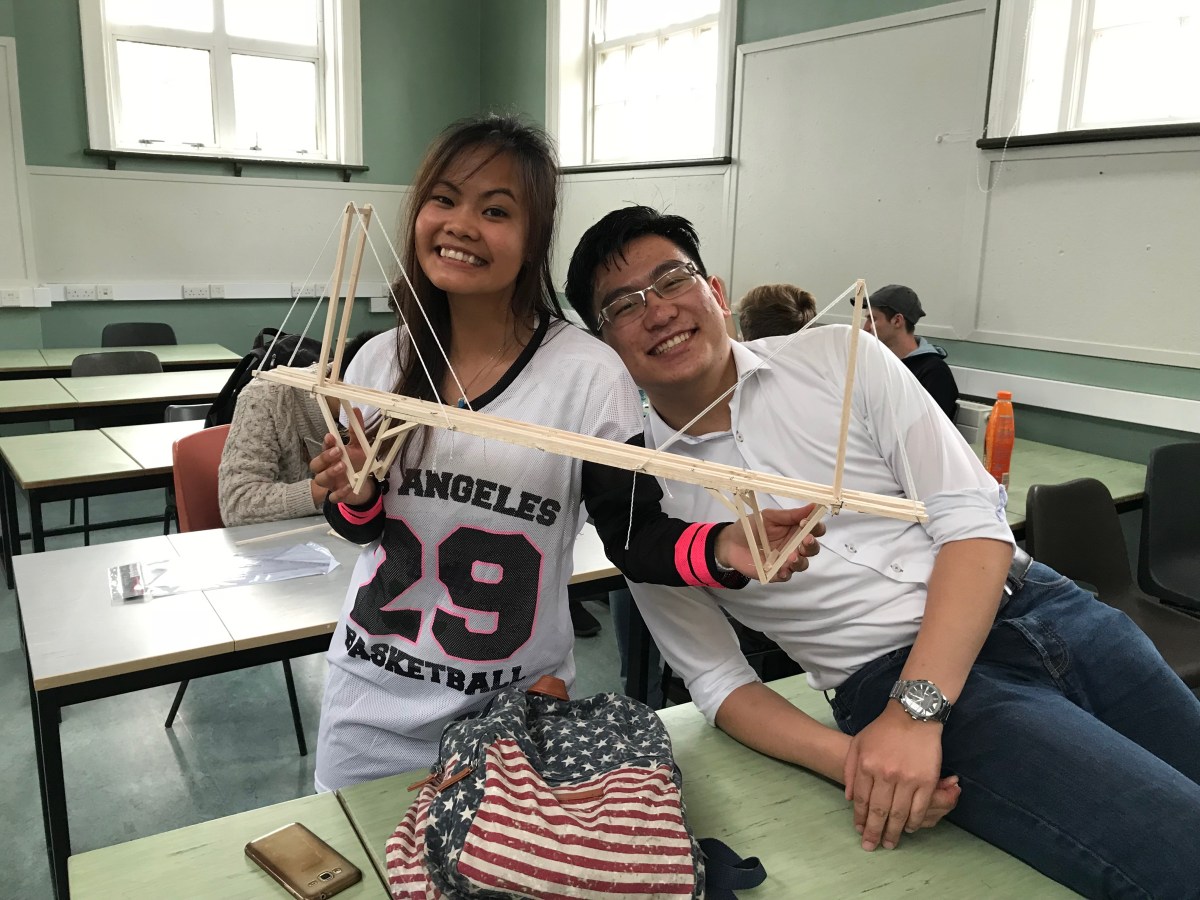
Visited former colleagues and students in their bridge projects class at DIT during my Febraury research trip to Dublin.
Kept up my yoga and swimming, and at least 10,000 steps 6 of 7 days per week.
Kept up with the achievements of my former architecture students via Facebook and LinkedIn. I’m thrilled with their achievements—books launched, exams passed, registrations earned, lives well-lived. For instance, I saw both The Shape of Water and Black Panther – the second being a movie to which my former students contributed.
We played in the snow on the last day of February, since the “Beast from the East” closed Dublin Airport and prevented a trip over to Ireland for research and speaking.
Flashback: Teaching architecture students about sun angles at Hampton University, circa 2007.
I keep shifting roles in higher education so I can learn new skills. I spent 15 years teaching in the USA (advancing my way up to Professor of Architecture in 2014) before coming to Ireland as an education researcher and now Lecturer.
Transitioning from teaching to researching was more difficult than I had anticipated, partly because the work is more sedentary, but mostly because I missed interacting with students every day. And while I do enjoy engineering, I also miss discussing architecture and urban design on a daily basis. Fortunately though, I also enjoy interviewing engineering students.
As part of my Marie Curie Individual Fellowship to Dublin Institute of Technology (2014-2016), I conducted 60-90 minute interviews with 47 women in Poland, Portugal, and Ireland. The interviews I conducted as a researcher allow me to connect with students in new ways.
Flashback to Portugal, where my colleagues and I have interviewed 11 women studying engineering.
Since the end of that initial Marie Curie fellowship, I’ve continued this research project alongside new responsibilities. I’ve recently conducted follow-up interviews with 11 of the 47 women in my study, for instance.
After that Marie Curie fellowship ended, I also found work as a Lecturer on the teaching staff in DIT’s School of Multidisciplinary Technologies and found my way back into the classroom. Today, I get to work with wonderful teaching colleagues, and to teach undergraduate as well as Masters-level students. I’ve included a photo gallery at the end of this blog, showing a typical week of teaching.
So these days, I divide my time between teaching in-class 16 hours per week, learning new content for the classes I teach, advising thesis students, serving as a year tutor in our MSc program in BIM technologies, and doing research. (I’ve taken a break from grant-writing this semester and have enjoyed the respite.)
Planning for future studies in London.
I enjoy exciting new adventures, though, and so I’m preparing to transition back into full-time research for a while, so I can develop new skills by working for two years at University College of London. UCL’s website provides more details via a press release about the fellowship).
I’ll look for opportunities to teach informally while I’m at UCL, as well, and I’ll look forward to my return to DIT’s classroom in two year’s time to apply what I’ve learned through observation and research.
DIT has granted me a Career Break so that at the end of the fellowship I’ll be able to come back to my current lecturing post. I’m excited about this because I feel I’ve found my feet and my voice teaching here. Aongus (my partner) says it’s clear I selected the right profession since my passion for teaching and for students comes through in the stories I tell at the end of the day.
Now, in the month before I leave for London, I’m trying my best to track down the 10 students from my DIT cohort who I haven’t yet met for follow-up interviews and move to this research project ahead.
Monday: Technical graphics
Monday: Technical graphics
Monday: Technical graphics
Monday: Technical graphics
Monday: Technical graphics
Monday: Technical graphics
Monday evening: BIM, guest lecture by Dr. Bill East
Monday evening: BIM for Construction Managers and Quantity Surveyors
Monday evening: BIM with Barry McAuley
Wednesday’s RoboSumo project starts with a one-hour lecture by Ted Burke that I document for our class blog.
Wednesday: RoboSumo electrical design project
Wednesday: RoboSumo electrical design project
Wednesday: RoboSumo electrical design project
Wednesday evening: BIM
Wednesday evening: BIM
Friday: Bridge (structural and civil design) project








 Ireland by Chance