I’d like to share recent social media posts by my colleagues/past students/friends — their perspectives on transcontinental collaboration are unique and valuable! Thanks to Mia Dukuly, Violet Maufuwe, Tarrah Beebee, and Shinya Takehara for taking the time to reflect, document, and publicly share your experiences.
Tanzania
The first three of these — Mia, Violet, and Tarrah — participated as students in a Fulbright-Hays Group Project Abroad that I led to Tanzania in 2005.
We spent five weeks in Dar es Salaam, studying alongside Tanzanian architecture students and teachers. Several of the students forged lifelong friendships (and some even marriages) with other members of our 63-person study group (25 students and teachers from the USA, 38 students and teachers from Tanzania).
I didn’t establish this blog (IrelandByChance.com) until 2012 (seven years after that trip, when I went on my own Fulbright fellowship to Ireland). Nevertheless, several of my past posts have mentioned aspects of that 2005 study abroad program:
Also of interest is the post Trend Shifters and Hip Young Urbanites, featuring Donald Roman, a student of mine from Hampton University who participated in the 2005 Fulbright-Hays trip as well.
Mia and Tara are two USA-based Fulbright alumnae who keep returning to East Africa — and sharing their adventures with others.
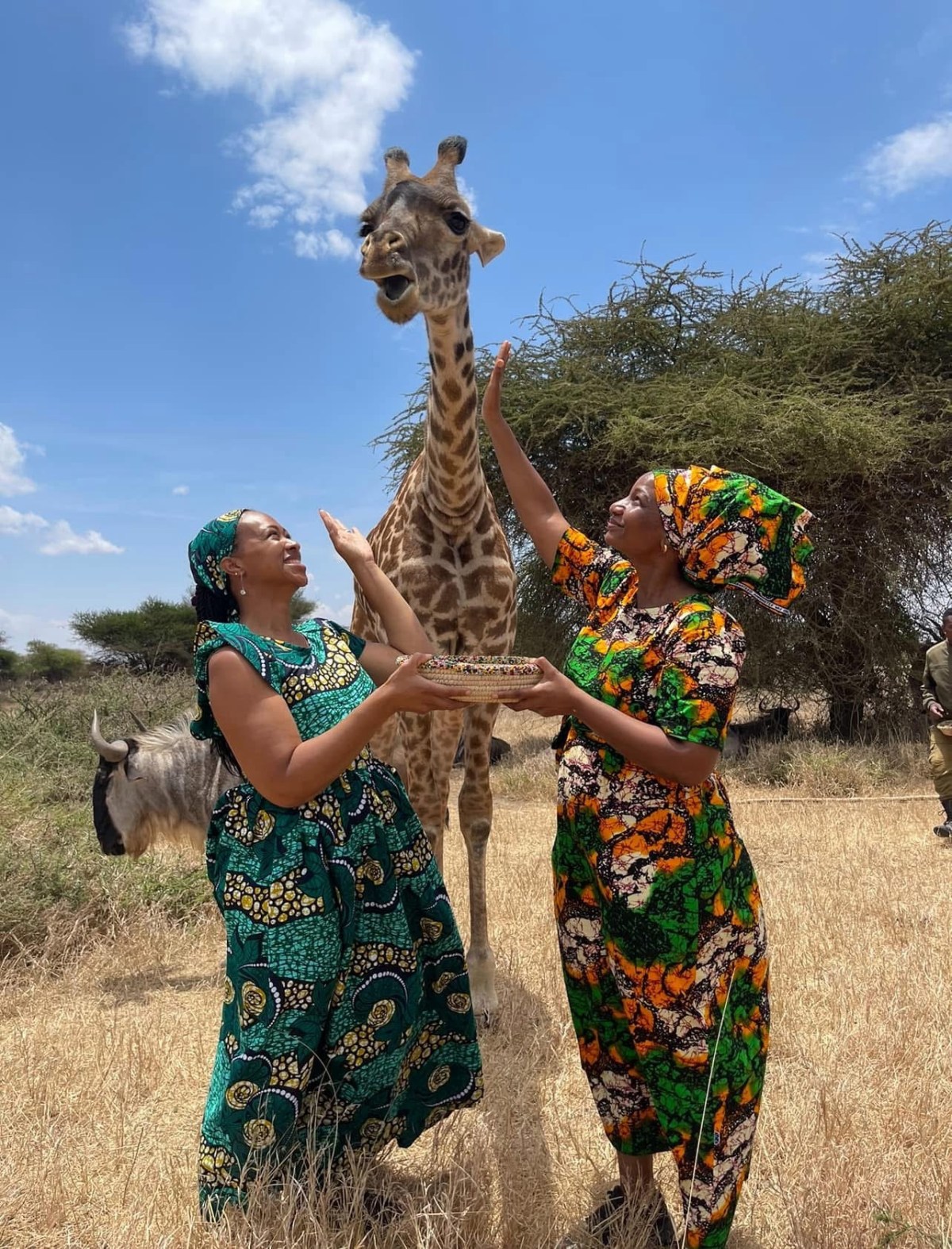
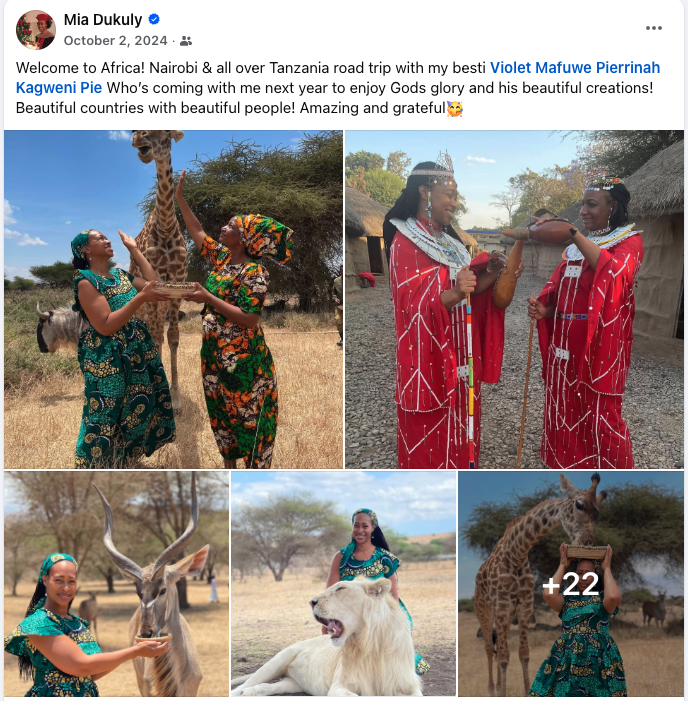
Here’s a taste of what Mia and her architect friend Violet Mafuwe have gotten up to recently:
A post shared by Mia Dukuly this past autumn.
Violet was one of the Tanzanian students participating in the 2005 study abroad program, and the only female among dozens of males.
The sisterly bond between these architects, Mia and Violet, is truly heartwarming.
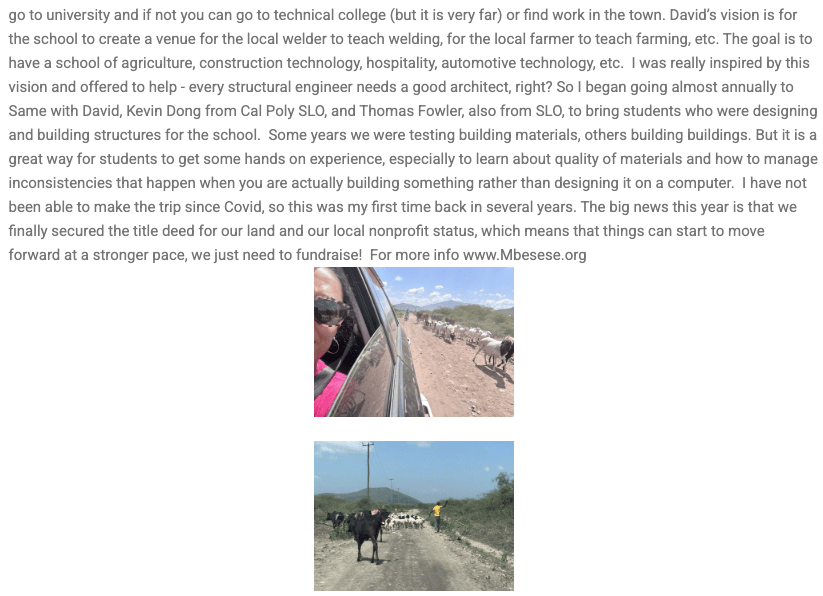
Tarrah, Mia, and Violet are all actively engaged in social missions, continually reaching out and helping others, particularly vulnerable people in East Africa.
In this screenshot, Tara describes how she connects her teaching, architectural design, and outreach activities.
In fact, it was Tarrah’s February 3rd blog post that inspired me to share the treasure trove below. Tara is an architect living in Los Angeles.
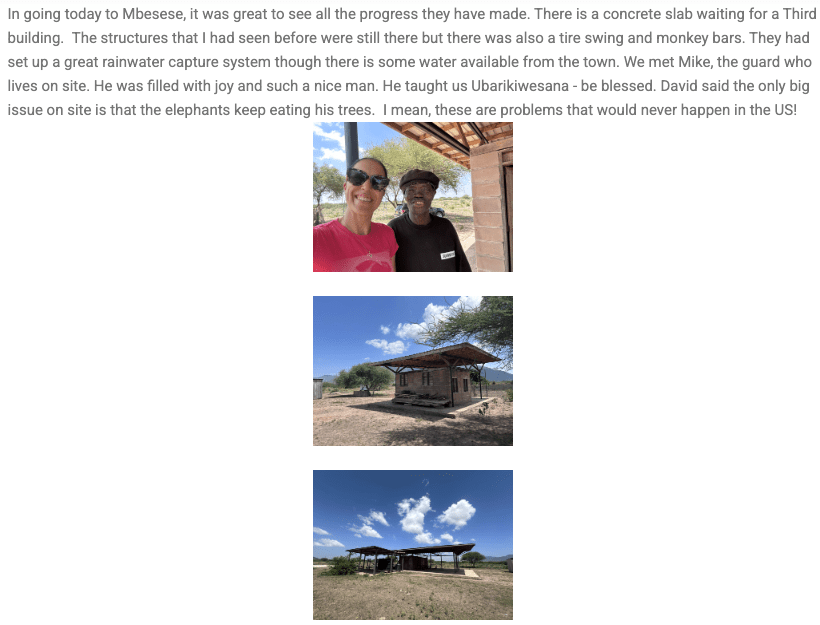
Tarrah mentioned me at the top of the blog, and it means a lot to me that I helped enable and inspire her to stay involved in Tanzania. She’s been helping build an educational complex for many years.
In this screenshot, Tara provides information on the educational facility.
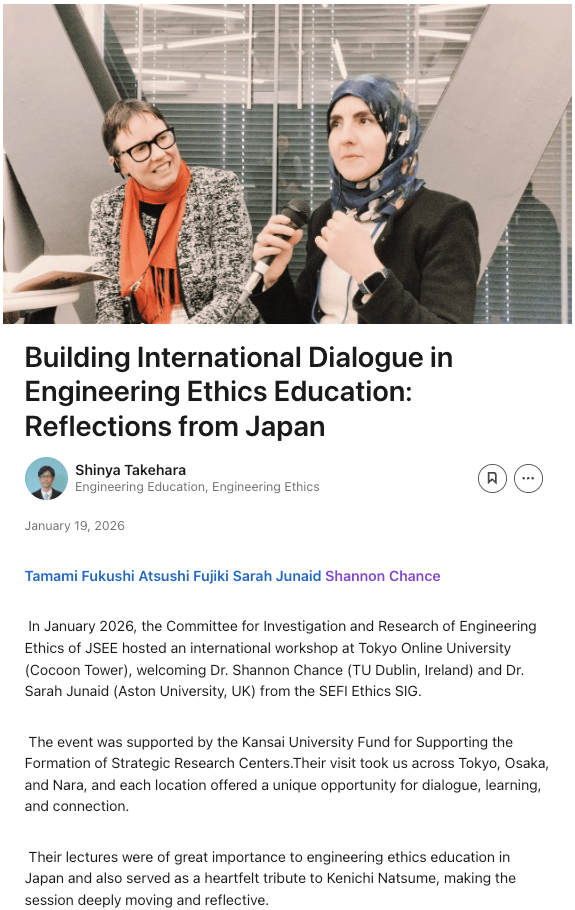
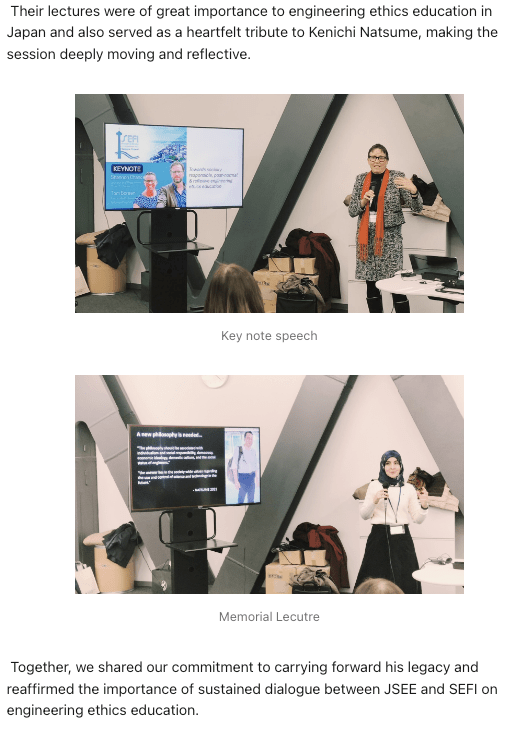
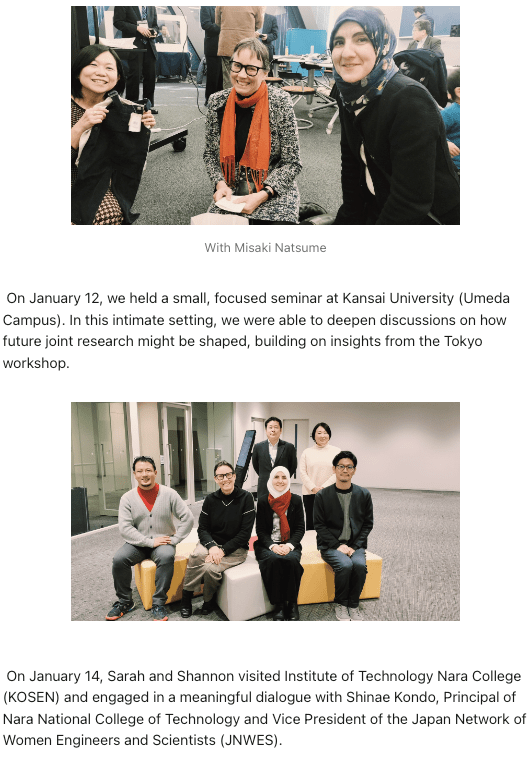
Which brings me to the other recent post I’d like to share. Shinya Takehara isn’t a Fulbright fellow (yet!), but I feel I wouldn’t have met him without the entry I got into engineering education research as a Fulbright Fellow in Ireland.
I am deeply indebted to each of these wonderful people — Shinya, Tarrah, Mia, and Violet — for making my life brighter and more meaningful, and for always reaching out to help others and spread the ethics of care.
I also thank Shinya, Tarrah, and Mia for giving me permission to share their posts here. Sending that request brought more good news, as Mia has recently secured a new job and will be relocating with her family to Germany soon. She reports good progress with her Architecture Registration Examination — a grueling multi-part test that takes most of us years to complete. I am so excited to learn of her progress!
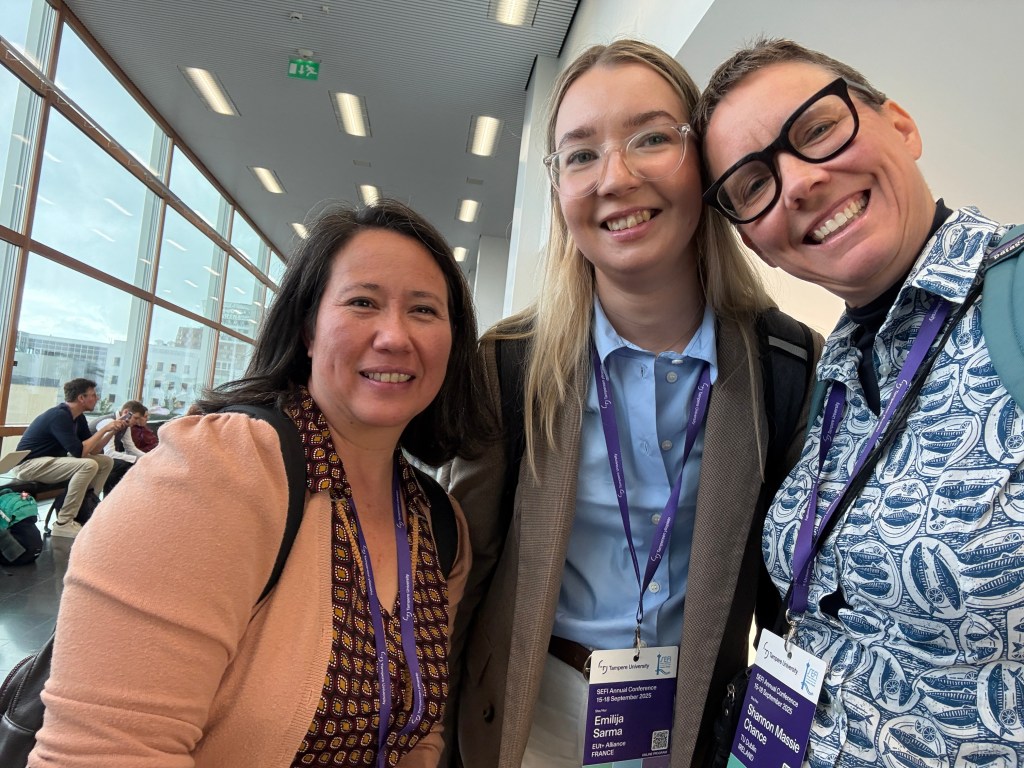
What an inspiring whirlwind week at the European Society for Engineering Education SEFI 2025 Annual Conference! The event was packed with meaningful presentations, deep and reflective conversations, intellectual rigor, and memorable community moments. Attending SEFI always feels like a homecoming to me, and this year’s conference certainly delivered, especially with the monumental achievements of my colleagues and students.
From Handbook to Keynote Stage
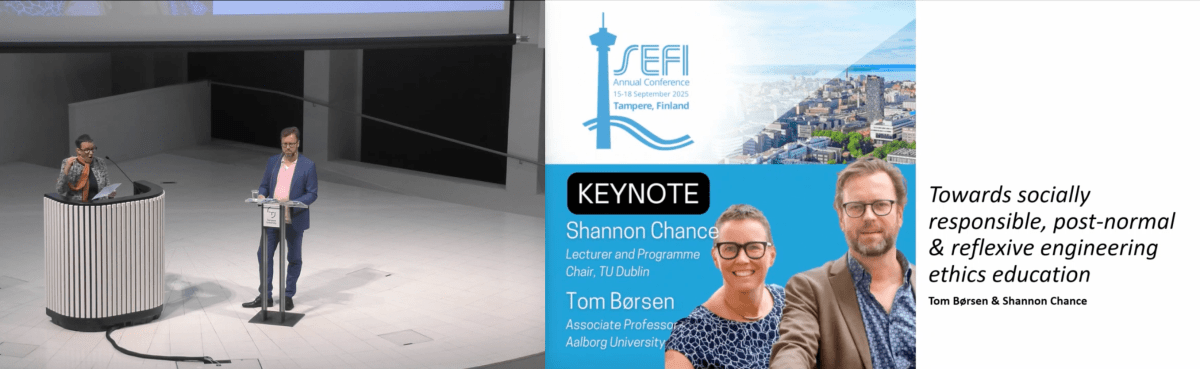
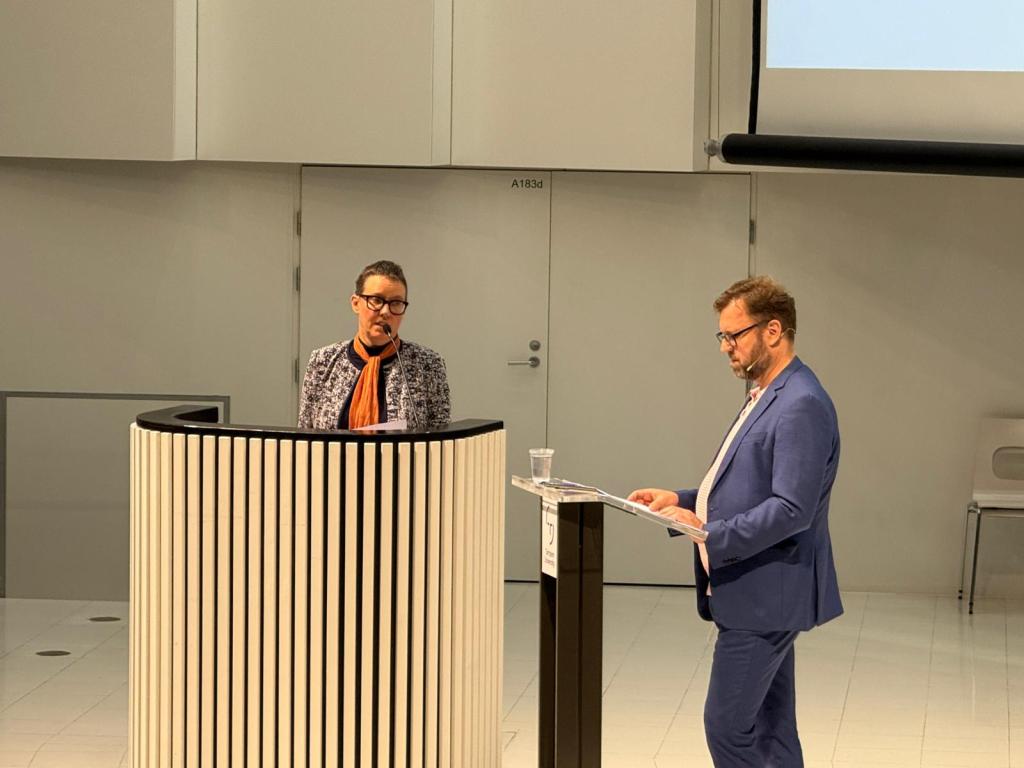
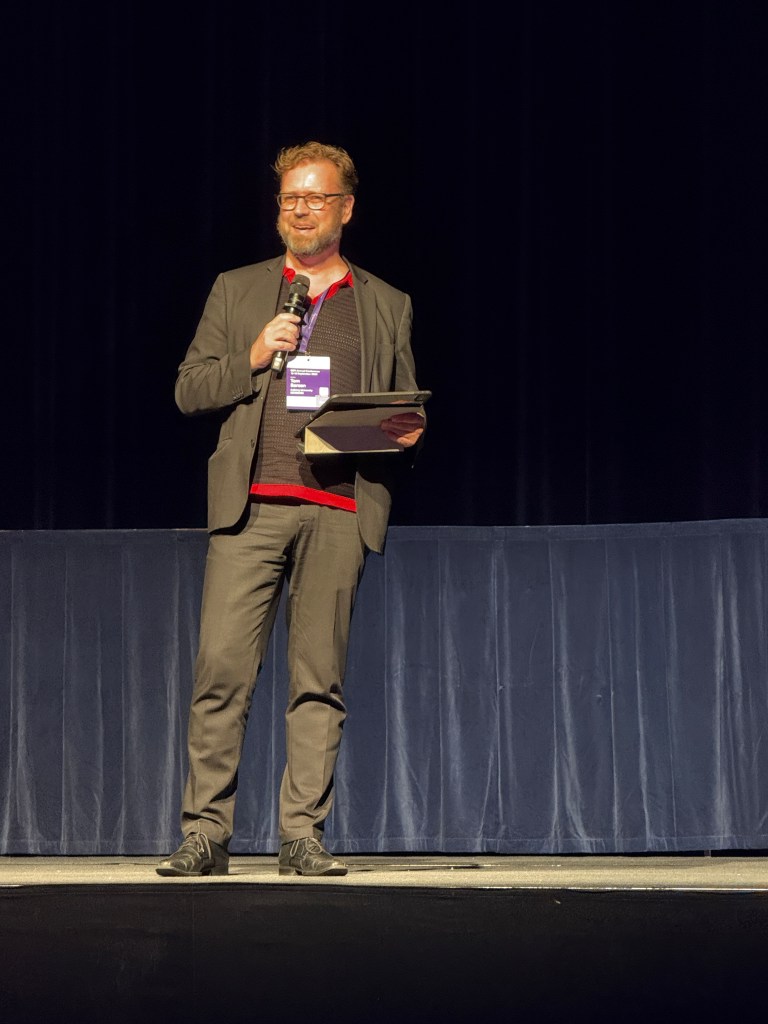
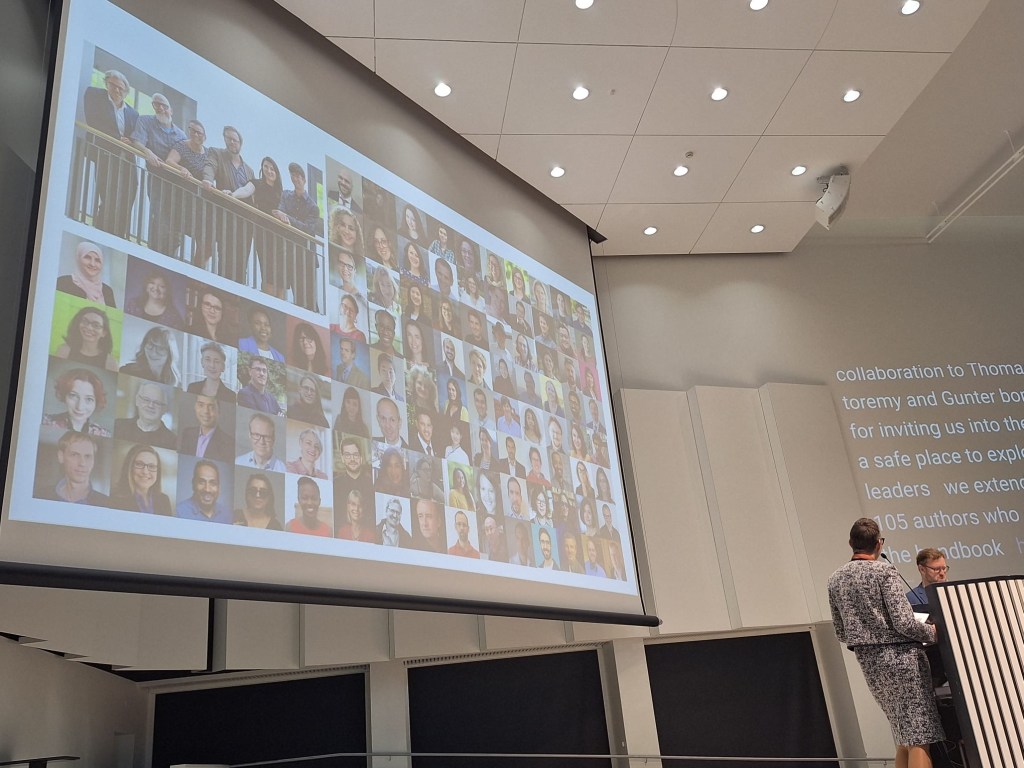
A significant highlight for me was being invited to deliver a keynote address at SEFI alongside Associate Professor Tom Børsen from Aalborg University. The address drew extensively from the Routledge International Handbook of Engineering Ethics Education, which Tom and I co-edited alongside our phenomenal team of co-editors, Diana Adela Martin, Roland Tormey, Thomas Taro Lennerfors, and Gunter Bombaerts.
Our keynote, titled “Towards socially responsible, post-normal and reflexive engineering ethics education,” (video link here) called for a bold transformation in how engineering ethics is taught. We addressed the urgent need for engineering ethics education (EEE) to move beyond traditional, individual-focused approaches to embrace collective responsibility, reflexivity, and social justice. This is particularly critical in “post-normal times,” characterized by uncertainty, high stakes, and contested values.
Among other things, Tom and I urged the community to integrate non-Western and AI ethics, foster transdisciplinary collaboration, and empower engineers to challenge power structures and cultivate an ethics of care for people and the planet.
And regarding Tom, I was thrilled to watch him receive a major honor at SEFI: the 2025 Maffiolli Award. Tom has been instrumental in advancing the field of Technological Anthropology, and this award is so very well deserved! Tom won in the individual category, and my colleagues from UCL, led by Fiona Truscott, won in the group category. A very excitig night, all around!
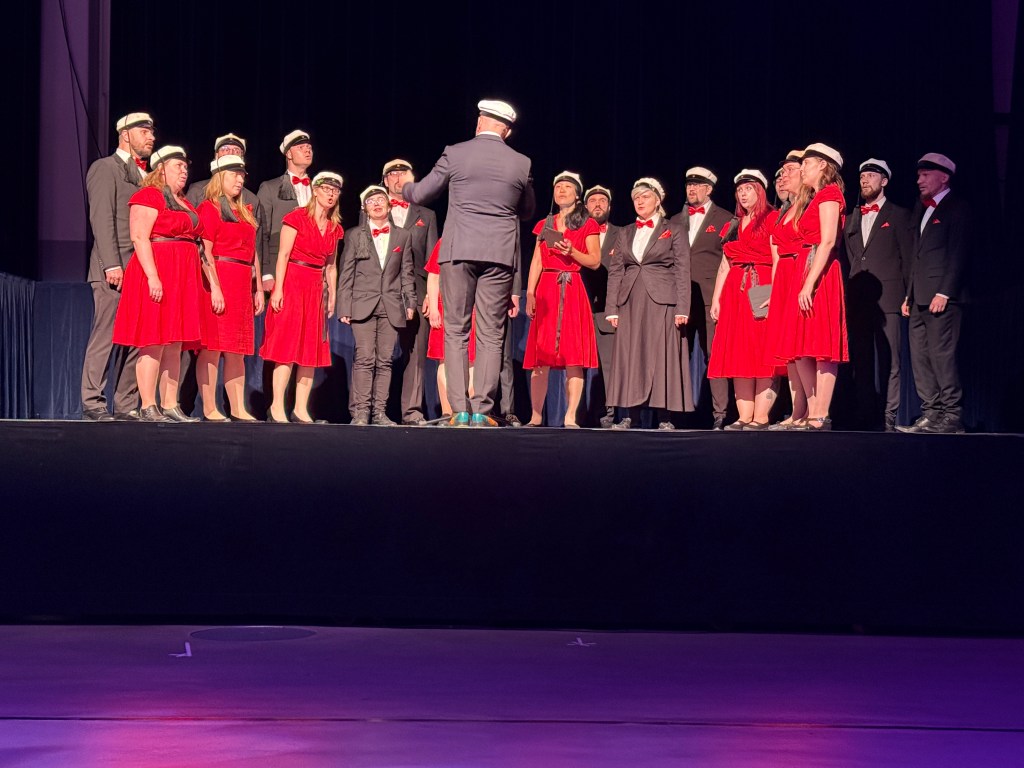
The awards were presented at the conference banquet – the entertainment was superb! Singing Finnish engineers – a whole choir of them – who knew?
I knew about Tom’s award, as I’d been pulling for this outcome for over a year. Yet, other outcomes of the conference were a complete surprise…
The Power of Collaborative Research: Winner of the Best Research Paper Award!
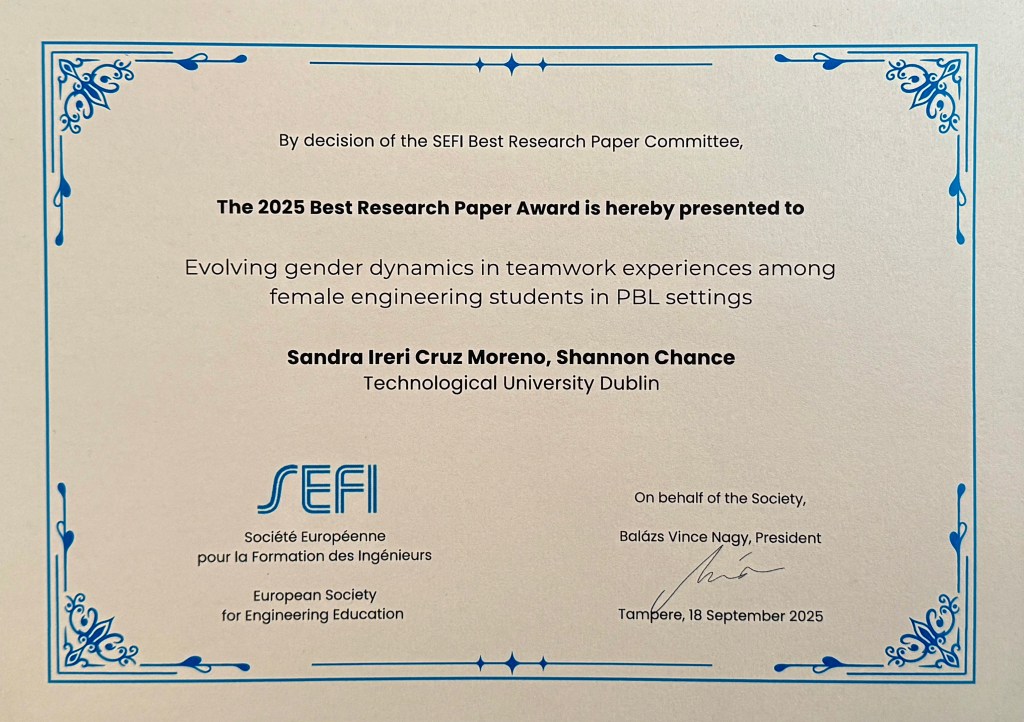
My PhD student, the incredibly talented and astute sociologist Sandra Cruz Moreno, won the BEST RESEARCH PAPER award for SEFI 2025. I serve as her supervisor and was the co-author of this paper.
The recognition for excellent research was deeply validating, especially since the paper, “EVOLVING GENDER DYNAMICS IN TEAMWORK EXPERIENCES AMONG FEMALE ENGINEERING STUDENTS IN PBL SETTINGS”, was nominated in three separate categories, each with its own panel of judges: Best Student Paper, Best Diversity and Inclusion Paper, and overall Best Research Paper.
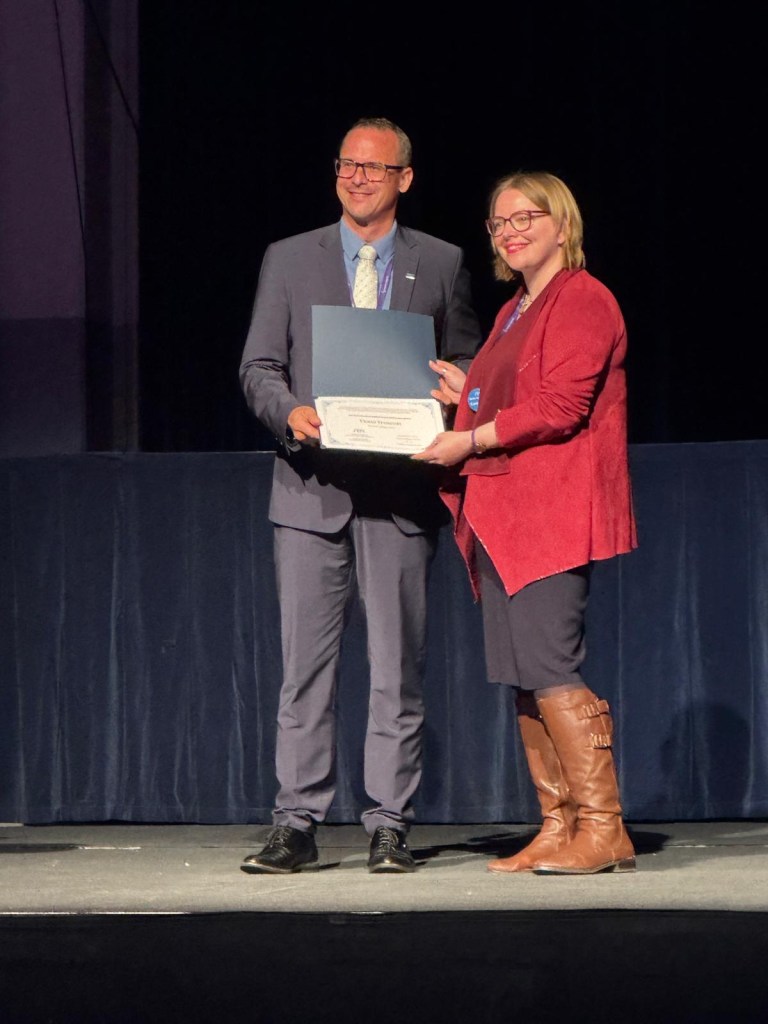
The certificateShannon and Sandra at an emotions symposium in Portugal
The paper reports one aspect of Sandra’s doctoral research, which has been funded by a First-Time Supervisor grant to me from TU Dublin. The funding allowed us to analyze the extensive interview data I collected since 2015.
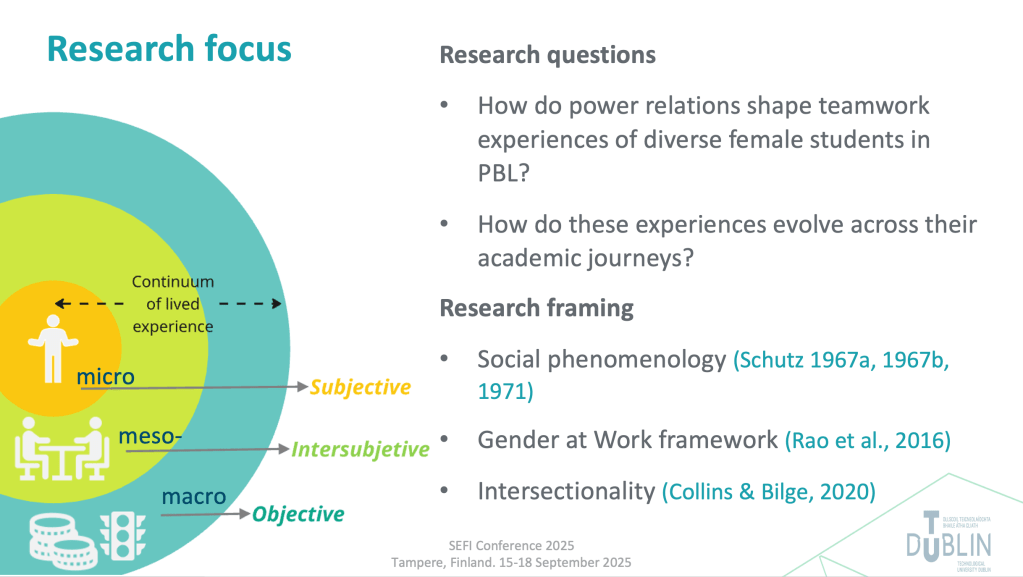
Sandra’s study is crucial for understanding inclusivity in engineering education. It employed a longitudinal, qualitative social phenomenological approach combined with an intersectionality framework. Using data from 41 interviews with 22 female engineering students from seven countries at TU Dublin, Sandra explored how diverse students navigate challenges and evolve strategies during project- and problem-based learning (PBL) teamwork across their academic journeys.
A key finding was that while students’ confidence and participation increased over time, the women persistently faced gendered biases and cultural norms that influenced their perceived roles and credibility in teams. For instance, they reported often being relegated to non-technical tasks like presenting or report writing, while feeling required to constantly prove their competence regarding hands-on skills. This analysis led Sandra to conclude that focusing solely on individual resilience is insufficient; systemic structural interventions are also needed to promote inclusive educational practices and challenge embedded norms.
I was honored to accept the award in Sandra’s absence, celebrating the resounding endorsement of her work. This recognition is truly a cherry on top of our successful 3.5 years of teamwork.
Cruz, S., & Chance, S. (Accepted/In press). EVOLVING GENDER DYNAMICS IN TEAMWORK EXPERIENCES AMONG FEMALE ENGINEERING STUDENTS IN PBL SETTINGS. Paper presented at European Society for Engineering Education (SEFI) Annual Conference 2025, Tampere, Finland.
Nurturing Community and Capacity
SEFI is always about nurturing the community, and I was pleased to contribute in several ways:
• Doctoral Symposium: I co-facilitated the full-day pre-conference Doctoral Symposium to support early-career researchers.
The 2025 Doc Symposium
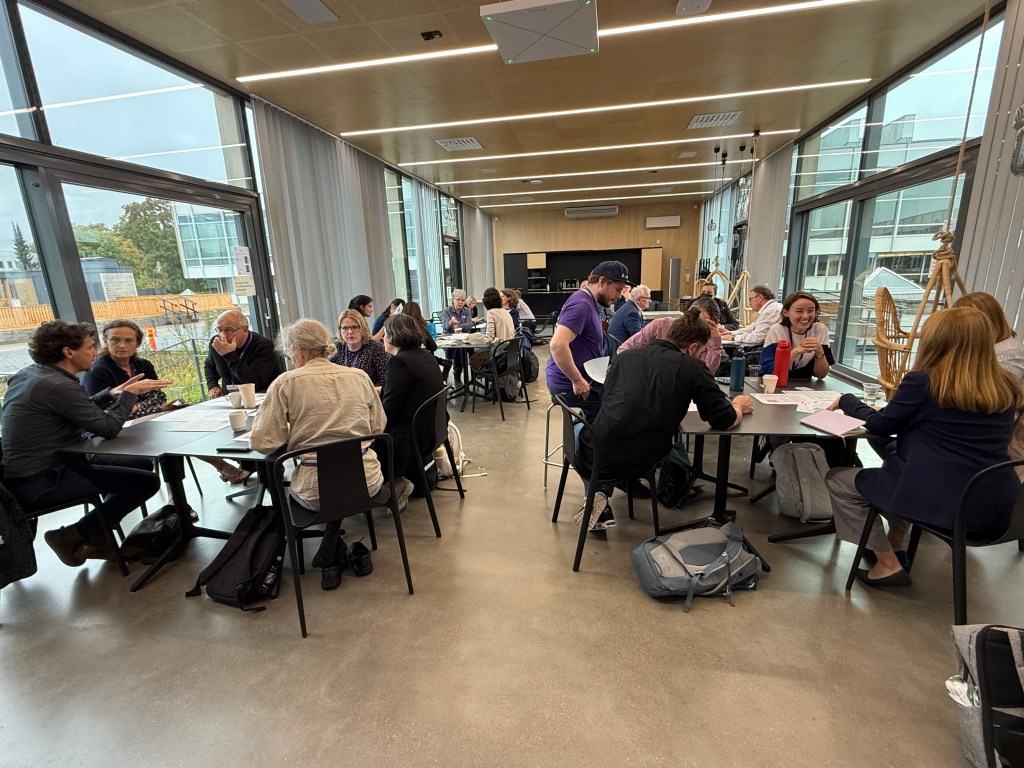
• Workshops: I delivered and co-facilitated multiple workshops, including one on integrating ethics into course delivery, a session on methodological approaches in Engineering Education Research, a workshop on the ethics of care, and a peer-review workshop for journal editors and aspiring reviewers.
The workshop I facilitated on intergrating ethics into your teaching
O’Gorman, L., Gwynne-Evan, A., Ridgeway, L., Rebow, M., & Chance, S. (Accepted/In press). ACCREDITATION CONSIDERATIONS IN ENGINEERING ETHICS EDUCATION: BRIDGING GLOBAL STANDARDS AND LOCAL PRACTICES. Paper presented at European Society for Engineering Education (SEFI) Annual Conference 2025, Tampere, Finland.
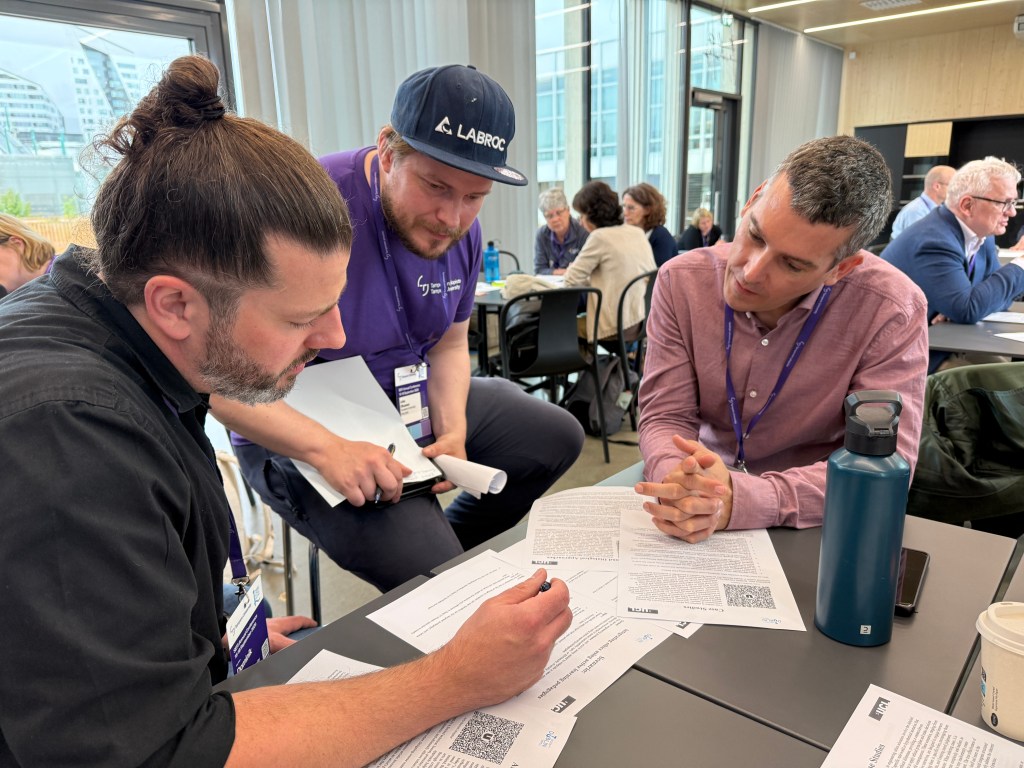
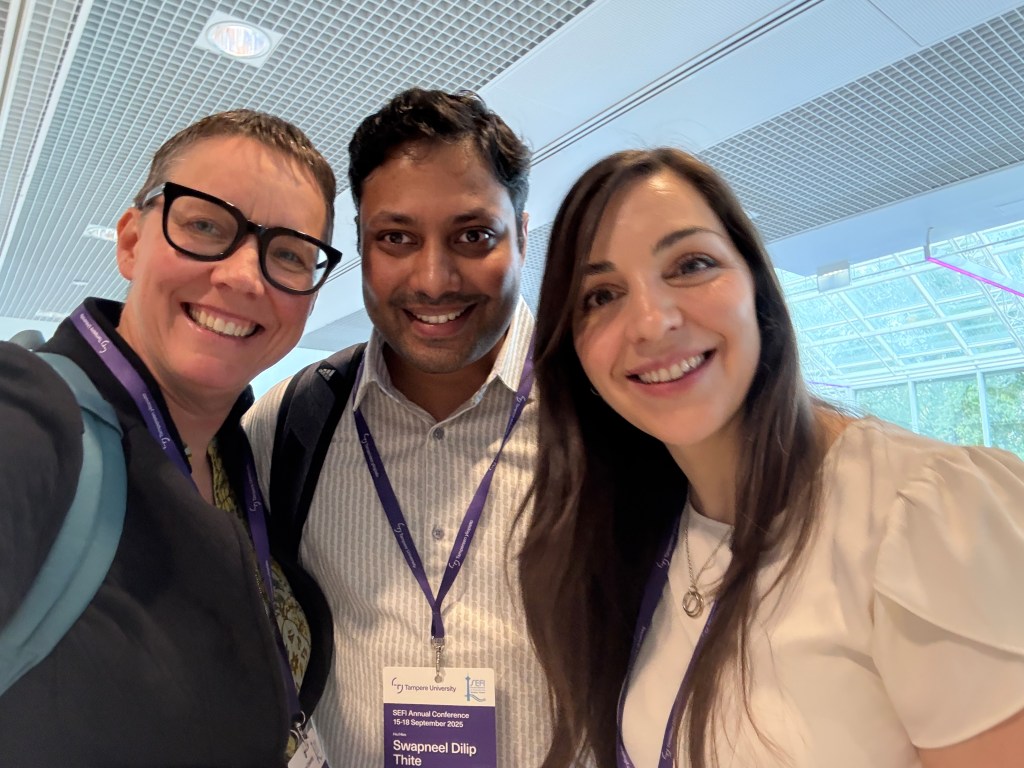
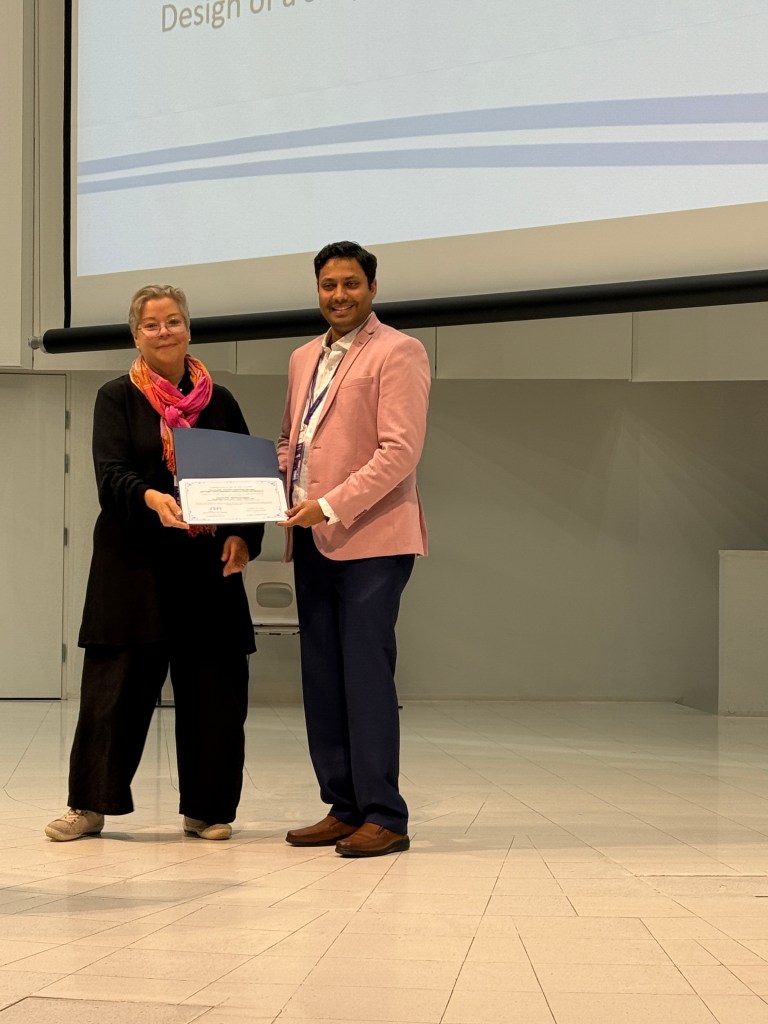
• Supporting Swapneel Thite: I had the immense pleasure of facilitating the attendance of Dr Swapneel Thite, a recent PhD earner. Swapneel won the prestigious Best Paper Award for Volume 49 (2024) of SEFI’s journal, the European Journal of Engineering Education (EJEE), for which I serve as Deputy Editor. He and his PhD supervisors published the “Design of a simple rubric to peer-evaluate the teamwork skills of engineering students” with us. Since I had already paid my registration fee, I was able to offer Swapneel the free registration given to me as a keynote speaker, helping him travel to SEFI to receive his award and meet the community. His paper, recognized for its rigor and practical utility (an easy-to-use instrument for peer assessment of teamwork), is well worth reading!
Meeting Swapneel Thite with SEFI incoming president, Emanuela TilleyKristina Edstrõm presenting Swapneel’s team’s award
Post-Conference Finnish Discoveries
The conference officially wrapped up on Thursday, but the adventures continued. I attended the SEFI Board of Directors meeting, worked with colleagues on planning future SEFI events, and then headed to Helsinki.
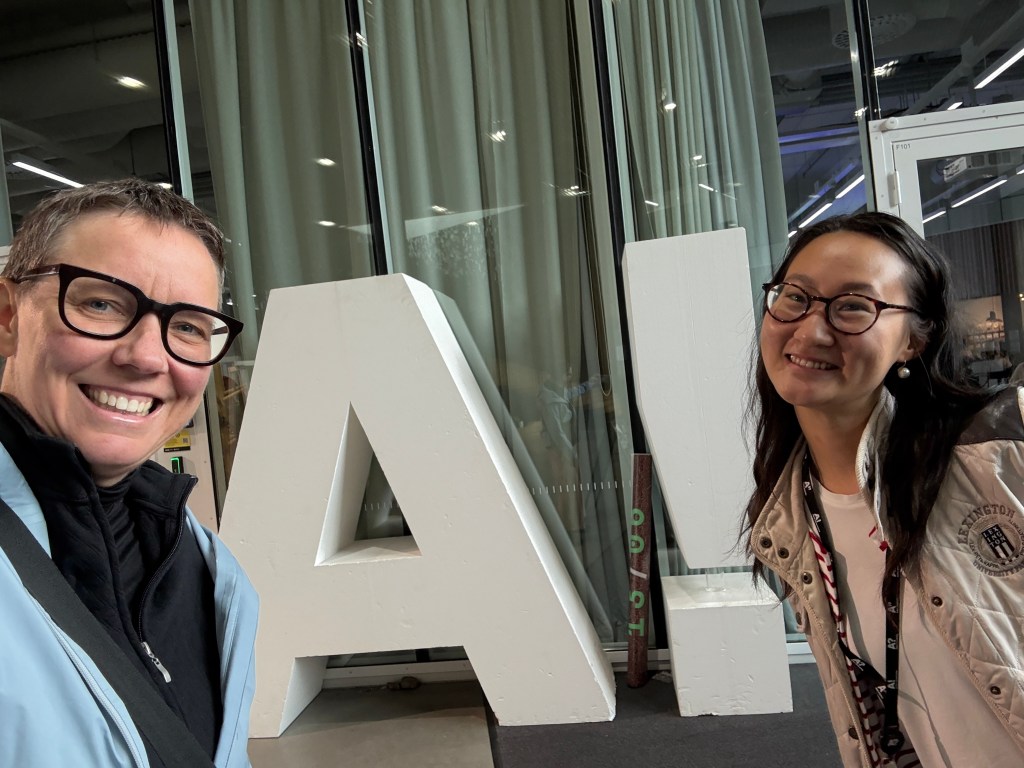
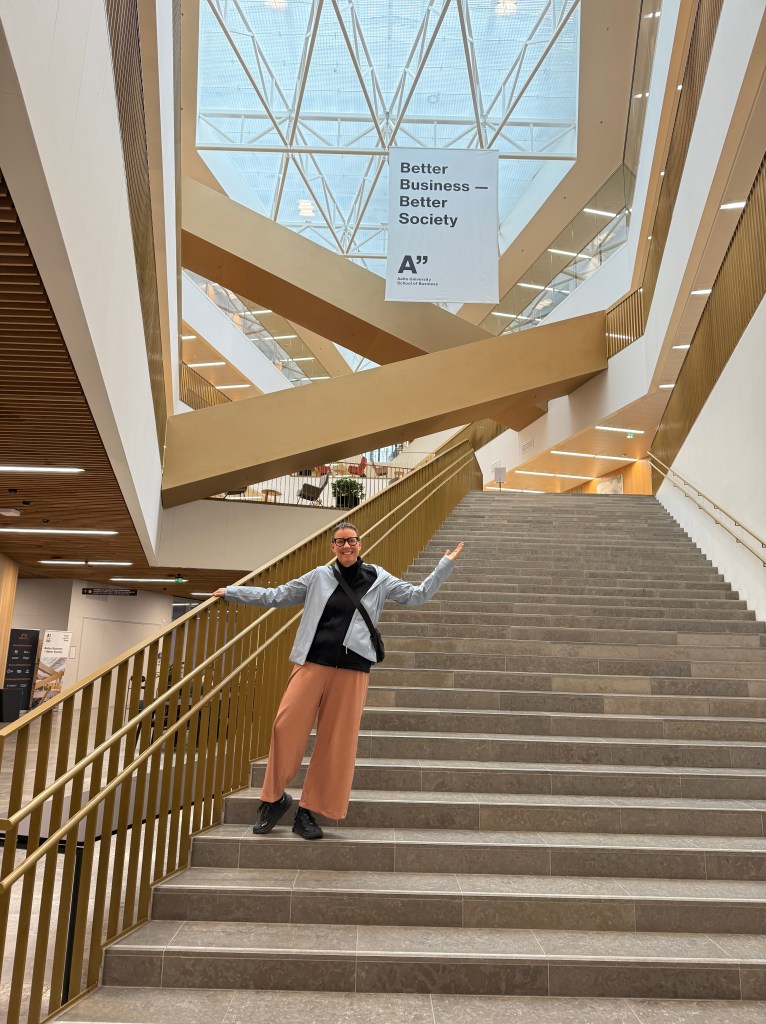
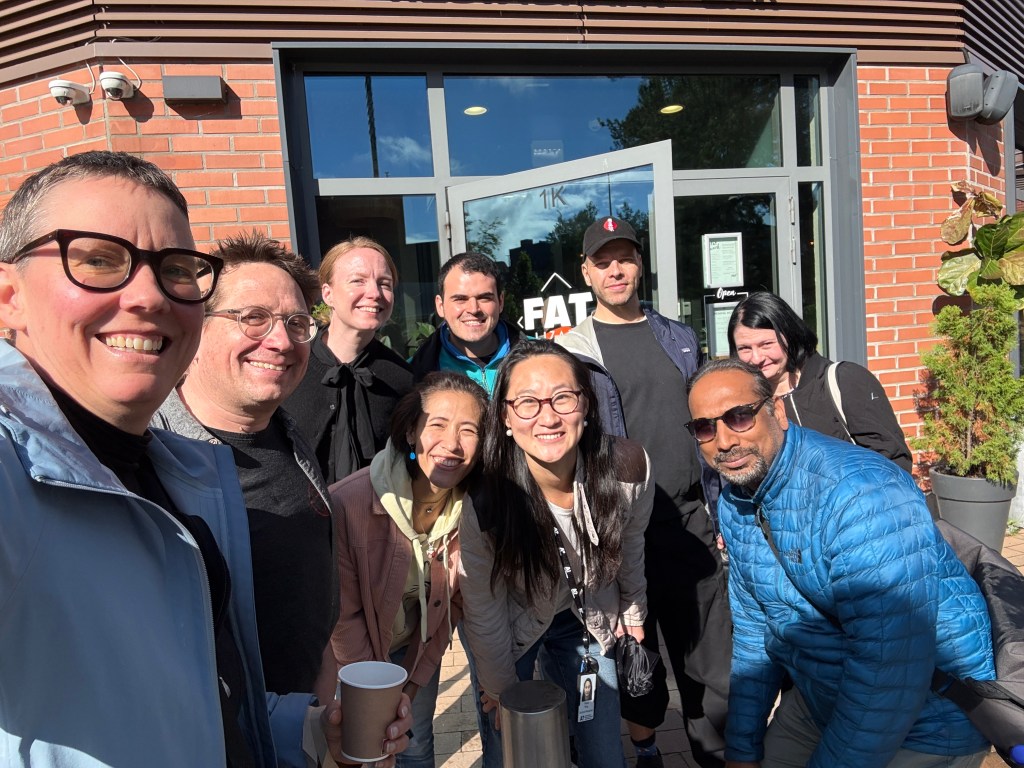
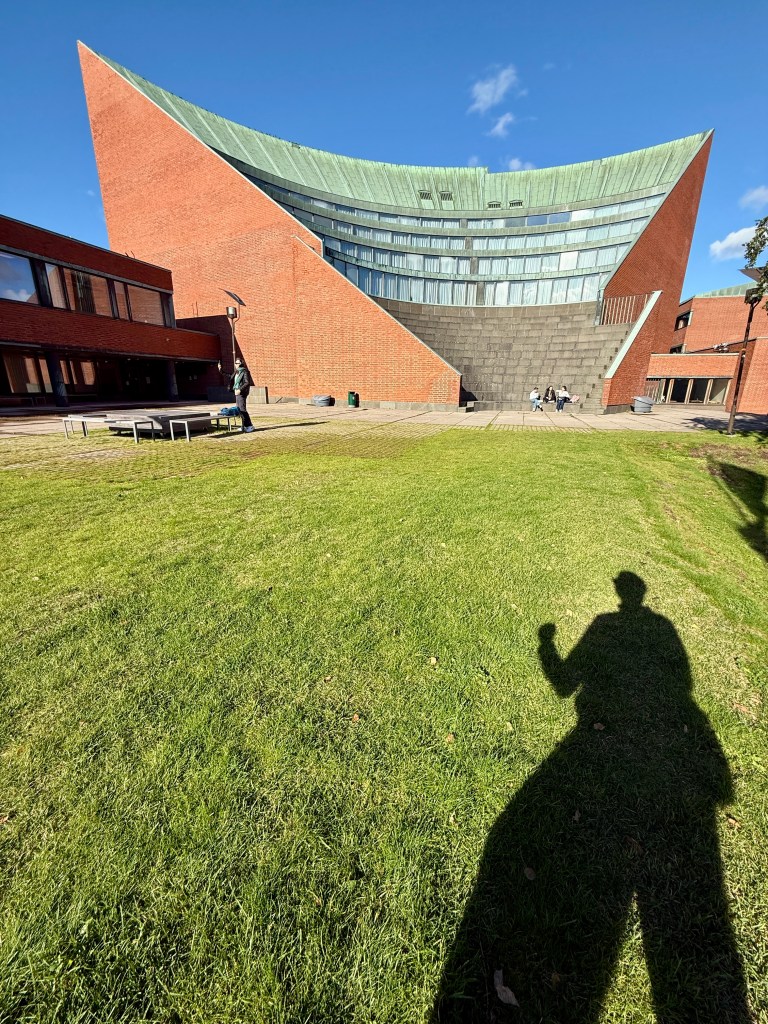
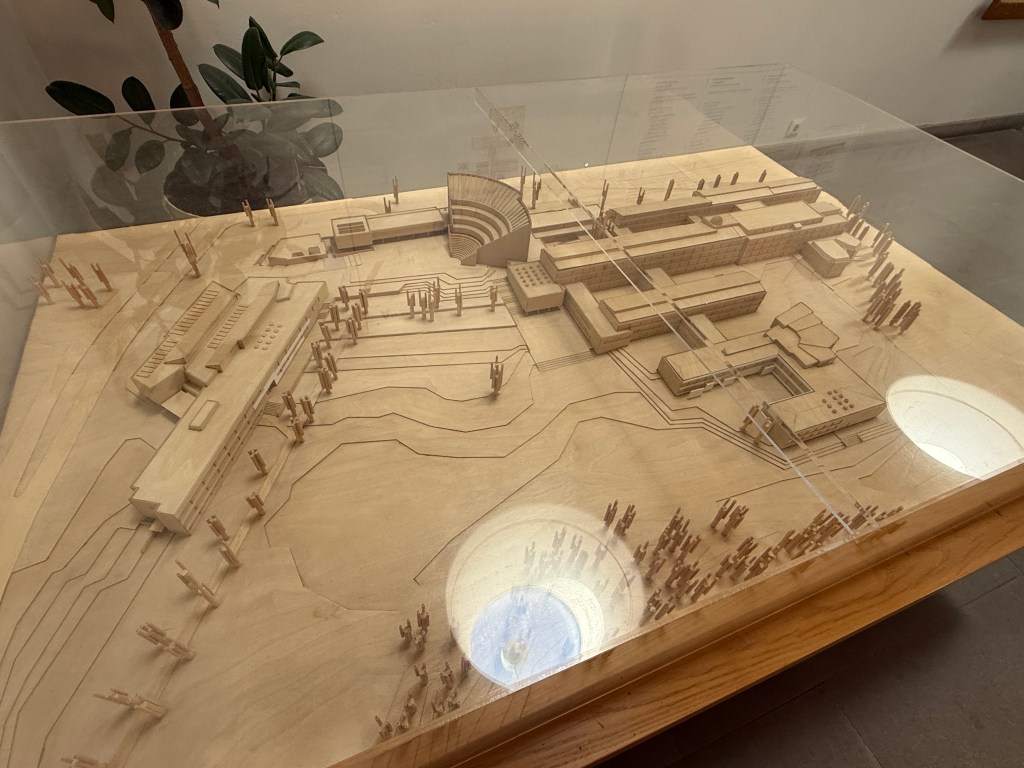
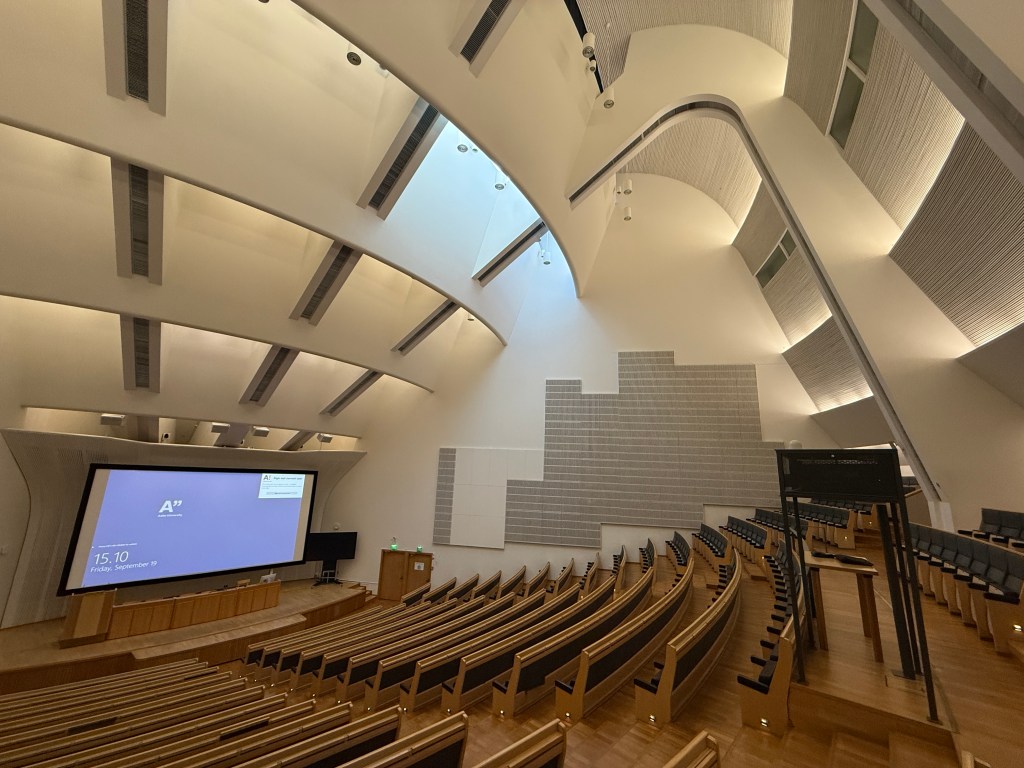
I spent Friday exploring Aalto University and meeting colleagues there. Dr Xiaoqi Feng provided a personal tour and connected me with her colleagues—a bittersweet moment as she prepares for her new job at TU Delft.
Snapshots from my day at Aalto University — thanks Dr Xiaoqi Feng for the personalized tour!
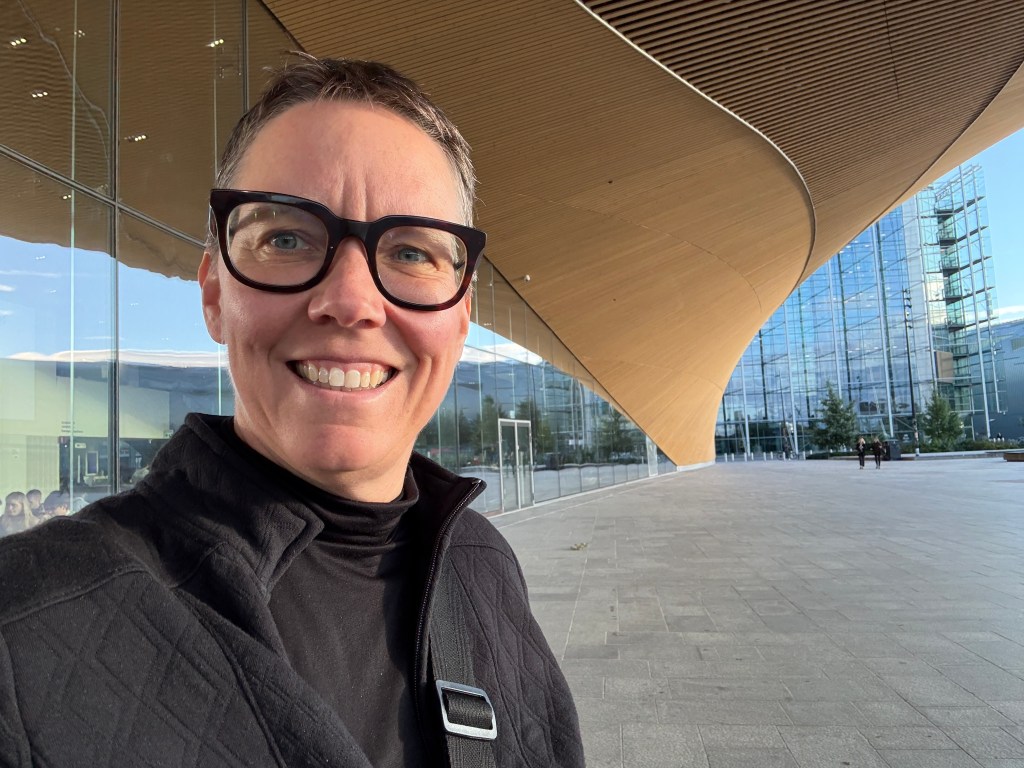
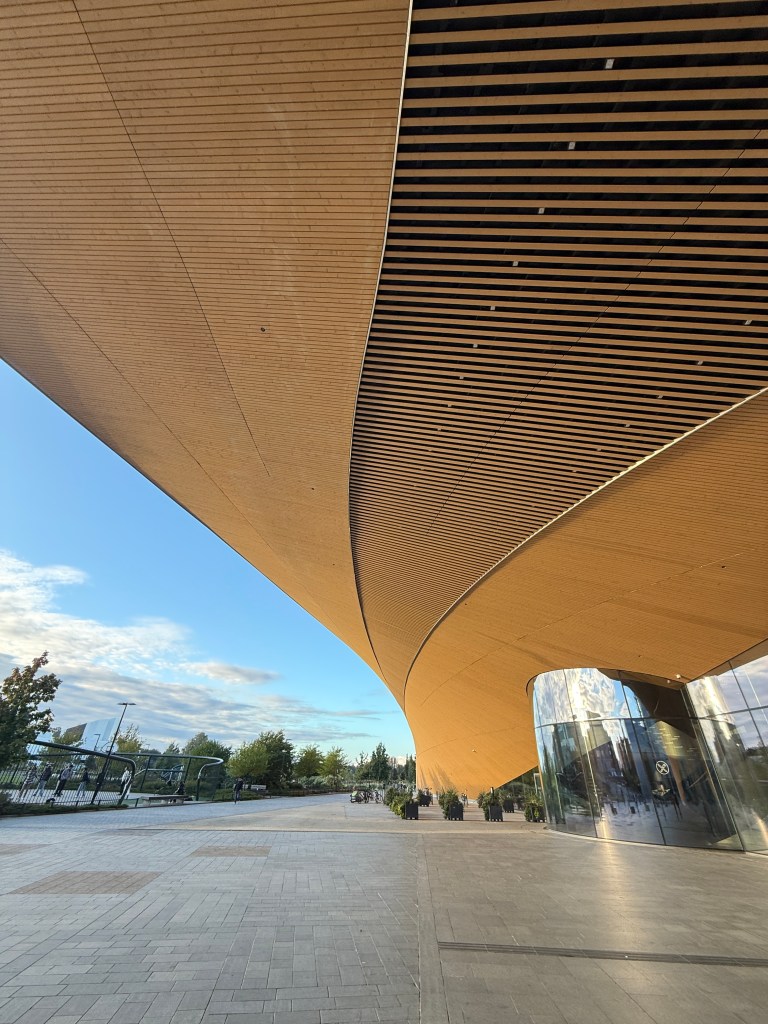
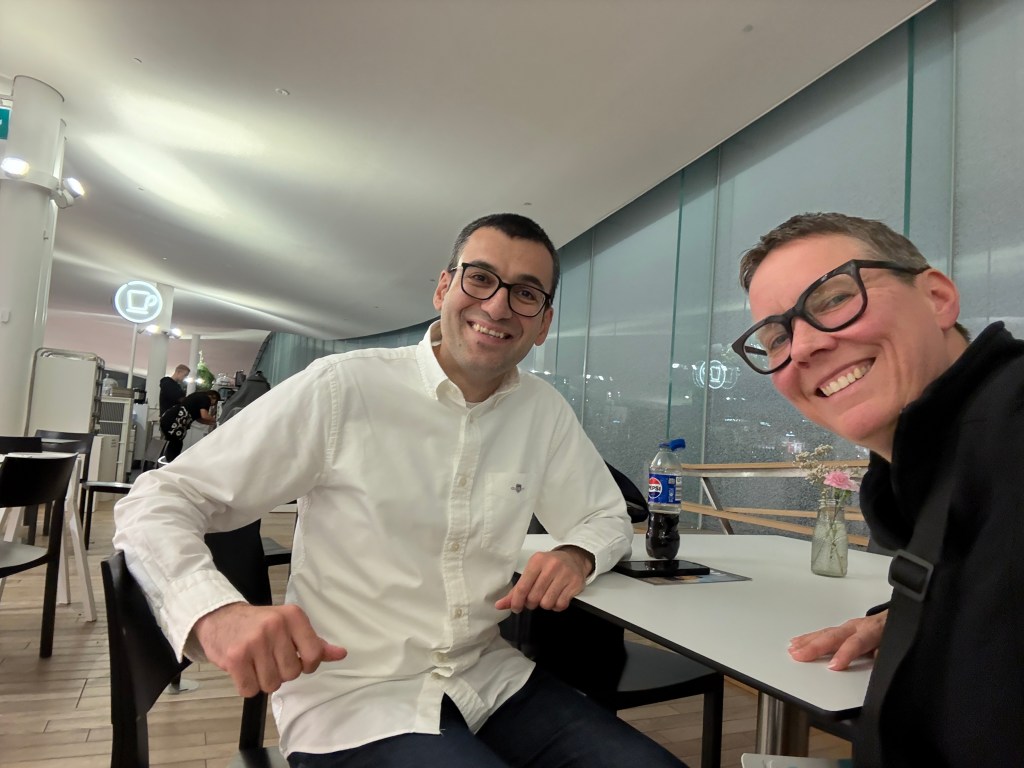
My Finnish travels culminated on a serendipitous high note when I ran into early-career researcher Yousef Jalali at the remarkable Oodi, Helsinki’s new Central Library. Moments like this—a chance encounter in a vibrant cultural space far from home—gave Yousef and me a chance to reflect on the conference and help support each other as “researchers on the move” who have relocated ourselves far from home in the pursuit of academic excellence.
What an amazing community of inspiring educators SEFI is!
Wrapping up the day at the people-magnet library, Oodi, in central Helsinki and rurring into Dr Yousef Jalali.
From celebrating major awards and delivering keynotes to fostering the next generation of researchers and exploring expressive Finnish architecture, this SEFI was truly a testament to the powerful, collaborative community we have built in engineering education.
For me, SEFI 2025 was such a celebration of community and collaboration.
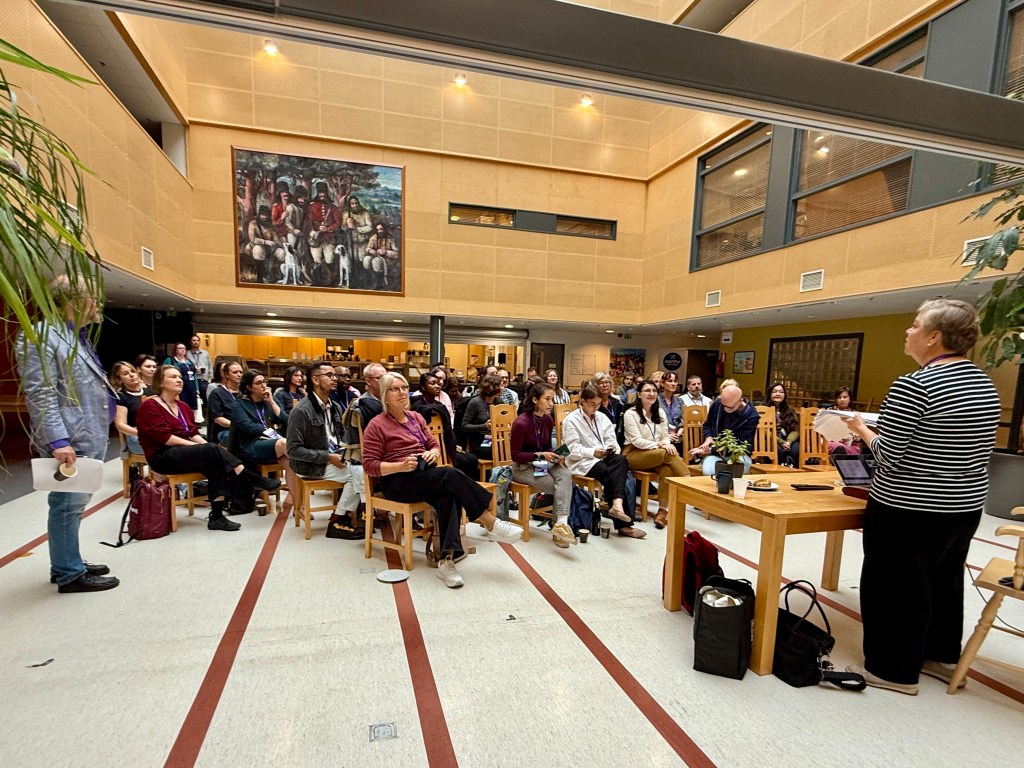
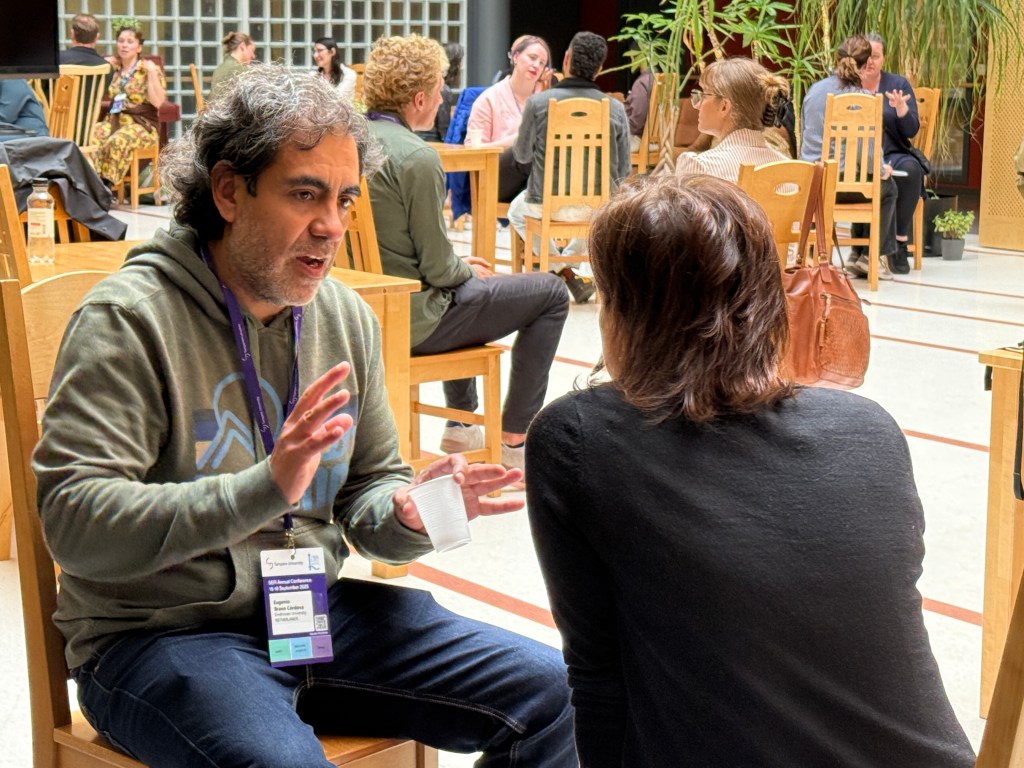
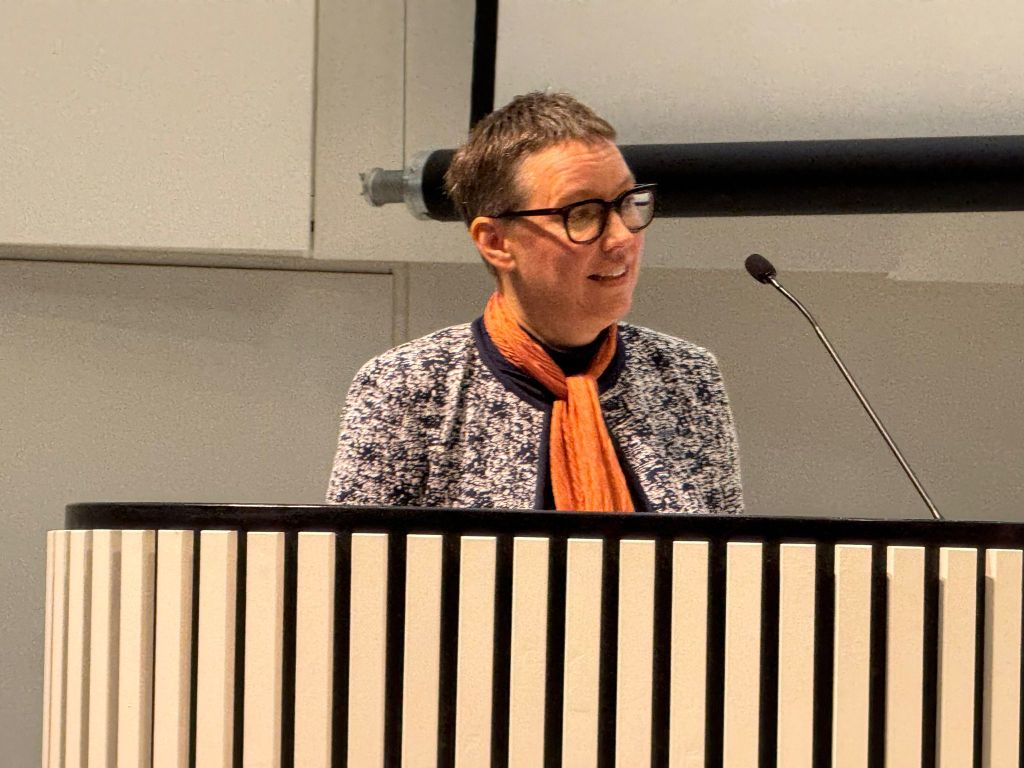
Practicing the keynoteDelivering the keynoteCelebrating our handbook authorsConferring with colleagues near and far — these two from the European University of Technology — I’ll be working with them on an event for December — stand by for news on that!
Looking forward to visiting Helsinki and Aalto University again soon!
The architecture teachers at KLE Tech are really enthusiastic about teaching and about learning to do educational research. A number of them attended the engineering education conferences held at their institution in January — the IUCEE conference on engineering teaching and REES, the Research in Engineering Education Symposium, which focuses on research about engineering teaching.
KLE Tech’s lovely Dipanwita Chakravarty was the most enthusiastic among them, delighted as she was to find an architect speaking on a panel at REES.
That architect was me! 🙂
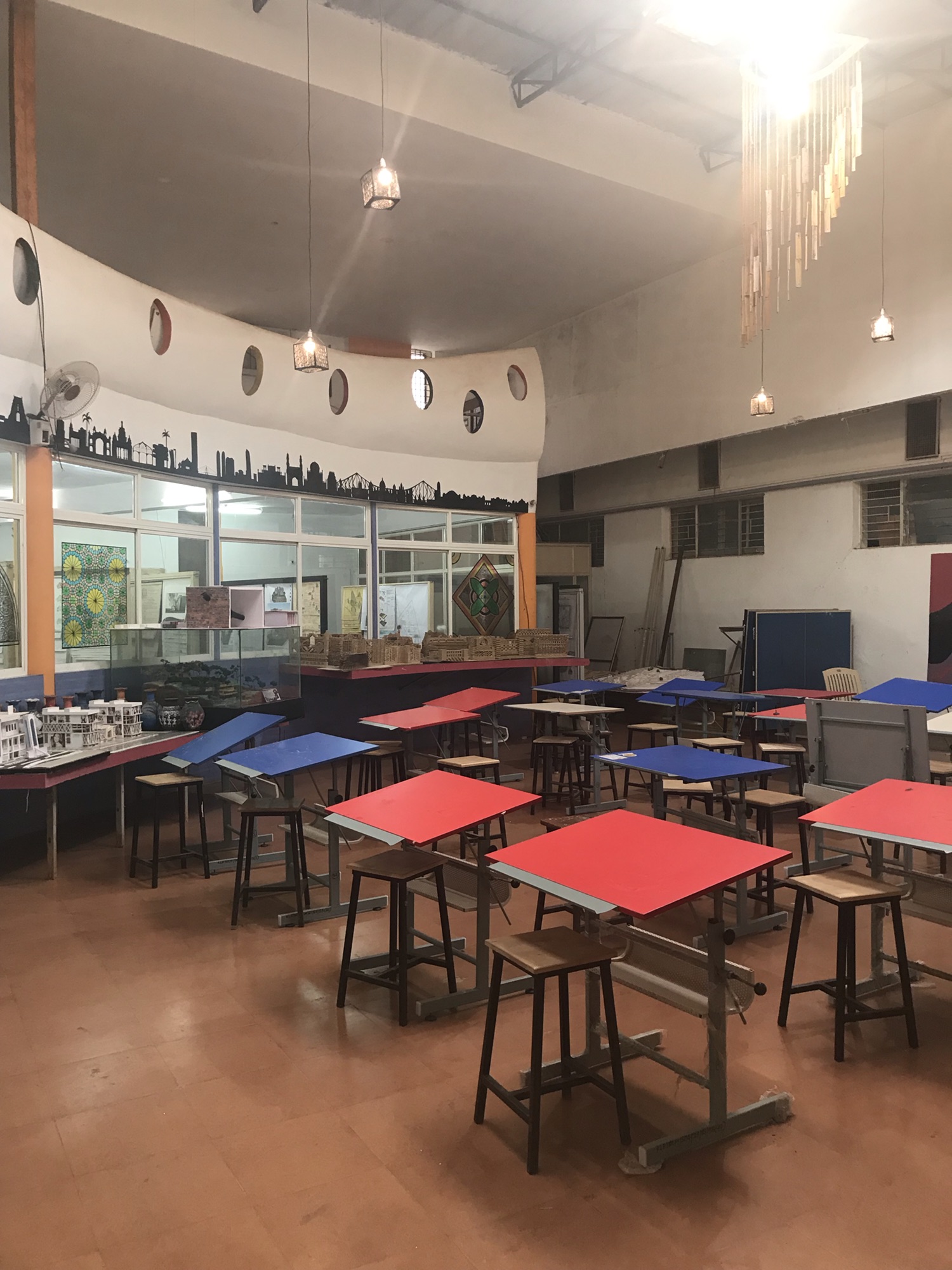
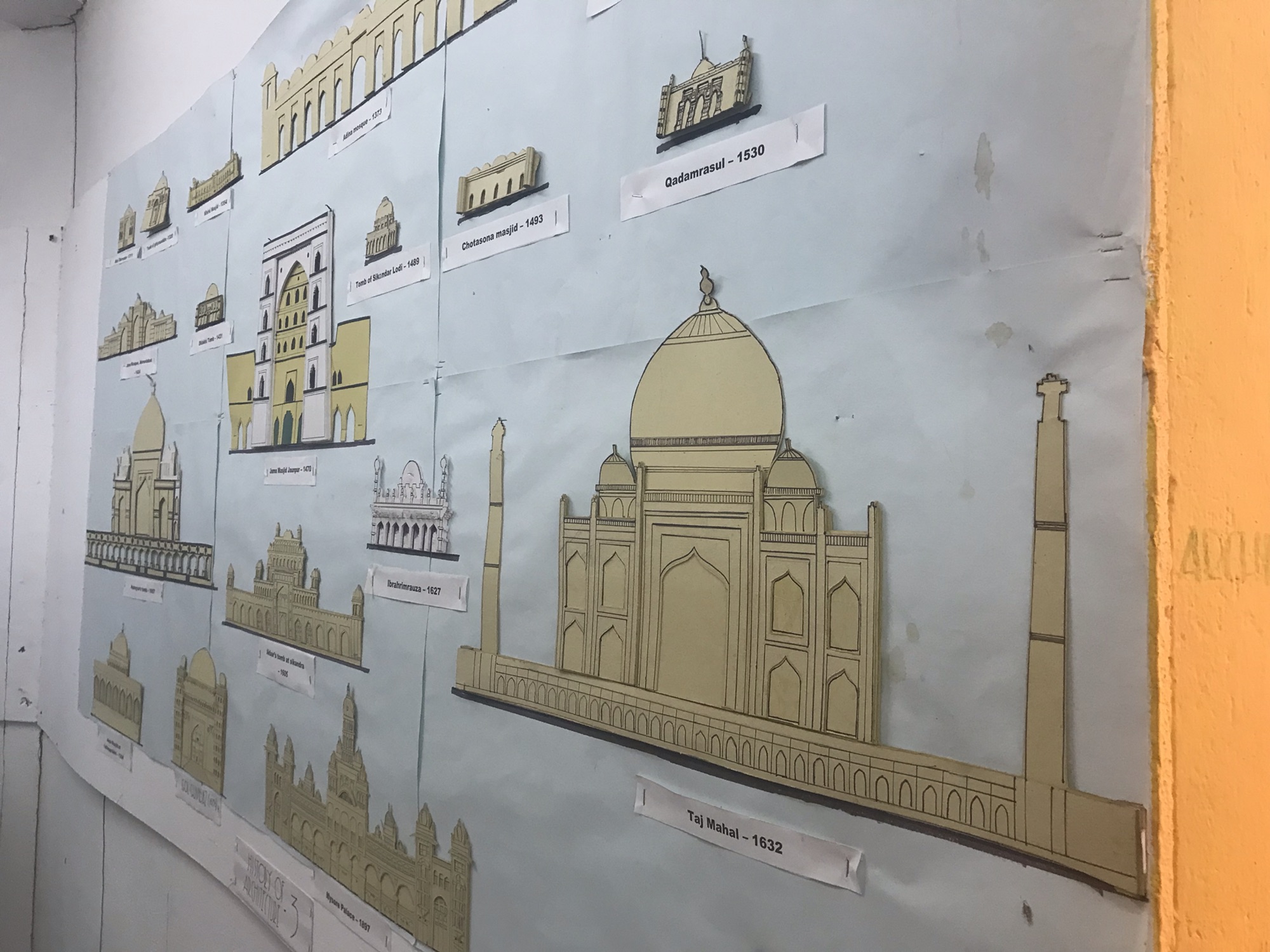
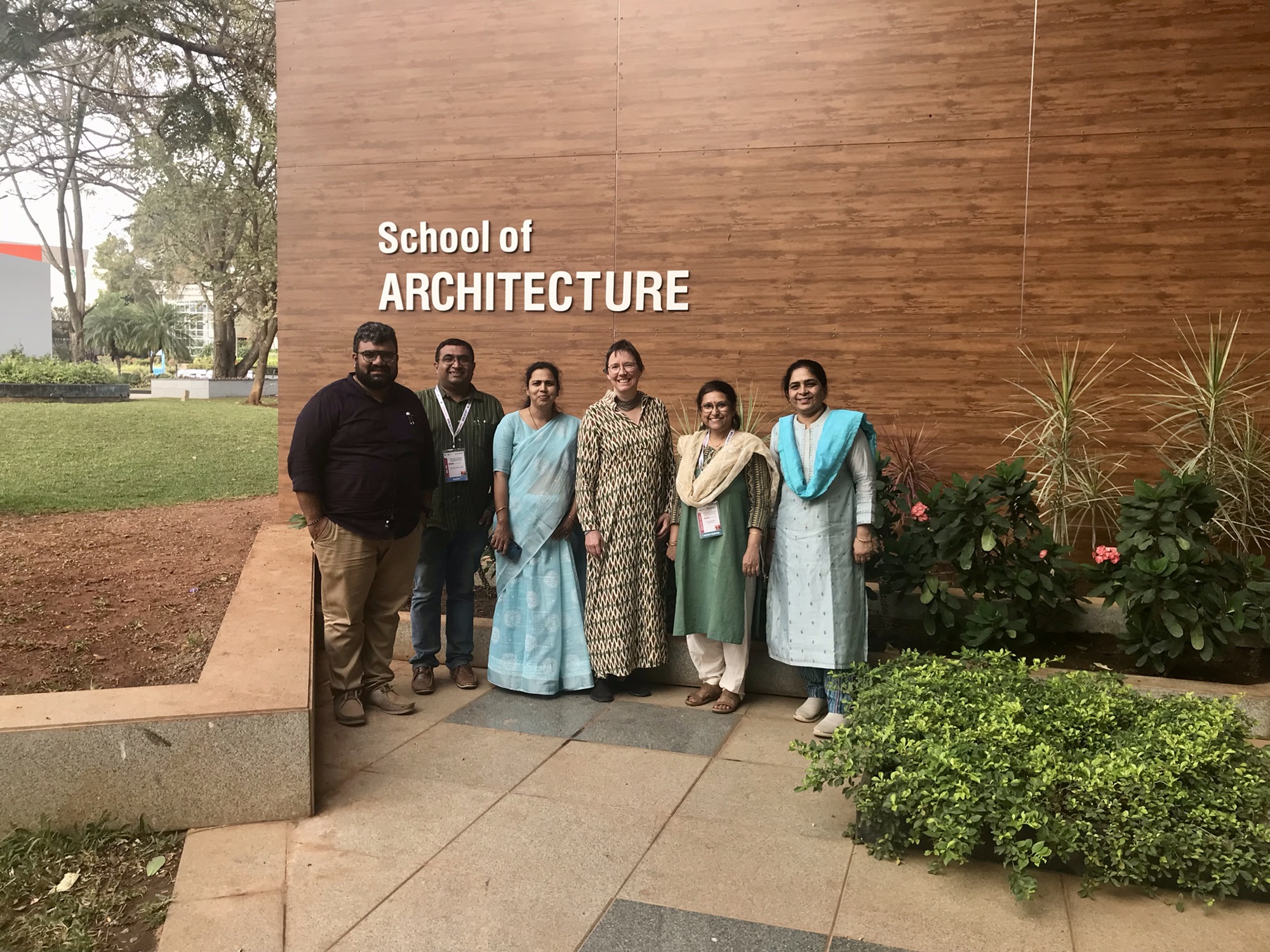
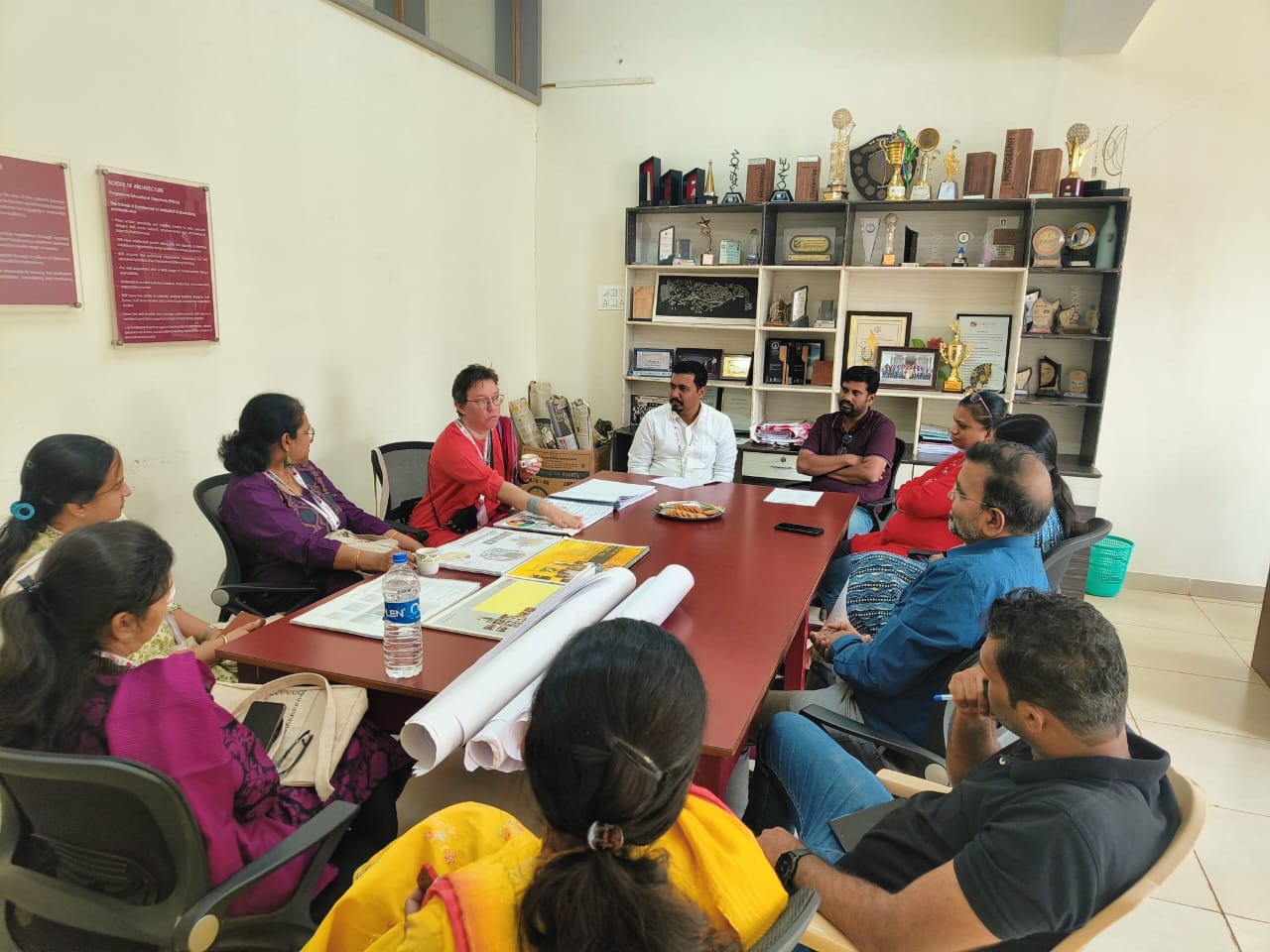
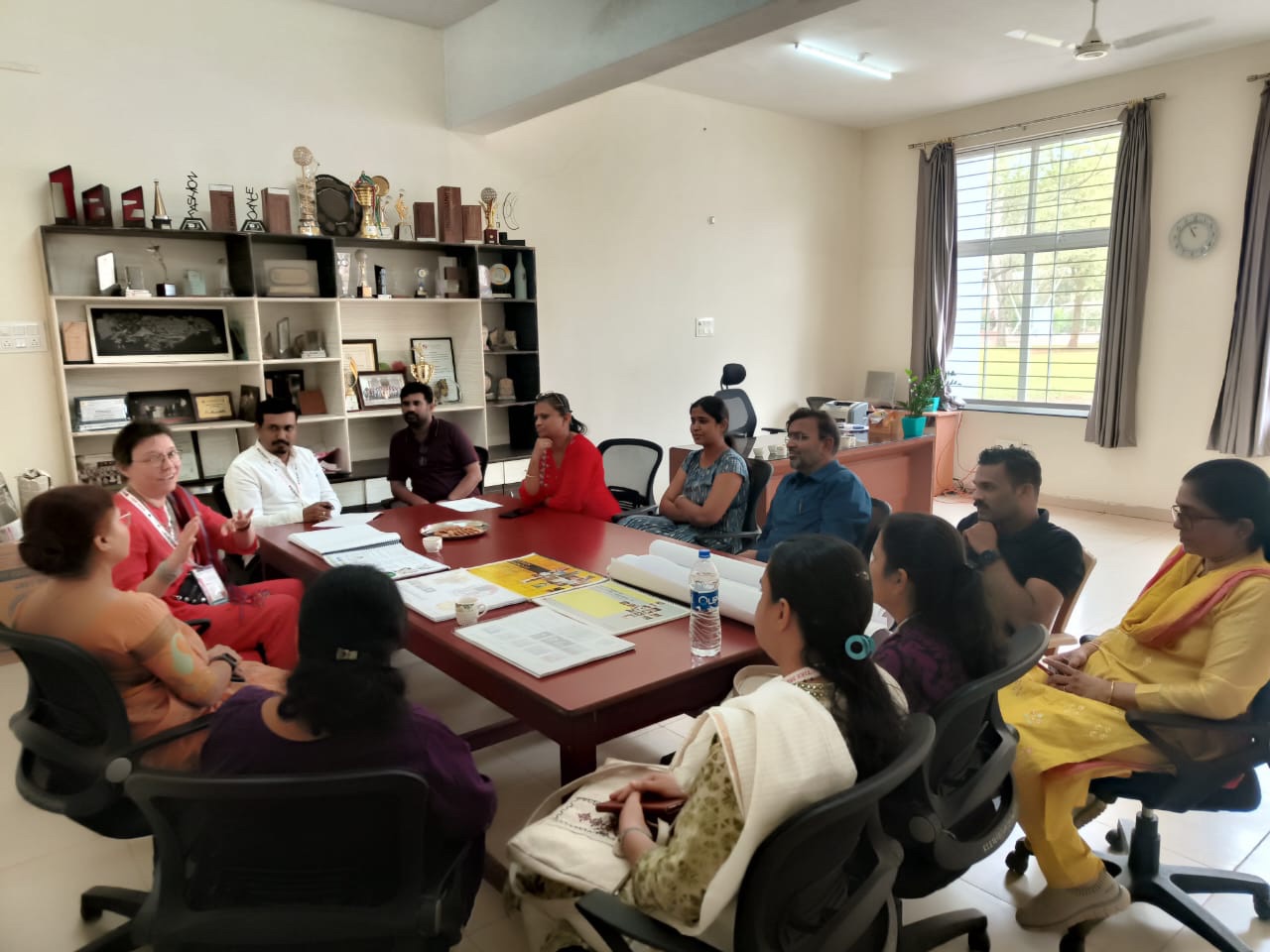
Dipanwita found me soon after I presented, asking me to meet her architecture colleagues. She spirited me away from the events at REES, to meet Deepa Mane and Rohini Mligi, tour a room archiving their architecture students’ work, and then meet even more colleagues for an animated chat about research and curriculum design. And tea! Such excellent tea!
Here’s a glimpse of that afternoon’s tour and interactions:
A classroom for hand drawing.It’s chock full of models and drawings by students.KLE Tech has an extensive archive of architecture students’ work.I found this size comparison of Indian temples very interesting!Seeing the work brought me to life!Rohini and I had a great chat.And Deepa took many photos of the tour with Dipanwita and Rohini.By the end of the afternoon, I’d exchanged ideas with architecture staff, including Rohini, Dipanwita, and Deepa.
In that initial discussion in their faculty boardroom, we talked about different types of research they are doing and their interests surrounding architectural accreditation.
They asked me to help them build momentum and capacity to do education research, as they were enjoying seeing work presented at REES but were not quite sure how this type of research would look in the context of architecture rather than engineering.
We decided we needed a group identity. We envisioned collaborating with the engineering education research center on their campus (which has its own building, as it’s the leader in this realm in India). We also envisioned becoming active members of India’s IUCEE (the corollary of ASEE or SEFI for India).
As a step forward, we asked Dr/Prof Vijayalakshmi M., one of the main organizers of IUCEE and this event, if we could start a special interest group for architecture (and design?) within IUCEE. She was supportive. She gave us the Indian head shake and said: sure, just get started, and let’s see how it grows!
Meeting with Dr/Prof Vijayalakshmi M. about setting up a special interest group in IUCEE.
It was a very satisfying exchange, and I returned to REES for the day, happy and energized. I toured KLE Tech’s building for technical engineering later that day alongside the always-smiling, always-energetic Dipanwita Chakravarty and my colleagues from near and far.
I received a welcome email from Dipanwita with a paper of hers that I am finally getting around to reviewing (there’s be so much to do since I returned home!).Dipanwita was an active participant throughout REES. Here, we were touring KLE Tech’s engineering research building during the Symposium.
The next morning, the architecture staff spirited me away again!
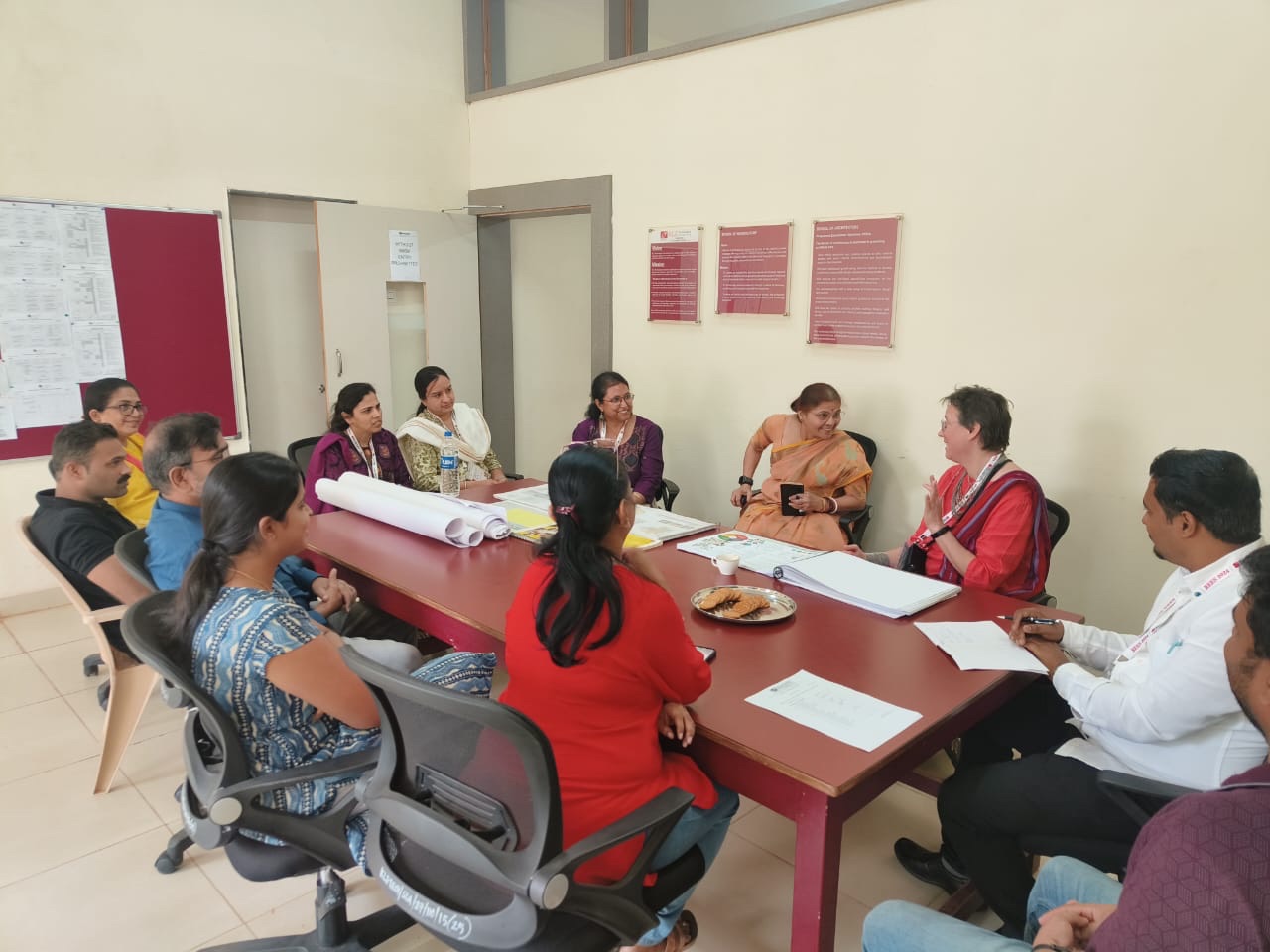
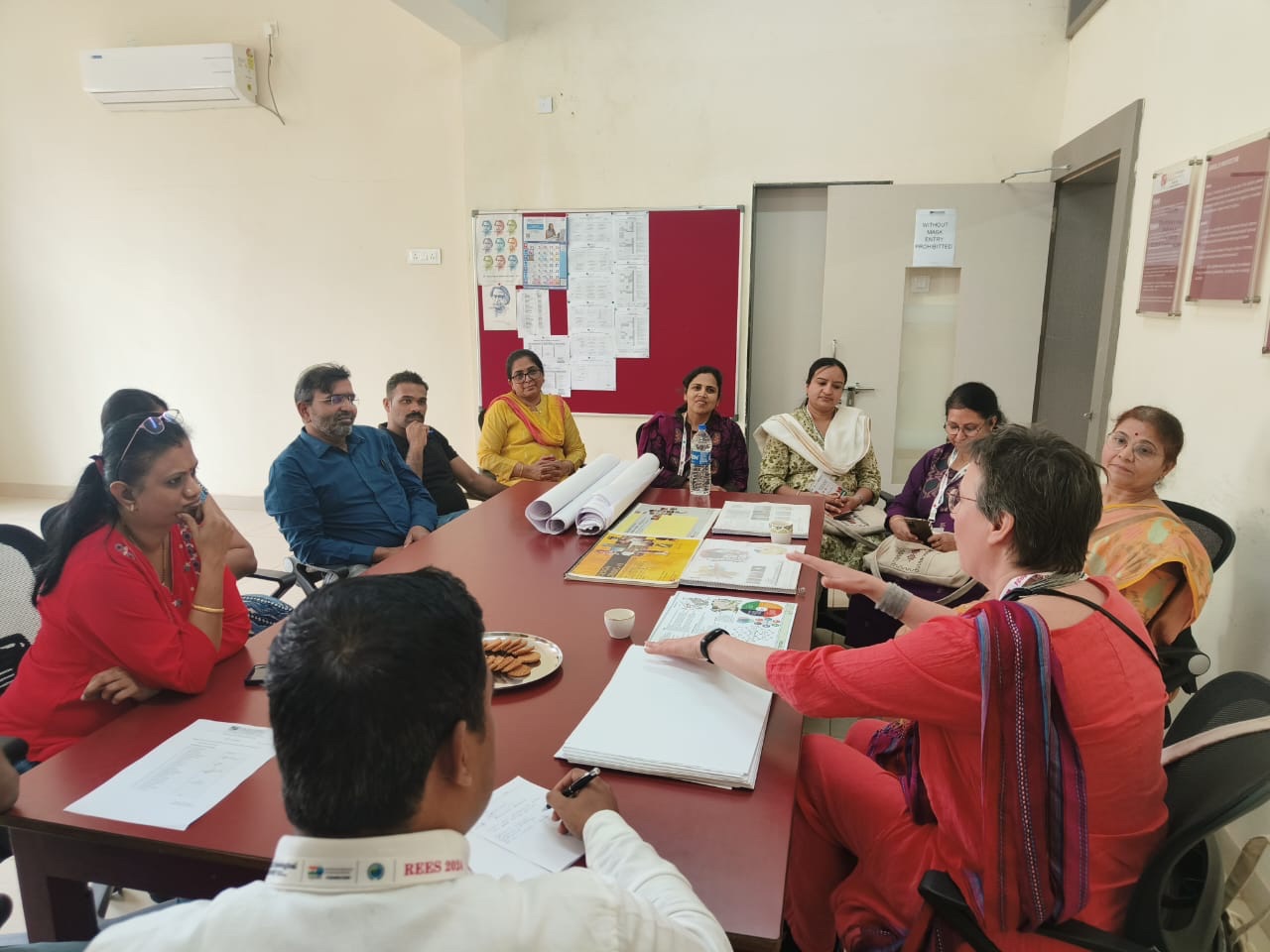
They’d assembled an even larger group to discuss what education research is, how education research differs from technical research on architecture and engineering (like the work they are already doing on thermal comfort and architectural heritage conservation), and how they can get started doing this new type of research.
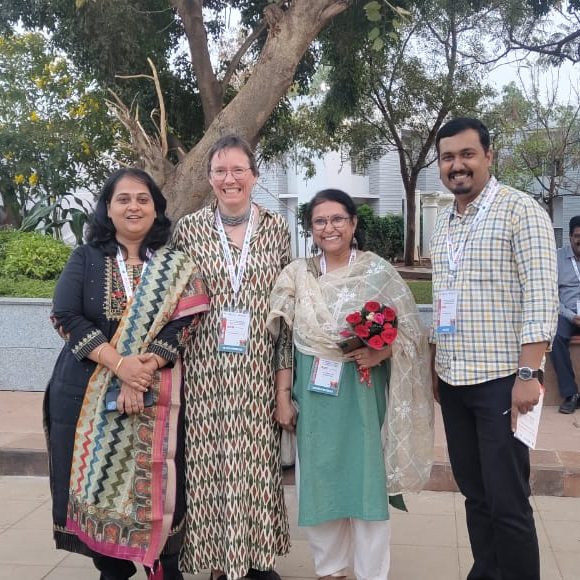
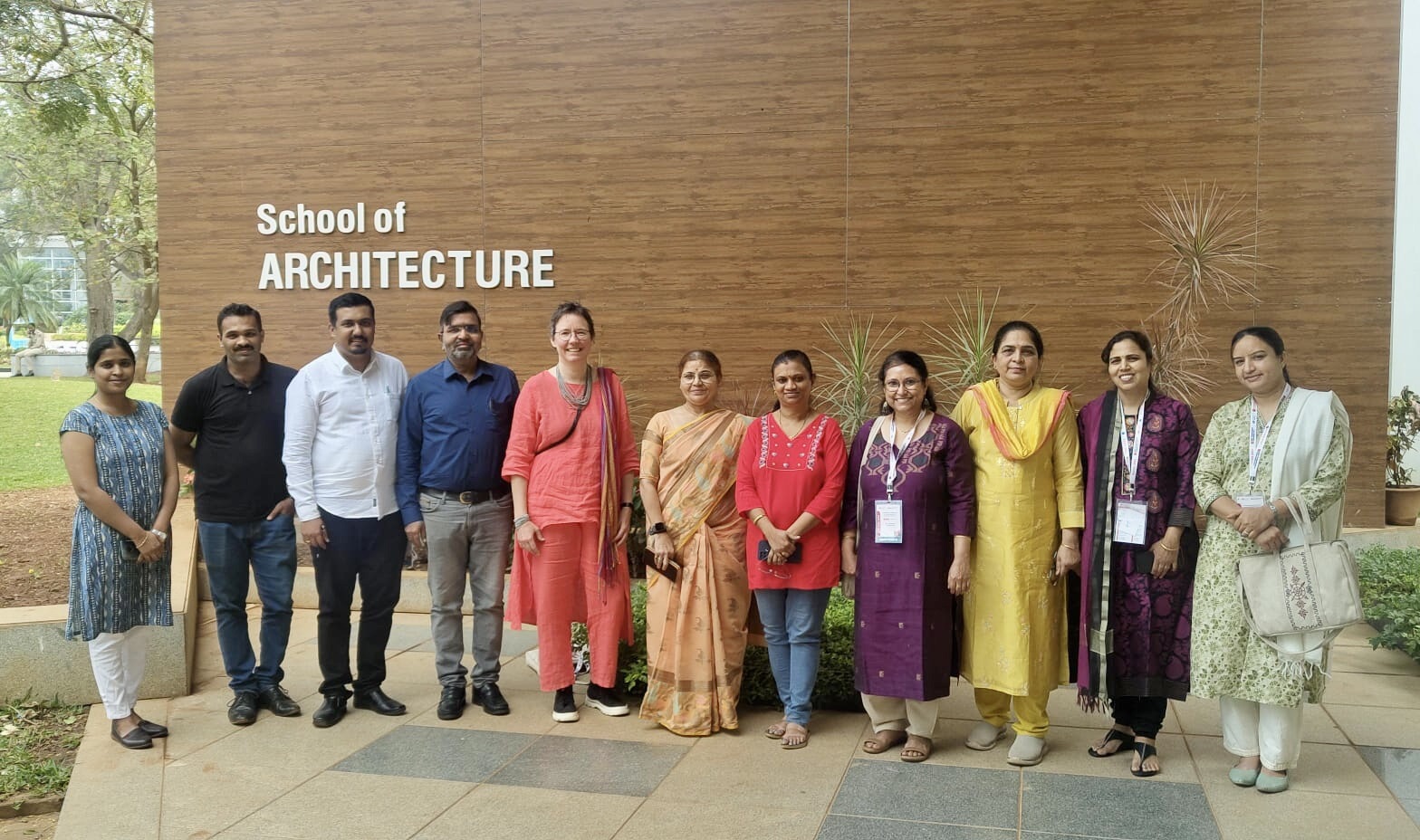
Here are the lovely photos they took of that impromptu seminar along with a photo of our whole group after that meeting.
You can see they made me feel like a rock star! The meeting was so much fun.
We’ve had a gap in communication since the conference ended, because I was on the lecture circuit (lol!) and then getting caught up back home and inducting a new cohort of BIM BSc students.
But my KLE architecture colleagues and I plan to hold online meetings in the near future to discuss examples of educational research in architectural education. I’ve agreed to help them envision, plan, and get started conducting education research.
One of the architects in the group emailed me later, asking me to share my own examples.
Reflecting on this request, I fear my own examples in this realm pale in comparison to my engineering education research. Architecture teachers tend to publish conference papers showing how they taught their class, and of these, my favorite among my papers reporting what might (optimistically) be called research-informed teaching or the Scholarship of Teaching and Learning (SoTL) would probably be Writing Architecture: The Role of Process Journals in Architectural Education and Beginning with Site in Architectural Education.
However, engineering education research is more rigorous than SOTL.
Although ‘engineering education’ conferences will allow the publication of reports on ‘how I taught my class’, the ‘engineering education research’ journals want empirical research studies. You have to collect and analyze data in a rigorous way. An example of this type of work is the book chapter Designing the Identities of Engineers, for which I collected surveys and compared results statistically between ‘engineering’ and ‘engineering technology’ students. The biggest difference I found, and my team reported, was that the ‘engineering’ students envisioned themselves as designers, whereas the ‘engineering technology’ students did not.
My primary research group, the European Society for Engineering Education (SEFI), embraces architects as if they are engineers, which is a reason I identify so strongly with SEFI. Yet, SEFI doesn’t have a special interest group in architecture or architectural engineering, even though the American Society for Engineering Education (ASEE) does have an Architectural Engineering division. ASEE’s Journal of Engineering Education rarely publishes research on architecture education.
In contrast, SEFI’s European Journal of Engineering Education, for which I am Deputy Editor, has been reviewing an increasing number of articles on architecture and construction-related topics in education. I suspect that’s partially because I have the interest, capacity, and collegial networks to help support such articles’ review, refinement, and publication. But I also have amazing mentors in my Editor-in-Chief, Dr. Kristina Edström, and co-Deputy Editor, Dr. Jonte Bernhard. They are encouraging me to build capacity in this realm. And they understand that building the cadre of reviewers with expertise in this area takes time, patience, and much enthusiasm!
Our merry band of editors has ample patience and enthusiasm!
A past EJEE editors’ dinner in Dublin, with Dr. Kristina Edström and Dr. Jonte Bernhard (right), me and Diana Martin (soon to be appointed Associate Editor after impressing Kristina and Jonte!).
[Edit after posting: SEFI just launched a new journal that does publish SOTL papers, see: https://sefi-jeea.org/index.php/sefijeea/announcement/view/1! It says, “The SEFI Journal of Engineering Education Advancement offers a route to share ideas, emerging research, practice experience and innovations in the engineering education field.”]
In reflecting on what publications I have of my own that truly relate to architecture, I have identified Using Architecture Design Studio Pedagogies to Enhance Engineering Education as a favorite of mine. Unfortunately, it isn’t easy to find on search engines and the platform to download it is far from user-friendly. It doesn’t get the attention it deserves, but you can download it by clicking the title and see how you like it!
Another relevant work of which I am very proud is Comparing the meaning of ‘thesis’ and ‘final year project’ in architecture and engineering education. Yet this paper is more conceptual than empirically based and, thus, isn’t the best place to start the discussion with my colleagues at KLE Tech. I am delighted to report that it’s garnered nearly 1300 views since it was published, just 5.5 months ago.
A good place to start our discussion might actually be Comparing Grounded Theory and Phenomenology, an article I think is one of my best but has a very long and obscure title that I haven’t bored you with here!
My KLE Tech colleagues have a keen interest in architecture accreditation. These days, I am more engaged with engineering accreditation than with architecture accreditation (having uploaded a conference paper earlier today on engineering ethics accreditation, in fact). But in the past, I’ve been quite involved with the USA’s National Architectural Accrediting Board (NAAB), and my colleagues at KLE Tech are using NAAB’s guidelines to help them structure their programs. One day, they may seek affiliate designation from NAAB.
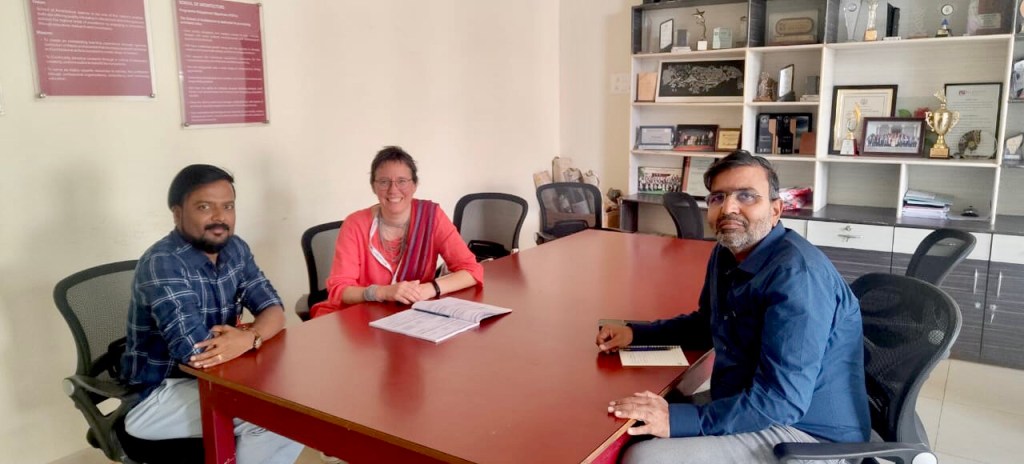
Near the end of REES, I found myself again spirited away to the now-familiar meeting room of KLE Tech’s architecture building to discuss accreditation options with Sharan Goudar and another colleague.
Discussing accreditation with Sharan Goudar (right) and colleague.
A text from Sharan encouraged me to finally craft this blog post, in fact. He responded to my recent blog Why India? Inspired by IUCEE and KLE Tech with a request for me to remember the architects:
A friendly text from Sharan Goudar.
Like Sharan, I, too, cherished the moments were shared in Hubli and I look forward to opportunities for more such moments, and a bit of hard (but fun and rewarding) research work, to boot!
My work with VIT Chennai and Dr. Nithya Venkatesan of the Internationalization Office may enable another trip to India, and I will make every effort to include a flight across to KLE Tech’s architecture department while I’m there.
These KLE architecture teachers are lovely, lovely people, and I look forward to getting to know them better and collaborating with them in both research and teaching.
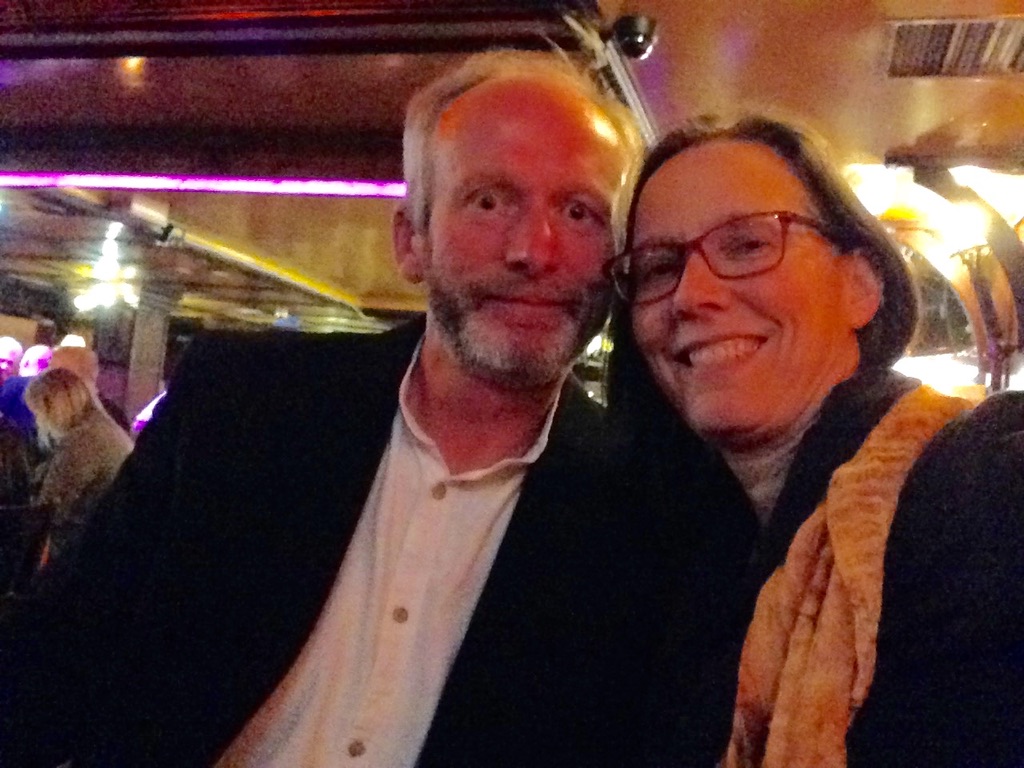
If you’ve known me long, then you have gotten to know my partner, Aongus, over the years. It’s likely that you know we like to enjoy life and have a good time….
Since our very first date back in 2016…Through our adventures living in London…Travelling the world and…Staying fit…And always trying to have some fun!
But you also likely know we’re hard workers! We love learning new things, stretching, and exercising our skills.
Today, I am taking the opportunity to brag about this lovely fellow.
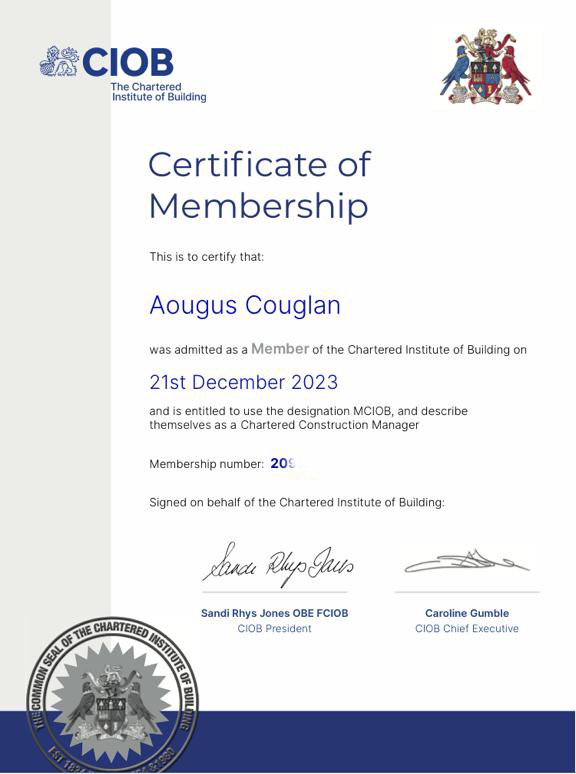
He started working on a new credential during the Covid lockdown, earning it just before Christmas. He’s now officially a Chartered Construction Manager and a full Member of the Chartered Institute of Building in Ireland and the UK. He gets to use the letters after his name:
Mr. Aongus Coughlan, MCIOB
This is the equivalent of a bachelor’s degree in the European system (the Level 7 ordinary bachelor on the Irish framework), so it represents a boatload of work. When he sat for the five-day exam, he did so well that they bestowed the designation of distinction, but earning this full credential required much more than just passing that exam. He also had to document his experience in detail, and pass high levels of scrutiny.
I couldn’t be prouder of Aongus!
He’s an all-around fabulous guy. He’s always thoughtful and considerate. He’s a great cook and a deeply caring companion. He’s good-natured and kind, never pouts, and always carries his own weight at home and at work.
And now the world knows he’s also an excellent manager!
Well done, baby! Studying is a very good look on you!
You might be asking yourself why I went to India at the start of the New Year. As you may recall, I served on the global Research in Engineering Education Network (REEN) for five years. During that time I chaired REEN’s governing body but before I started chairing I served on a sub-committee to recruit and select host/locations for our Research in Engineering Education Symposium (REES).
Hosts of REES 2024 (and the upcoming REES 2025 that will be in El Paso). Can you feel the energy?IUCEE award winners for 2024. Sooooo many working in Idnad to improve engineering education!
REES is generally held every other year, and we go to locations around the globe. REES is a way to meet new people, extend our networks, practice new research skills, and share what we find as we research engineering education. The symposia help attendees learn about engineering education in new parts of the world and they help the community in each region where REES meets to gain momentum. REE Symposia help people entering the field of Engineering Education Research (EER) to meet people who have been doing EER longer.
Two of the main organizers of the conferences were Dr/Prof Vijayalakshmi M. (left) and Dr Preethi Baligar (right).The sessions were very well attended!
REEN was held in Honolulu (2007), Davos (2008), Queensland Australia (2009), Madria (2011), Kuala Lumpur (2013), Dublin (2015), Bogotá (2017), Cape Town (2019), Perth (2021), and now Hubli, India (January 4-6, 2024).
The REEN.co website explains that “provides a forum to share, discuss, disseminate, and propagate high-quality research and best practices through the Global Engineering Education Research community.”
Networking with the lovely and energetic Dipanwita Chakravarty (KLE Architecture) while touring the engineering research building at KLE Tech.Three past REEN chairs in one place! Teresa Hattingh, Shannon Chance, and Adam Carberry. Homero Murzi just took the role of chair on January 1, 2024.
REES 2024 was hosted by KLE Technological University (KLE Tech) in collaboration with the Indo-Universal Collaboration for Engineering Education (IUCEE). We met on KLE Tech’s B. V. Bhoomaraddi Campus in Vidyanagar, Hubballi, Karnataka, India.
We typically team up with the local national organization for engineering practitioners and/or engineering educators. KLE Tech staff are leaders of IUCEE and are leading the way in EER, research-based teaching, and the Scholarship of Teaching and Learning (SoTL).
IUCEE is doing great things in India! It’s vision is “is to improve the quality and global relevance of engineering education in India” and to do this it seeks “to build an ecosystem for transforming engineering education in India with the assistance of engineering education experts and industry from around the world” (https://iucee.org/). The organization’s website is chock full of information with a vast number of events and activities featured every week on its homepage. Wow!
When I was on the REES selection committee, three scholars from India who are active in IUCEE applied to host a Symposium. That excellent proposal came from Krishna Vedula, Gopal Joshi, and Sohum Sohoni who I’ve had the pleasure of working with over the years since we made that selection in 2018.
Sohum Sohoni at REES 2024.Krishna Vedula there on the left, rallying the troops!
IUCEE was launched in 2007 and today the organization has members from all over India, as well as from the Indian diaspora (all those brave folks who left India to work, study and live elsewhere in the world), like Sohum, who teaches engineering in the USA. I don’t know how many members IUCEE has, but LinkedIn shows 847 followers. Ooops! Add one more! I’m following now, and so can you: https://www.linkedin.com/company/indo-universal-collaboration-for-engineering-education/?originalSubdomain=in
REES workshop activities — see my colleagues Dr Ed Berger and Dr Mikita Hari there in the center, engrossed in converesation.IUCEE includes a showcase of student research.
REEN also has a LinkedIn group you can join (https://www.linkedin.com/groups/8537067/), and you can also subscribe to get email updates from REEN (https://reen.co/subscribe/). My fabulous former boss currently runs the REEN website — shout out to John Mitchell at UCL, a truly great person to work with and for!
So, REEN selected India as a host and asked the applicants to send a member to our REEN team to help us all prepare for REES 2024. We scheduled the event for January when IUCEE’s annual conference falls.
Getting to Hubballi, Karnataka, India for the first time was no small feat, with complicated visa and flight arrangements. Thanks very much to Dr. Nithya Venkatesan, Assistant Director of International Relations at VIT Chennai for helping me arrange flights and some accommodations for my stay. Her help made my trip possible as I was truly overwhelmed.
The lovely KLE Tech auditorium building.All the REES 2024 attendees. Imagine, IUCEE was even bigger!
But it was all worth the effort. It was so inspiring to meet the very energetic members of IUCEE, as REES overlapped their conference by one day. May IUCEE members stayed on for the REE Symposium and contributed to it in insightful ways.
I’ll tell you more about the happenings of REES 2024 in an upcoming blog. Thanks for reading along today to learn how I was inspired to travel to India for my first time.
Meals under the marquee with delicious food plus great ambiance.Panel Discussion 2 on “Transitioning from Engineering to Engineering Education Research”.Making so many new friends and colleagues, like Dr Soumya Narayanan form KLE Tech. The awards ceremony for IUCEE. What enthusiasm and what beautiful dresses!
India is now the most populated country in the world. There’s a pressing need for more and better-educated civil engineers there. A civil engineer working in India today can expect to work 9 AM to 9 PM six days per week and 9 AM to 2 PM on Sundays (according to Dr. Balasubramaniam, Managing Director of Hitech Concrete Solutions Ltd) because their skills are in such high demand.
However, this current weekend is a holiday, so I hope most of them are taking some time off!
Based on my two-week glimpse into life in India, I believe Indian people work extremely hard. Most people working in businesses or projects at the national and international levels work in English. Higher education in India is also in English because India has around 100 languages.
Civil engineers’ work is incredibly important! In a developing nation, the infrastructure and buildings overseen by civil engineers (and architects!) shelter and support a growing population of people – a population working hard to live ethically and build a brighter future.
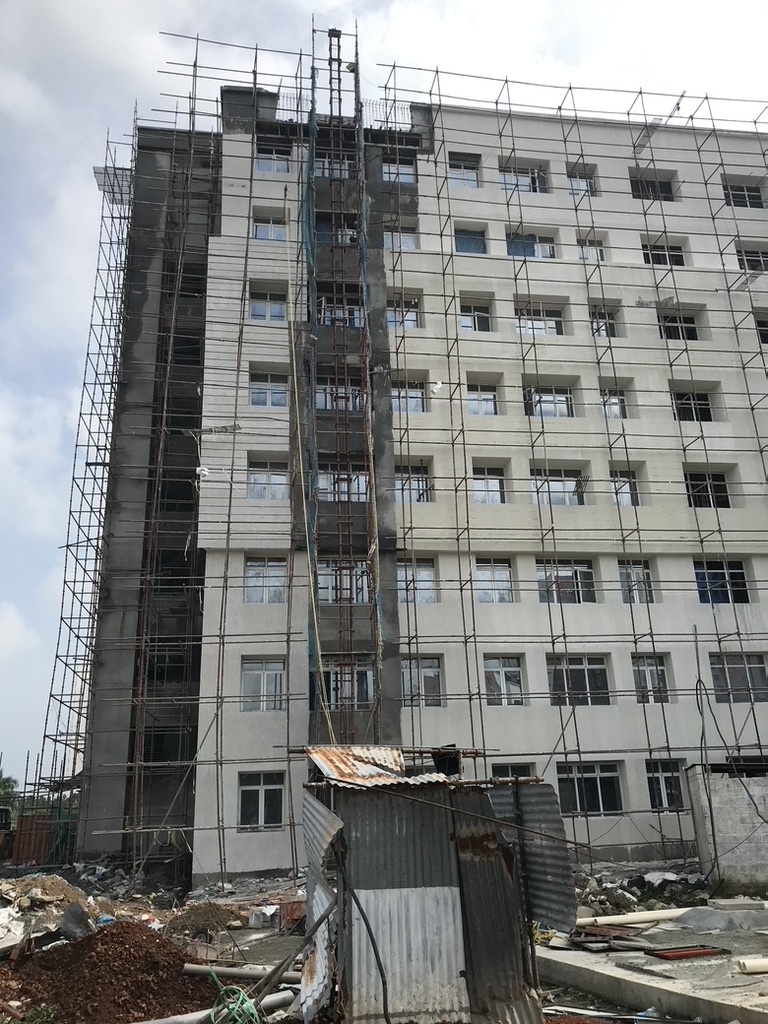
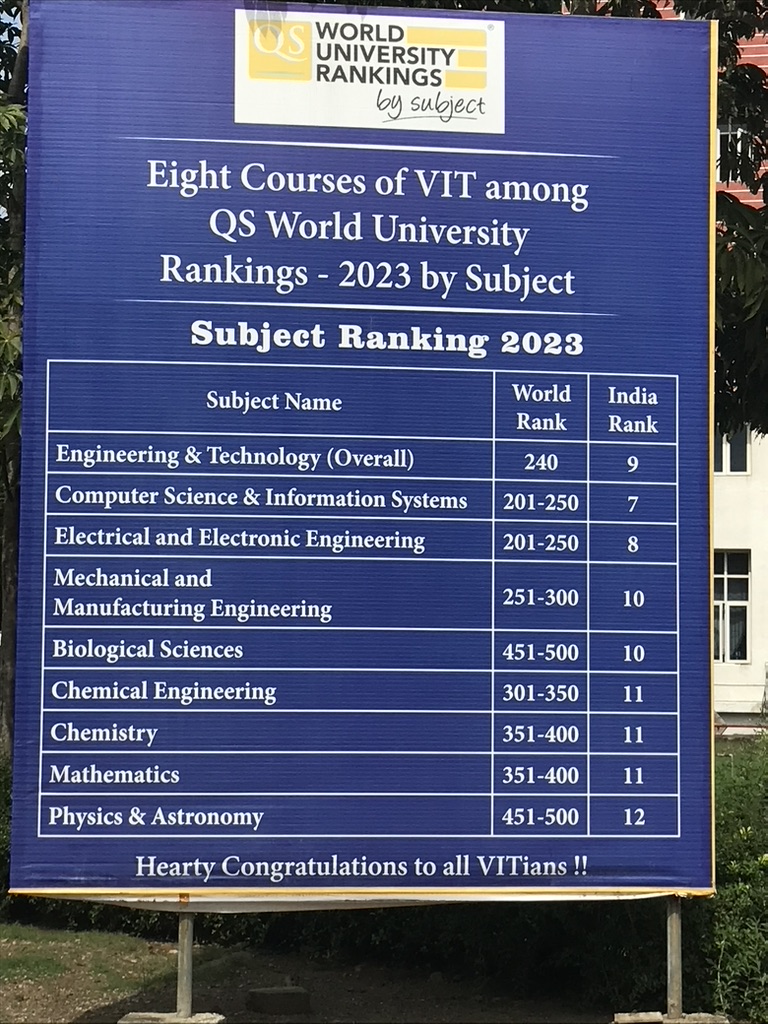
Building under construction on VIT campusDr. Shanmungham’s concrete testing labVIT world rankings (QS system) for 2023
In the first couple weeks of January 2024, I got an inside perspective by attending events and touring workshops and laboratories at the Chennai branch campus of Vellore Institute of Technology (VIT).
VIT’s Dr. Nithya Venkatesan, Assistant Director of International Relations, and Associate Professor Dr. Shanmuga Sundaram (who goes by Shanmugham) served as my primary hosts. They helped coordinate my entire two-week trip, and without them I never would have managed to make my first venture into this fascinating land.
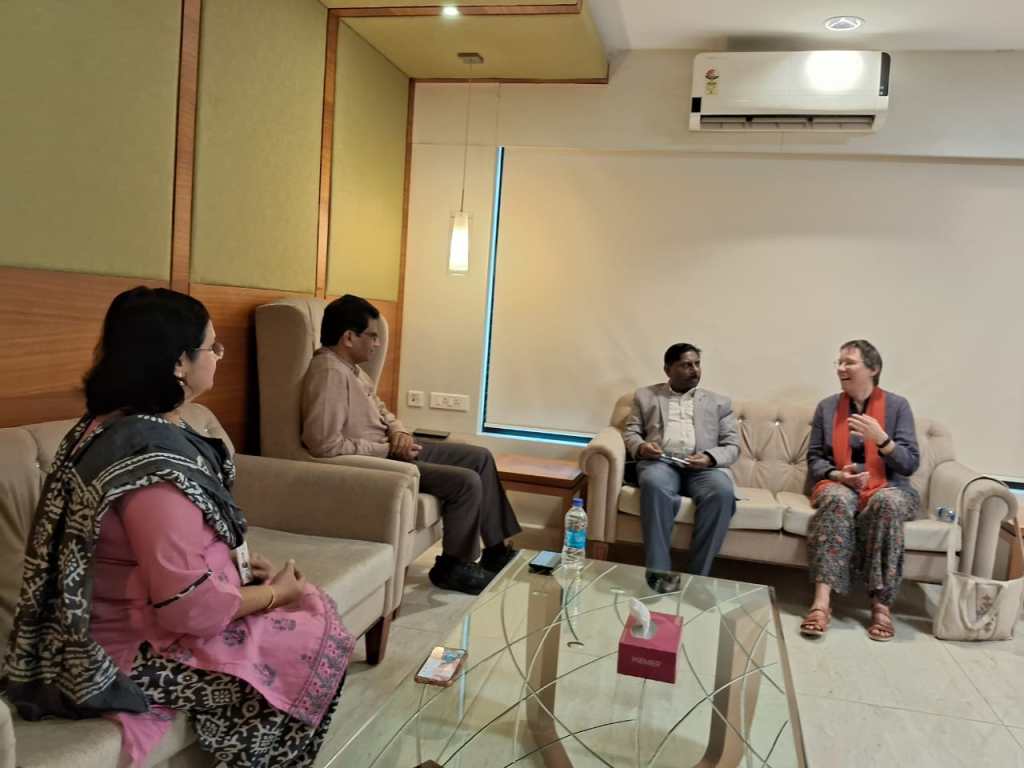
Visiting the VIT Chennai Internationalization Office and meeting Dr. Nithya Venkatesan.Sightseeing with Associate Professor Dr. Shanmuga Sundaram, my primary host.Meeting with VIT’s vice president for academics, Dr. Sekar Viswanatha (second from left), Dr. Nithya Venkatesan (far left) and Prof. Dr. Johnson Alengaram.
Dr. Renukadevi Selvaraj, Professor and Head of the Dept. of Education at the National Institute of Technical Teachers Training Institute (NITTTR), run by the Ministry of Education for the Government of India, connected me with VIT after I met her in Blacksburg, Virginia (my hometown) at an ethics symposium last summer.
At VIT, I attended a two-day conclave on civil engineering organized by Shanmugham that included presentations by academic and industry partners. Shanmugham’s areas of specialization include sustainable building materials, special concrete, alternative binding processes.
I delivered the opening keynote address for the conclave. Most of the audience of around 45 participants were civil and structural engineering students, but their teachers, some PhD researchers, and some industry partners also attended.
Other presenters at the conclave talked about structural failures within existing buildings (causes, effects, and ways of avoiding or addressing defects), earthquake resistance and previous structural failures in India due to earthquake activity, and the importance of being part of professional organizations (such as the UK-based Institution of Civil Engineers, ICE). India does not yet have a licensure program for professional/licensed/chartered engineers of the type you see in the US, UK and Ireland, but Professor Johnson Alengaram from the University of Malaya encouraged the audience to join ICE and maintain their learning and their credentials with care.
Shanmugham noted that he’s in the second generation of civil engineers the people of his father’s age with a first generation of civil engineering professional in the country. The students he is educating now, he sees as the third generation of civil engineering in India.
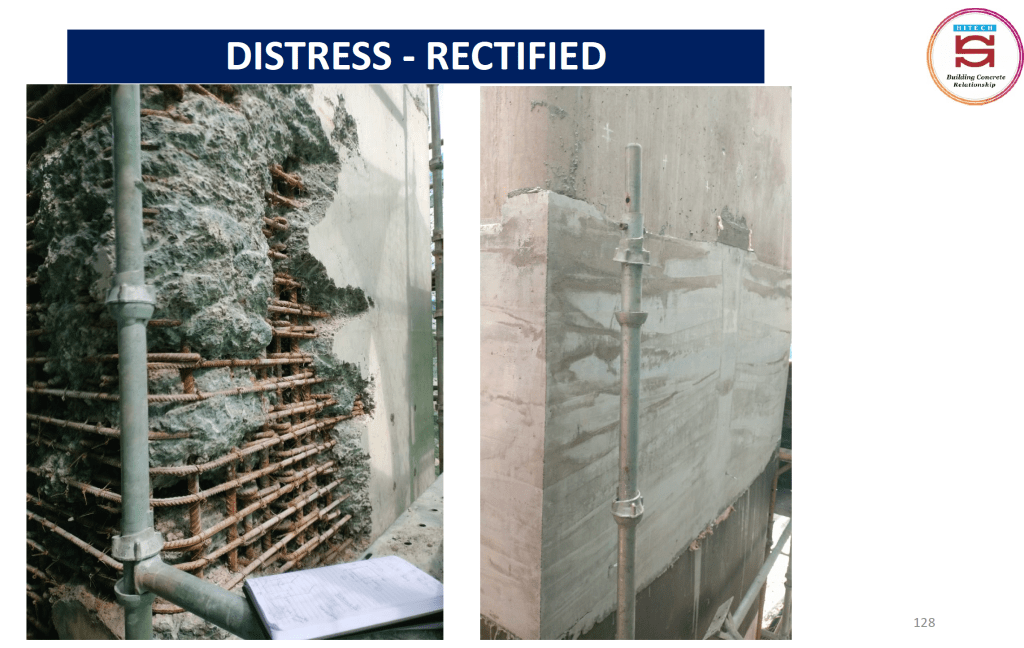
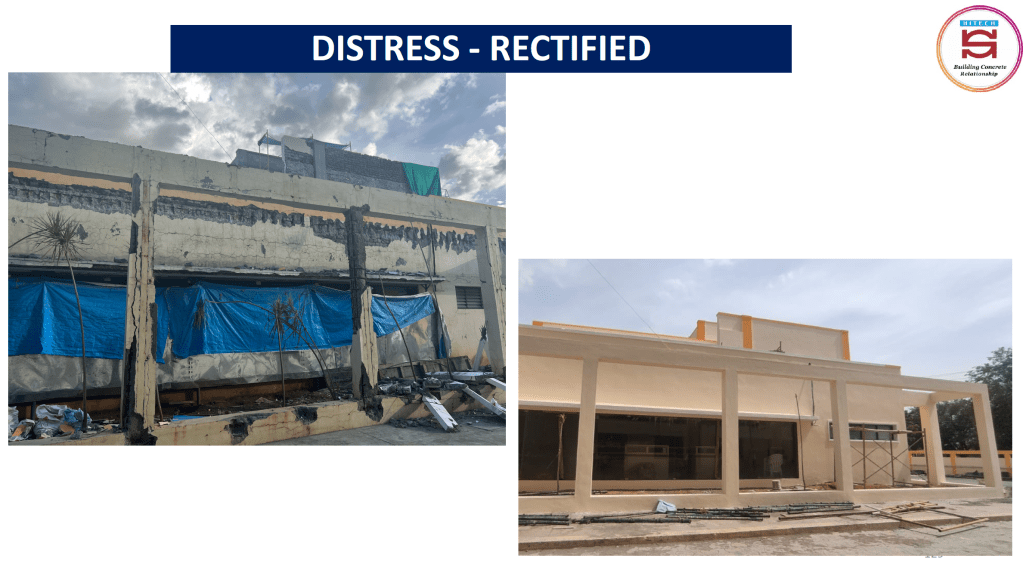
Arvindh Raj Rajendran, who earned a Master of Structural Technology degree, delivered the conclave’s final talk with an extremely well-articulated presentation about an apartment complex that his family’s company, Hitech Civil Engineering Services, Ltd., has worked to diagnosed and remediated. The original construction, by a different company, had severe deficits that had made national news in India. Hitech has made interventions to keep the structure inhabitable and conducted detailed analyses to help the government and the courts decide if the building can be salvaged or must be replaced. He explained the analysis and rectification process in detail. Arvindh showed other faulty structures that Hitect has been able to salvage, as well as the equipment they use (all pictured below).
A slide from Arvindh Raj’s Hitech presentation.A slide from Arvindh Raj’s Hitech presentation.Monitoring devices used at Hitech.
Before the conclave started, I had the distinct honor of visiting four of the engineering laboratories on the VIT Chennai campus, being shown around by Shanmugham. We visited the soil testing lab where he and his colleague, Associate Professor Dr. Karthiyaini train PhD students and conduct research.
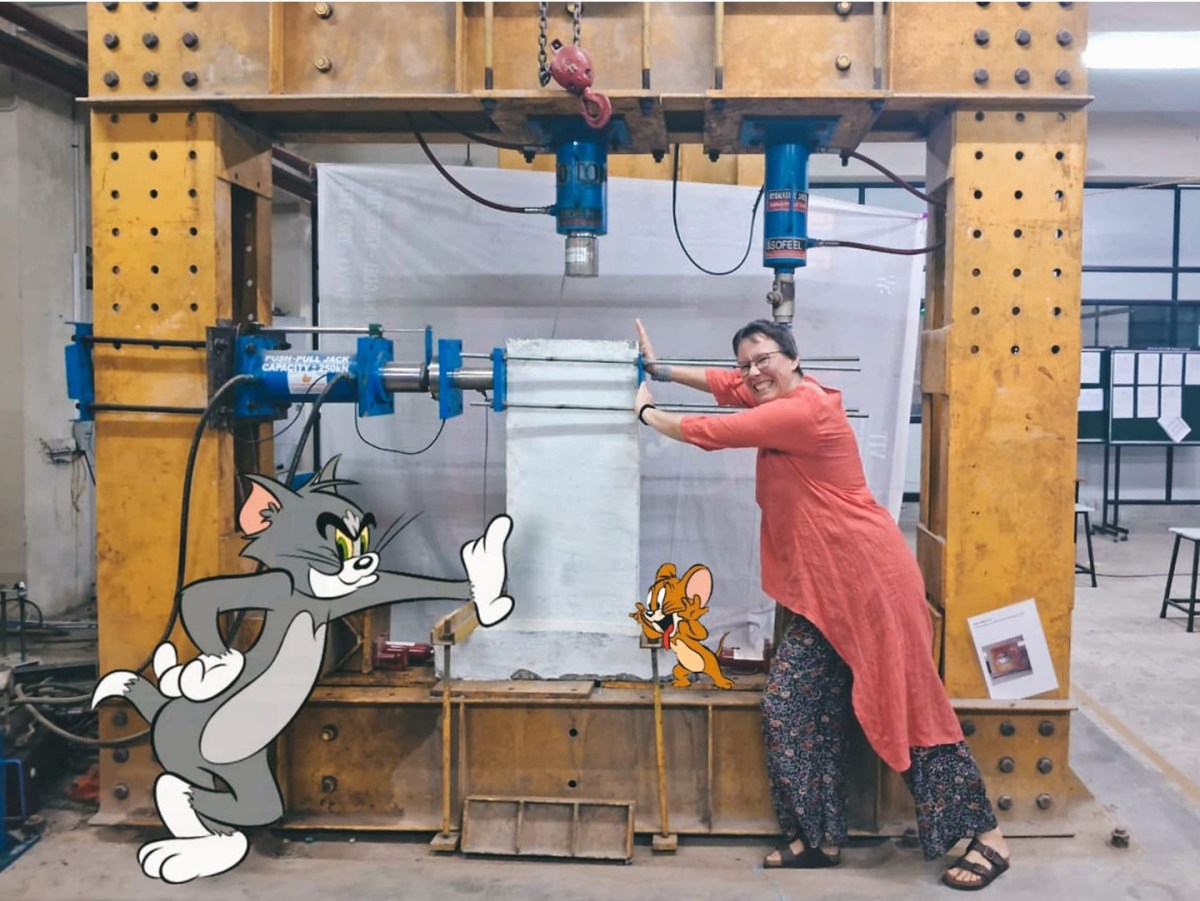
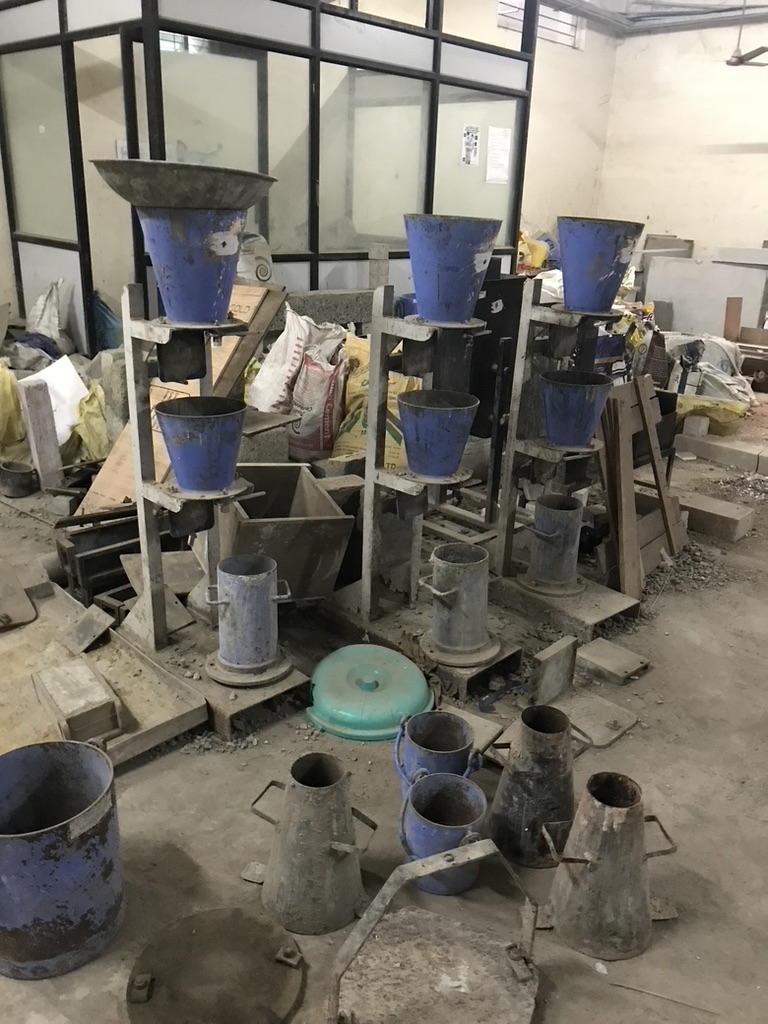
We visited Shanmugham’s materials testing laboratory. He has just gained national certification to test materials (such as concrete samples from active construction sites). He can test the performance of all kinds of concrete steel and concrete-related products. He is also researching possibilities for creating concrete mixed with less embodied carbon than today’s standard material.
He’s working towards a net-zero-type concrete method using byproducts of other industries in India — because concrete is a central construction material in the country. China and India are using a huge portion of the entire amount of concrete fabricated each year currently worldwide.
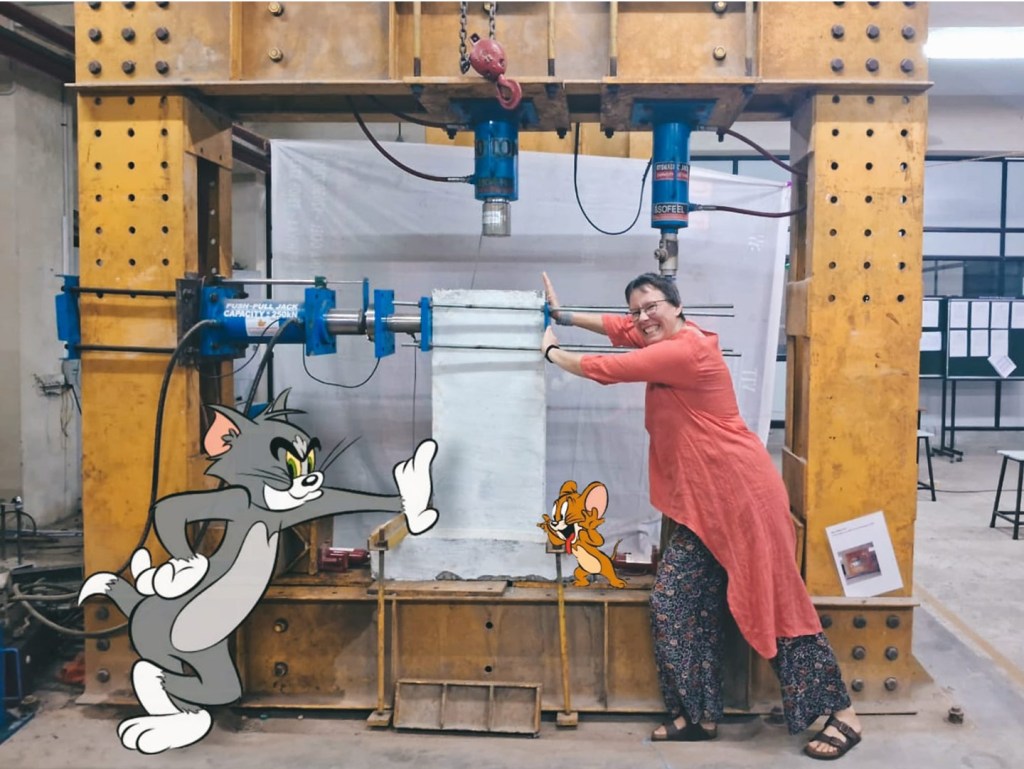
Dr. Shanmungham’s colleague added Tom and Jerry to my visit to the Shanmugham’s concrete testing lab!Official certifications for Dr. Shanmungham testing lab.A machine to demonstrate to students how to protect reservoirs from infiltration of contaminated water, built by Shanmungham.PhD research students in the geology lab.PhD students in the water quality lab.
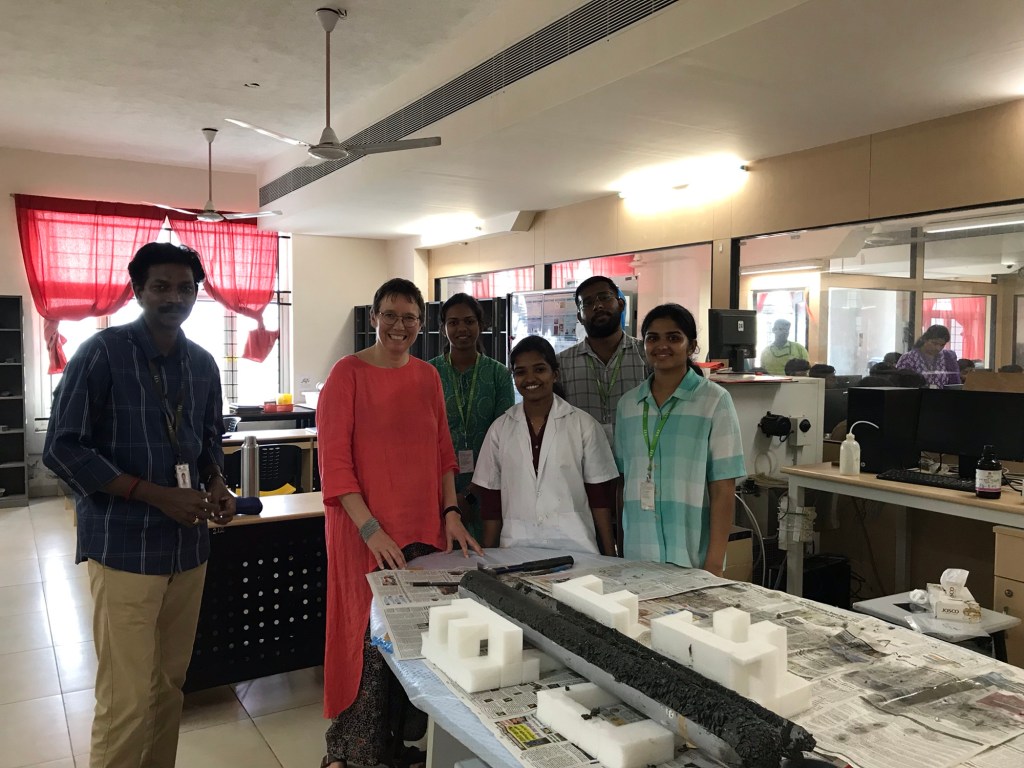
I also visited a water quality research lab and met the academic leader and her PhD students. They are working on a wide array of topics, including addressing toxic landfill effluents that leak into the soil, reviving microplastics from water, desalination process, and ocean clean-up techniques. I learned so much and wish I’d taken notes!
The geology lab was equally interesting as the students were taking samples from a soil boring to study contaminants. They introduced me to each doctoral research project, and I asked loads of questions, which, again, unfortunately, my brain failed to file into long-term memory. It does this filing in the night while I sleep and in the day when I retell what I’ve learned. But I learned so very much in that single day of touring that my brain couldn’t hold it all.
One thing I will never forget is how many talented women are studying engineering at VIT. To my delight, the research labs are gender balanced.
On the day of the tours, I also met VIT’s vice president for academics, Dr. Sekar Viswanathan. He holds this role on all four VIT campuses. I was very impressed with how attentively he communicated with Dr. Johnson, another international guest speaking at the conclave, and me.
VIT is a private institution that provides itself in excellence and holds academic world rankings. The Chennai campus is currently educating about 10,000 engineering students and is expanding its facilities to double its enrollment. This is very important in a country where many hundred thousand engineers graduate from higher education institutions each year but are not well-prepared for industry. Receiving an education at a highly-ranked institution like this helps ensure the graduate will be ready to perform well in the industry. The country desperately needs more civil engineers who can do this. Hopefully, one day, India’s civil engineers won’t need to work seven days a week!
Shanmugham was an exceptional host during my trip. He and his wife (Rama, an electrical/computer engineer who runs a startup business with a colleague) and their six-year-old daughter (Shanmuga, who speaks English in addition to her mother tongue), took me shopping for Indian outfits — so I’ll fit in better on my next trip to India!
They also invited me to their home, located in a huge complex of apartments. There are 20 buildings, each about 17 stories tall. I met their neighbors, and I learned something about how they live. We got to share a bit of our own cultures with each other, which was a true highlight of my time in Chennai.
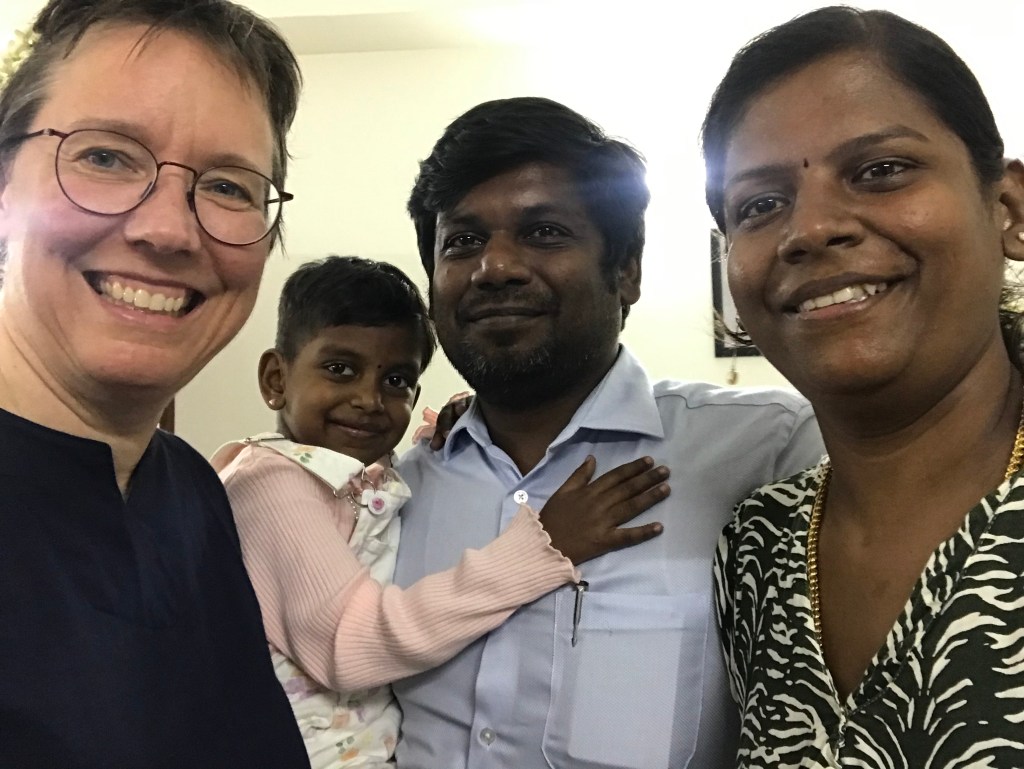
Shanmungham with Shanmunga and Rama, at their home.The shrine in their home.Shopping for Indian outfits with Shanmunga.Shanmunga and Rama’s neighbors also welcomed me into their home. The daughter will marry next week, and I have been invited. Unfortunately, I’ll be at work in Ireland during the multi-day wedding events.
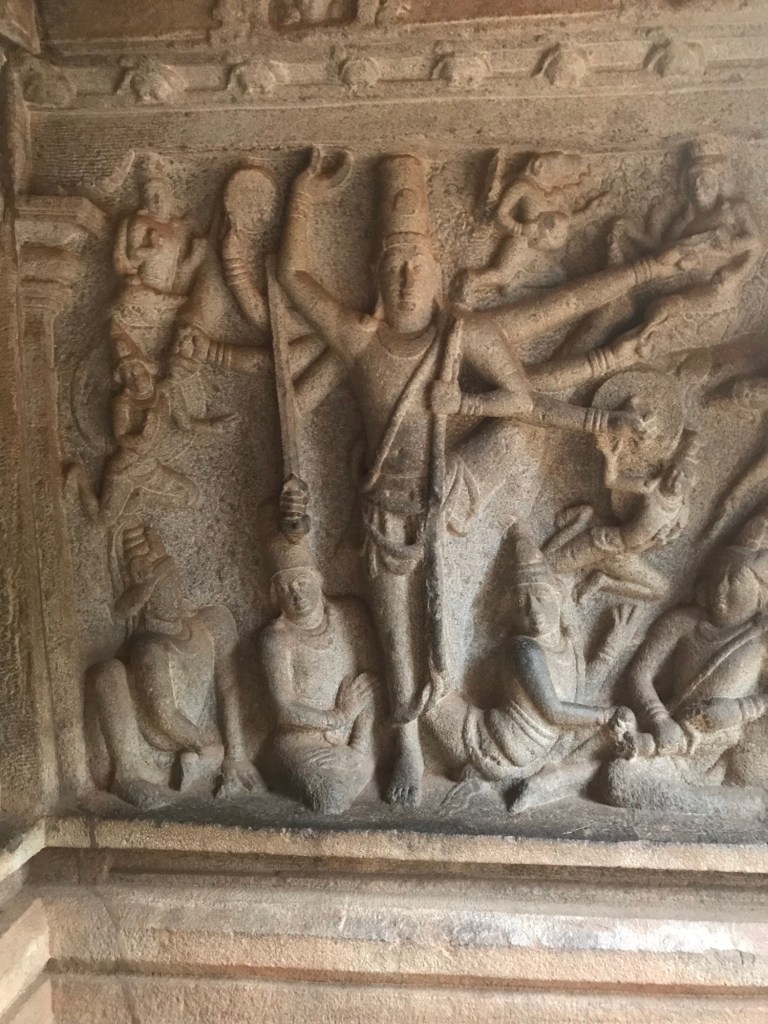
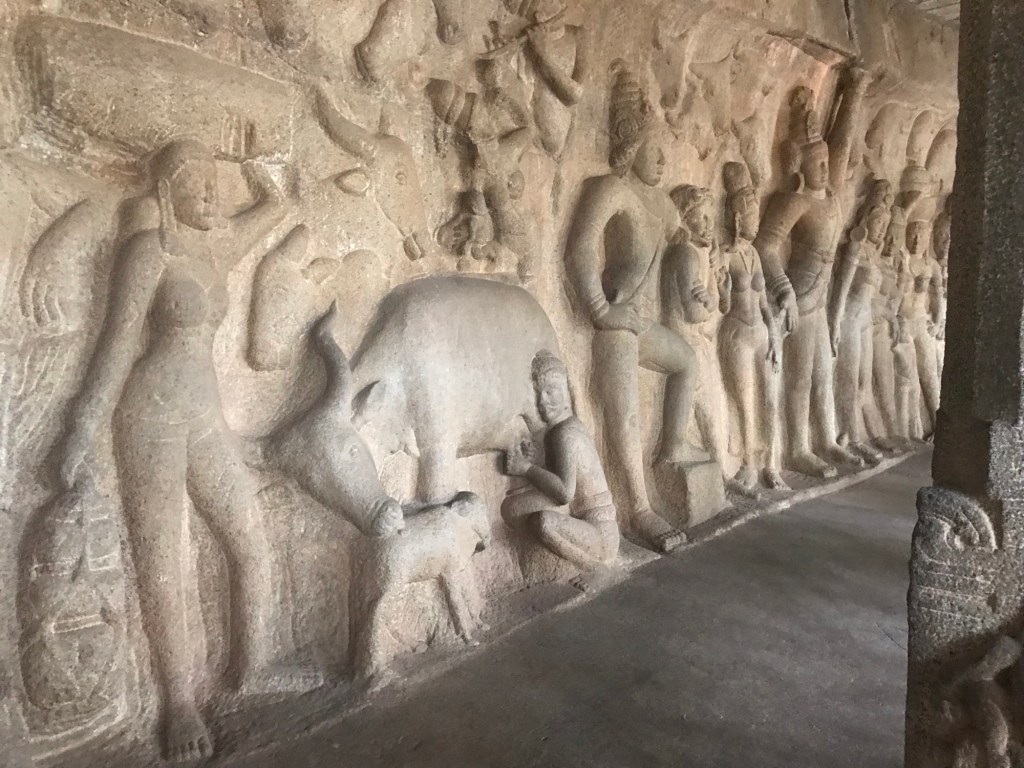
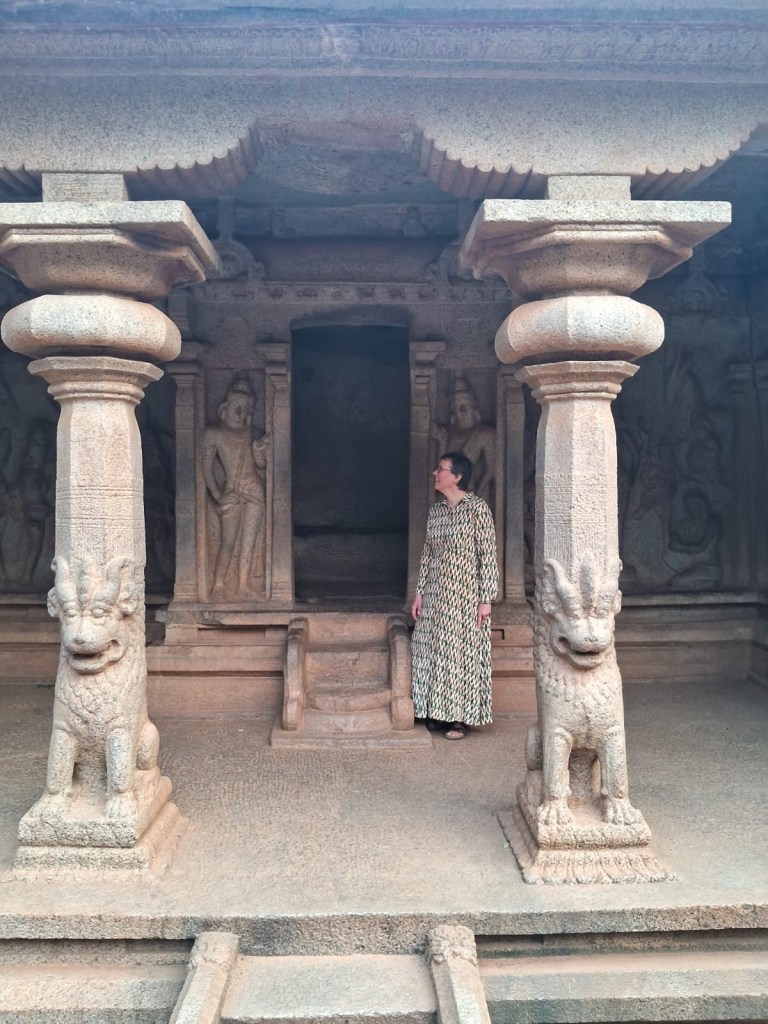
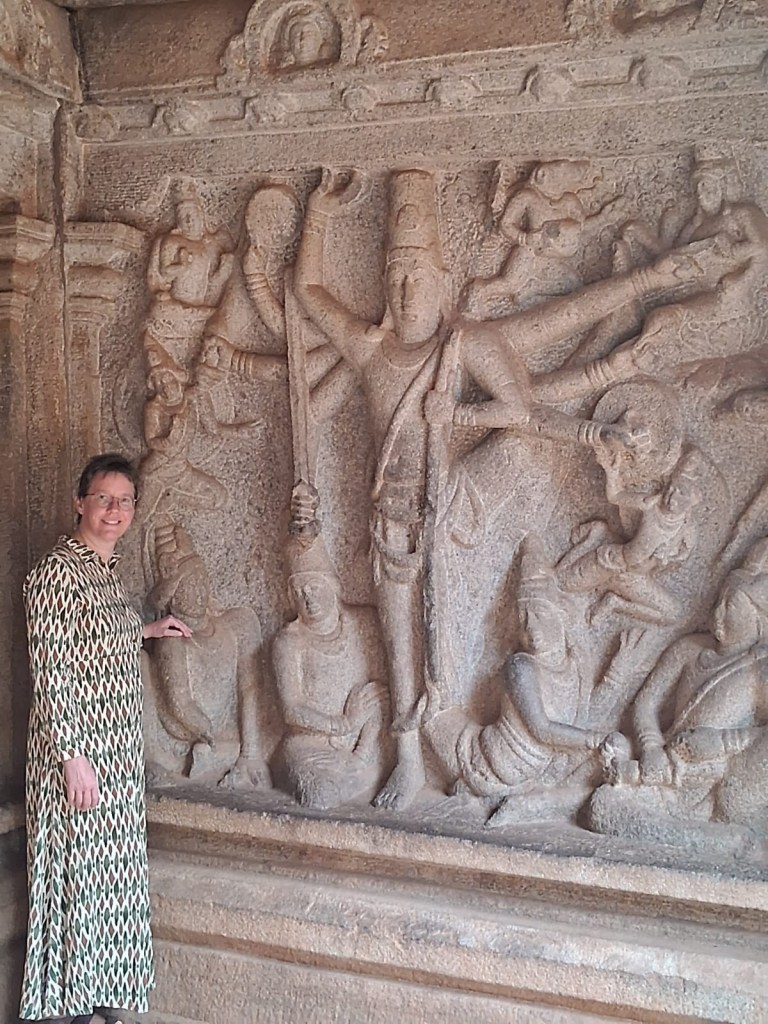
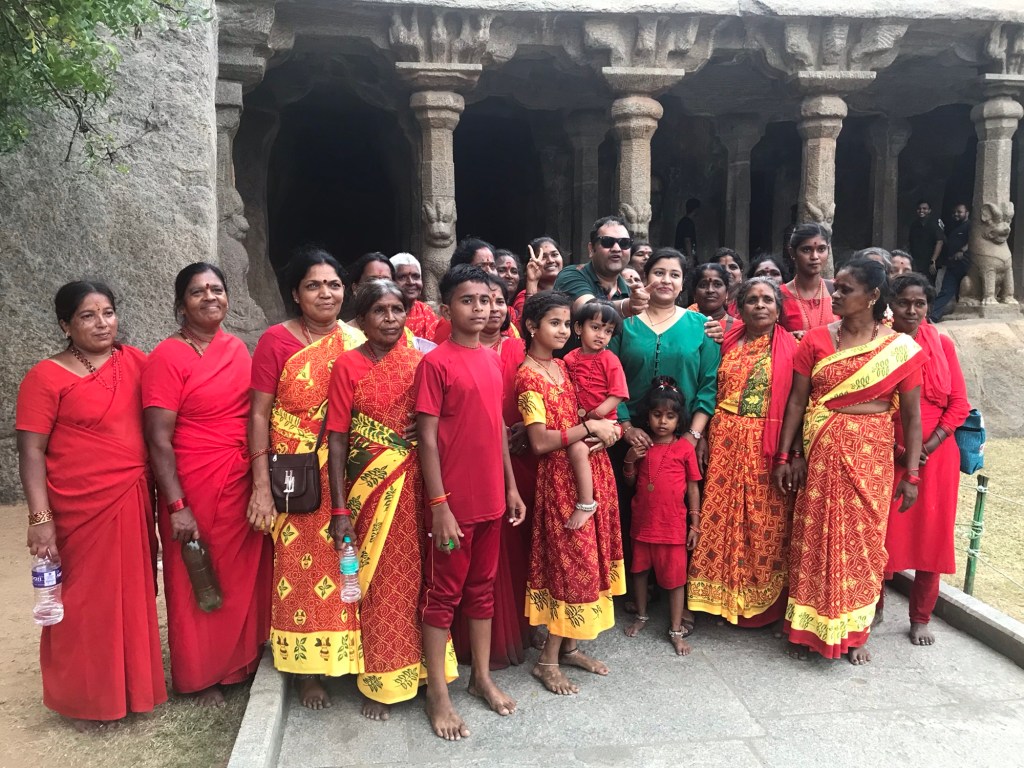
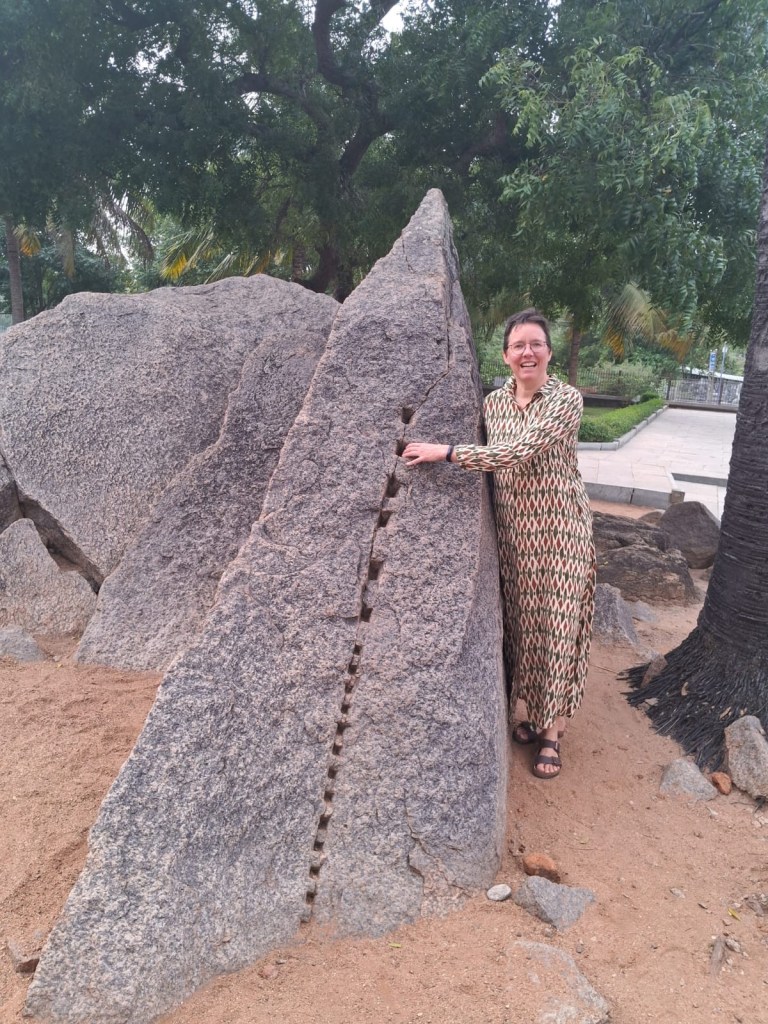
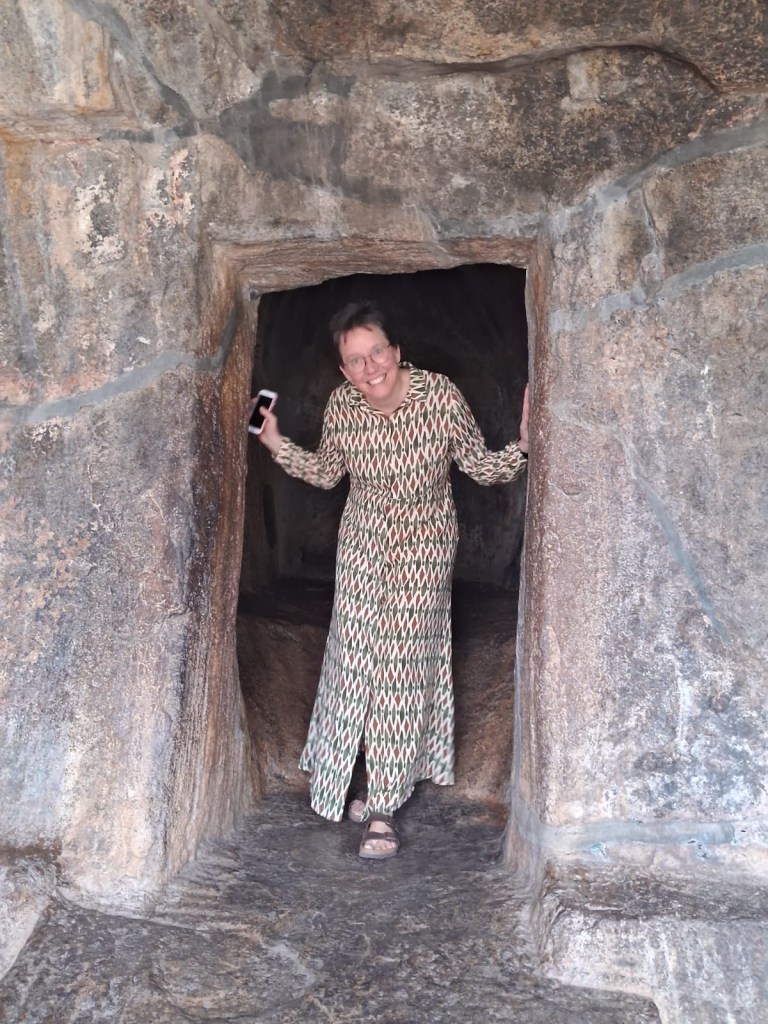
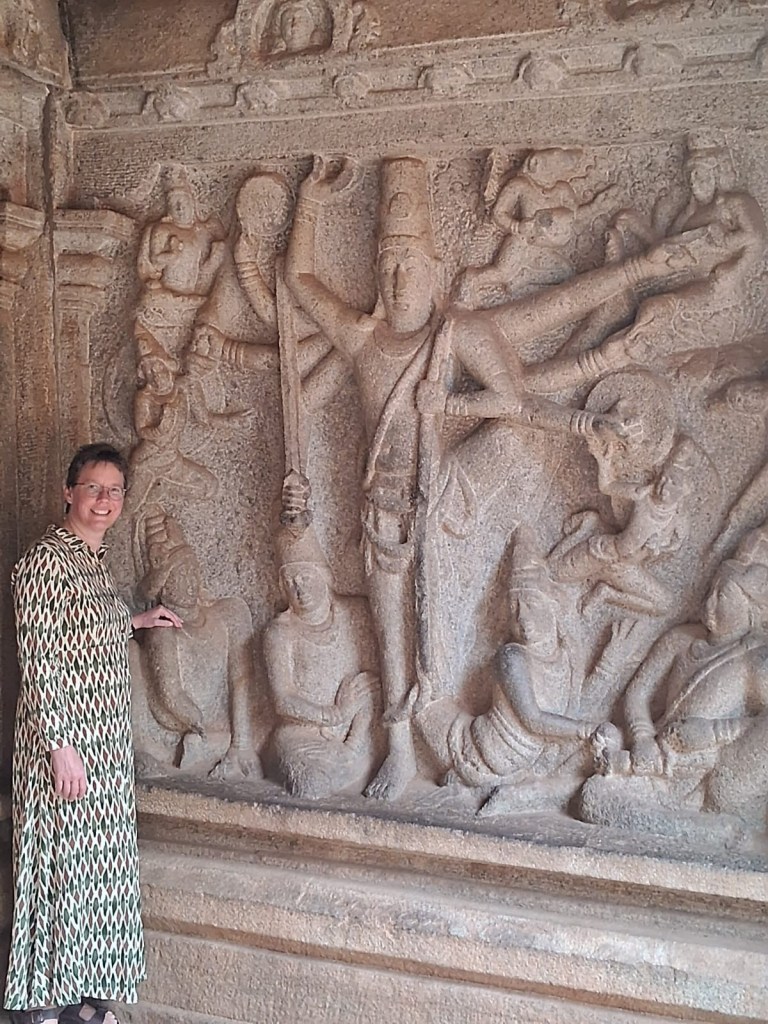
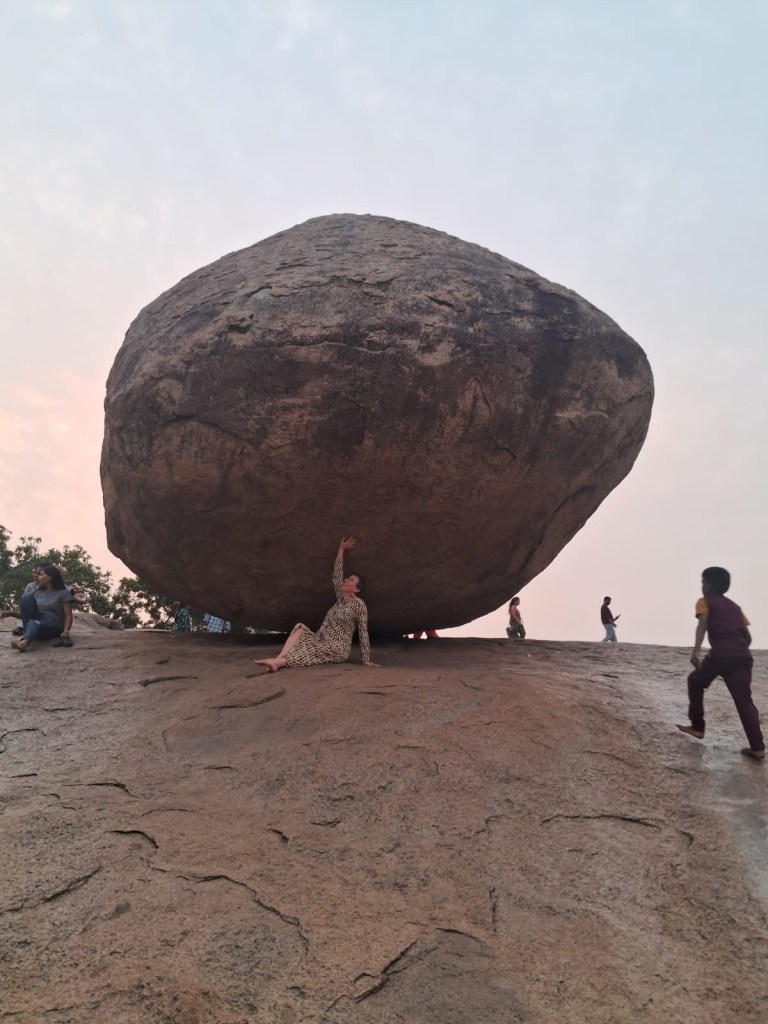
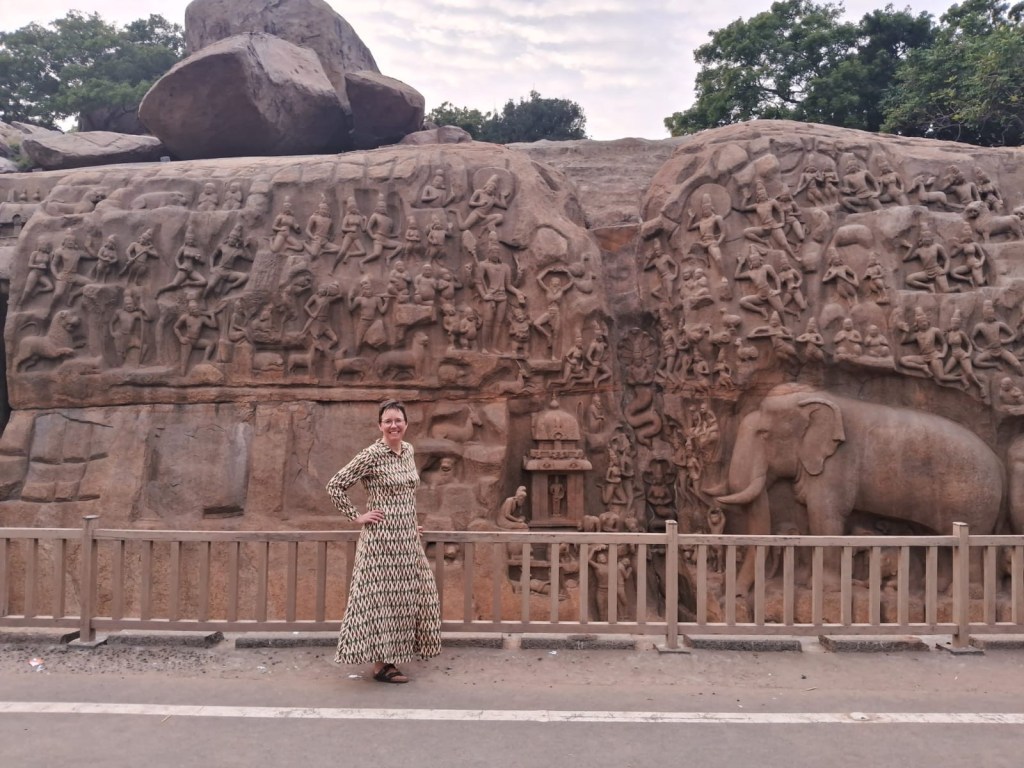
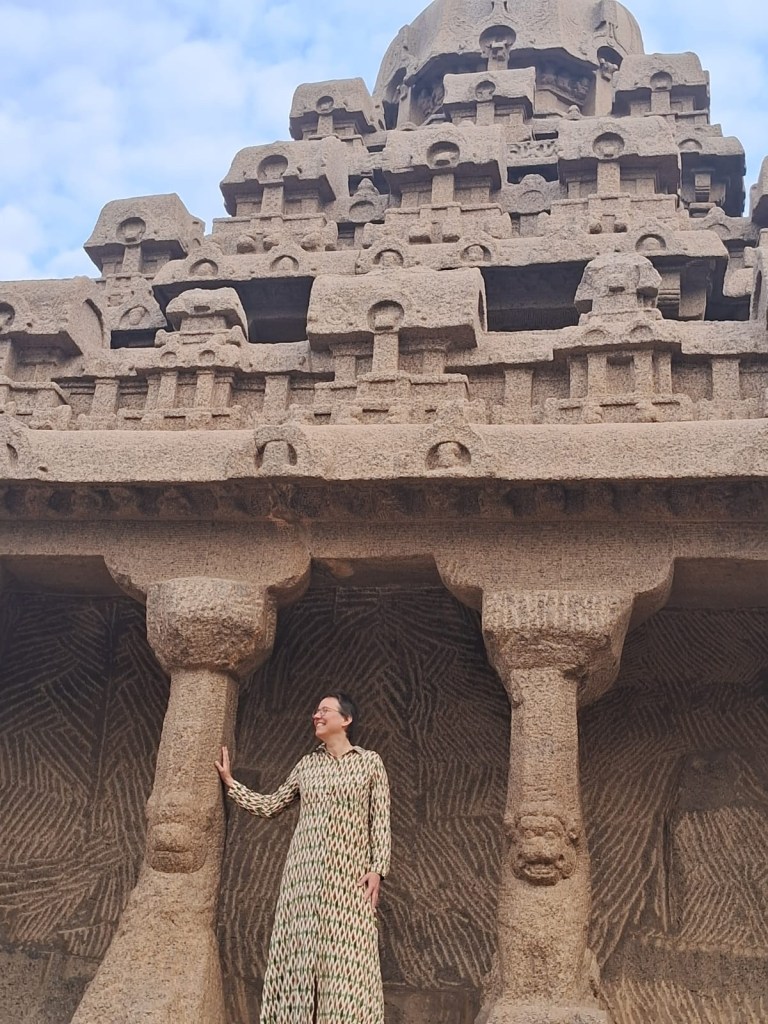
At the very start of my trip, I also got the chance to visit some stone temples near Chennai. Shanmugham showed me around the massive site and, in true Indian fashion, took pictures of me at each important structure. These temples, carved from solid granite boulders protruding from the sand at this coastal location, have stood for 1300 years. The craftsmanship was superb and awe-inspiring.
The day we visited the temples (the day I landed in India, January 2) was a holiday. The site was being visited by many busloads of tourists from all over India dressed to the nines. I included pictures of one group of visitors in the gallery below.
“The Group of Monuments at Mahabalipuram is a collection of 7th- and 8th-century CE religious monuments in the coastal resort town of Mahabalipuram, Tamil Nadu, India and is a UNESCO World Heritage Site. It is on the Coromandel Coast of the Bay of Bengal, about 60 kilometres south of Chennai.”
The Indian people definitely made me feel welcome and safe and thankful for this opportunity to meet and learn from them. Everywhere I went, people stopped and asked to take a picture with me. Little children looked at me in amazement. Shanmugham noted that many visitors to the temple had come from afar, from rural parts of India, and only some of the children had seen anyone like me before.
Incidentally, the food was incredible! During my two-week visit, I enjoyed the taste of every single thing I ate. At VIT, I had the privilege of residing at the international guesthouse. The drivers and guesthouse staff were absolutely incredible and made my stay a joy. At first, they offered me more Western foods, but when they saw that I enjoyed the Indian dishes more, that changed! The entire staff went the extra mile to ensure my safety and comfort.
In this post, I described just five of my days in India. I hope to post another blog this week about my experiences at REES 2024 in Hubli, India, and visiting NITTTR outside Chennai.
From ancient stone temples to teaching labs and structural failure — I got insider perspectives of civil engineering in India from the staff of VIT and I look forward to my next visit to India.
Monuments at Mahabalipuram, a UNESCO World Heritage Site near Chennai, India.
The pandemic closed life down on our little island just days after Christmas.
After a long winter’s hibernation, Ireland has just started to lift the lid. For months, I’ve rarely left home. Aongus got Covid the week his worksite opened back up, just after Easter. But despite staying right by his side, I didn’t contract the illness. I actually tested negative twice, but had to isolate (for what seemed like forever) nonetheless.
I did, though, get a wave of something while Aongus was sick. I felt drained, although not to the same extent as Aongus was.
It hasn’t helped that the big volunteer/publication project I’m currently wrapping up has taken five-times the effort it should have. I couldn’t be happier to see the backside of this lockdown. Or this project….
Fortunate for my sanity, things are gradually opening back up in Dublin, and the sun sometimes shines. My flat is still a nice sun trap which makes life bearable.
In the past couple weeks, Aongus and I have had a few nice outings.
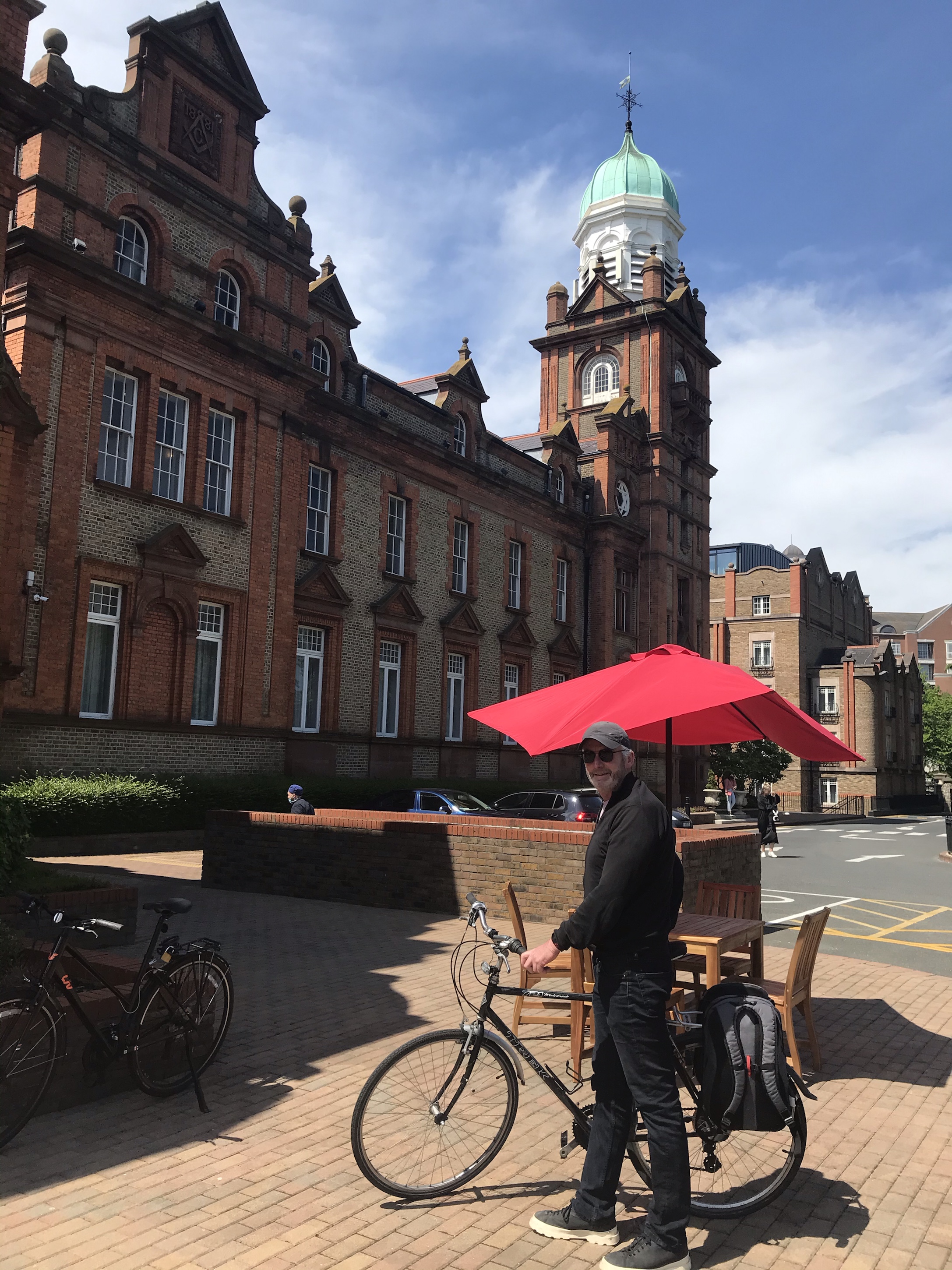
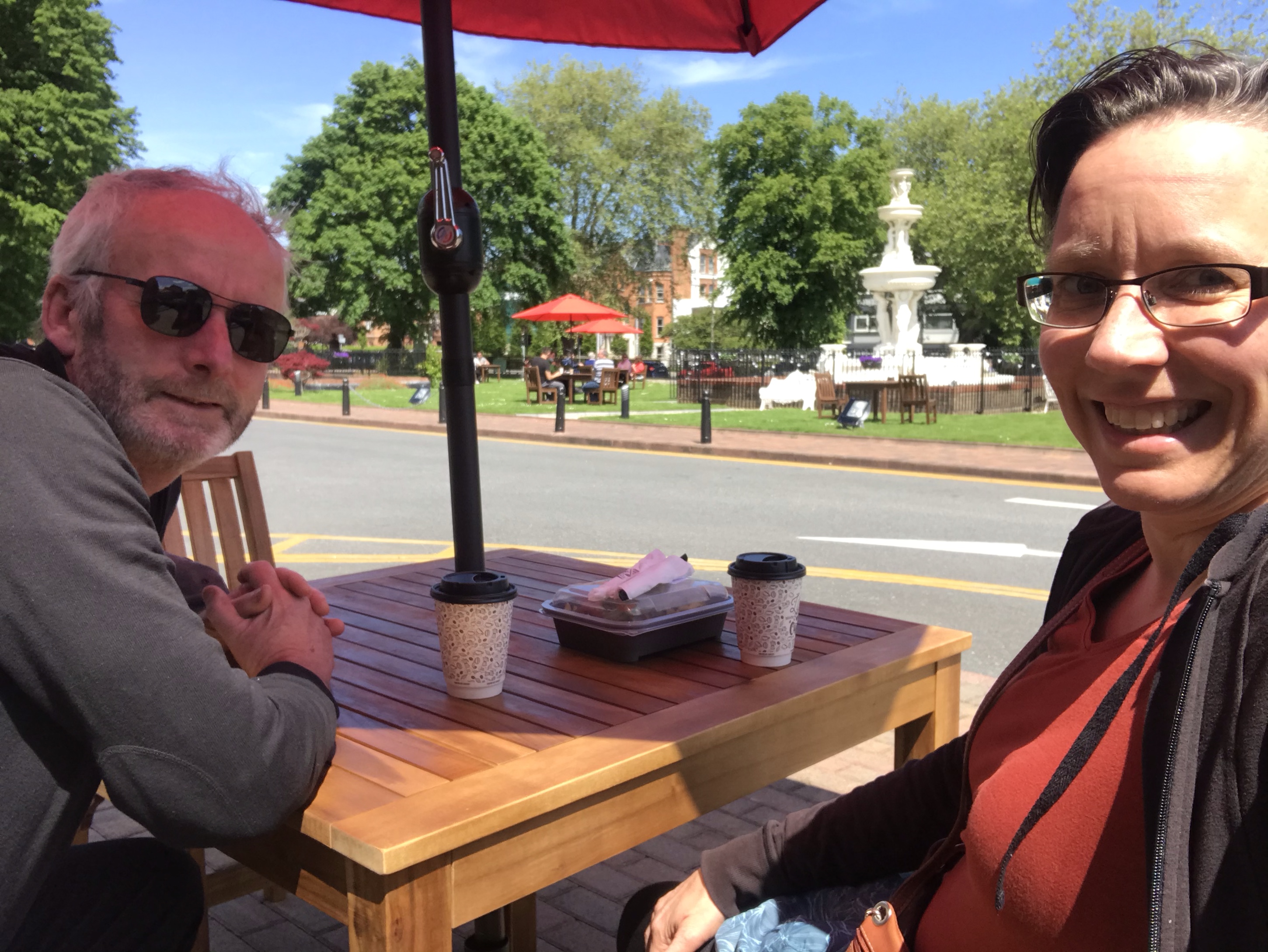
We had a lovely coffee and pasta last weekend sitting outside the Clayton Hotel in Ballsbridge on our cycle ride to Dun Laoghaire. I’ve always admired this majestic Victorian building but had never ventured onto the grounds.
Last weekend, visiting friends’ back gardens was finally allowed again. We had an absolute ball visiting our friends Diana, Stefan, and Diana’s mum on Sunday evening. We’re looking forward to the day we can welcome them to our place for a meal. (Inside visits are off limits until one of the two families is fully vaccinated or recovered from Covid. We’re well in our way to meeting the criteria!)
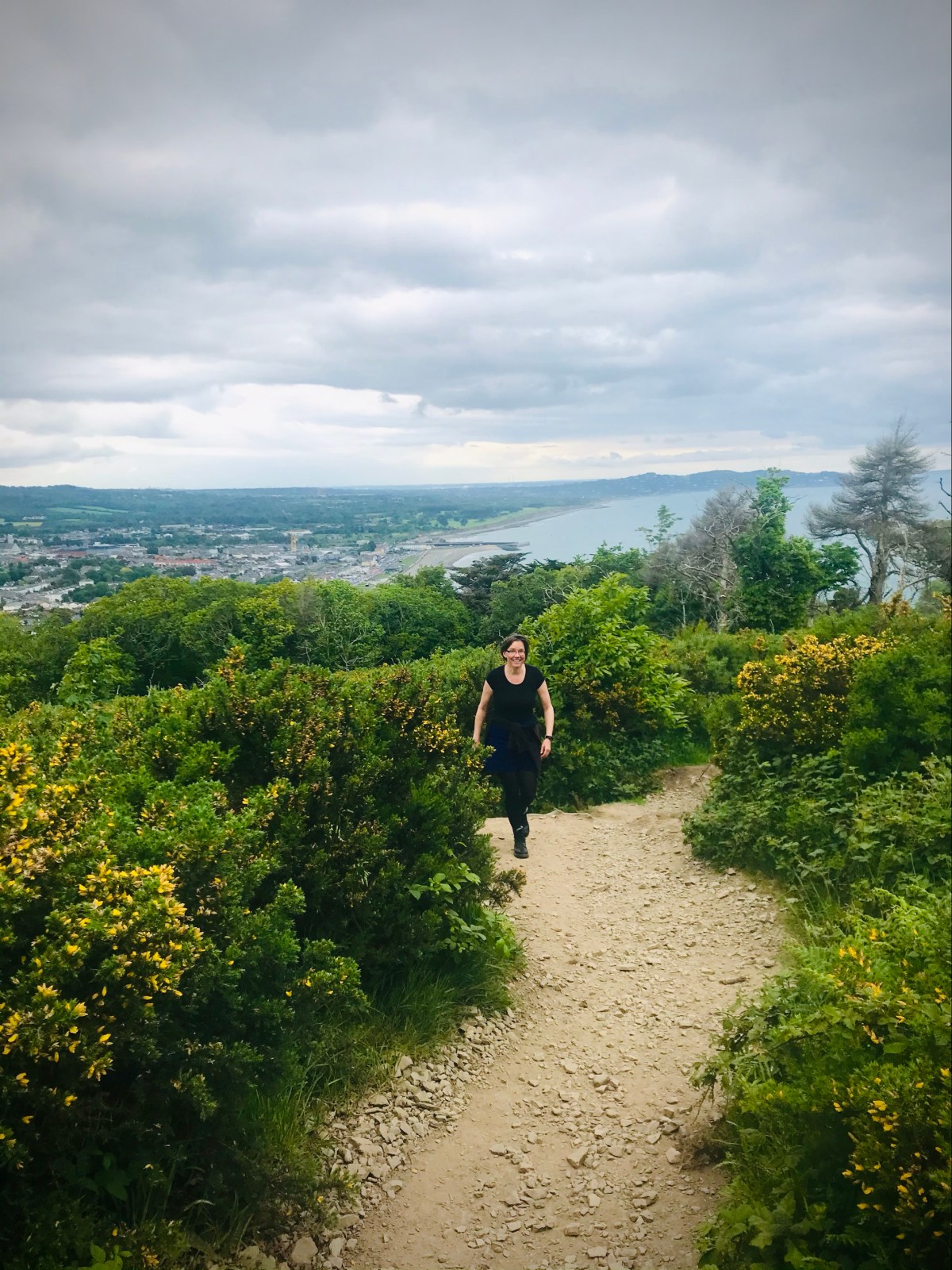
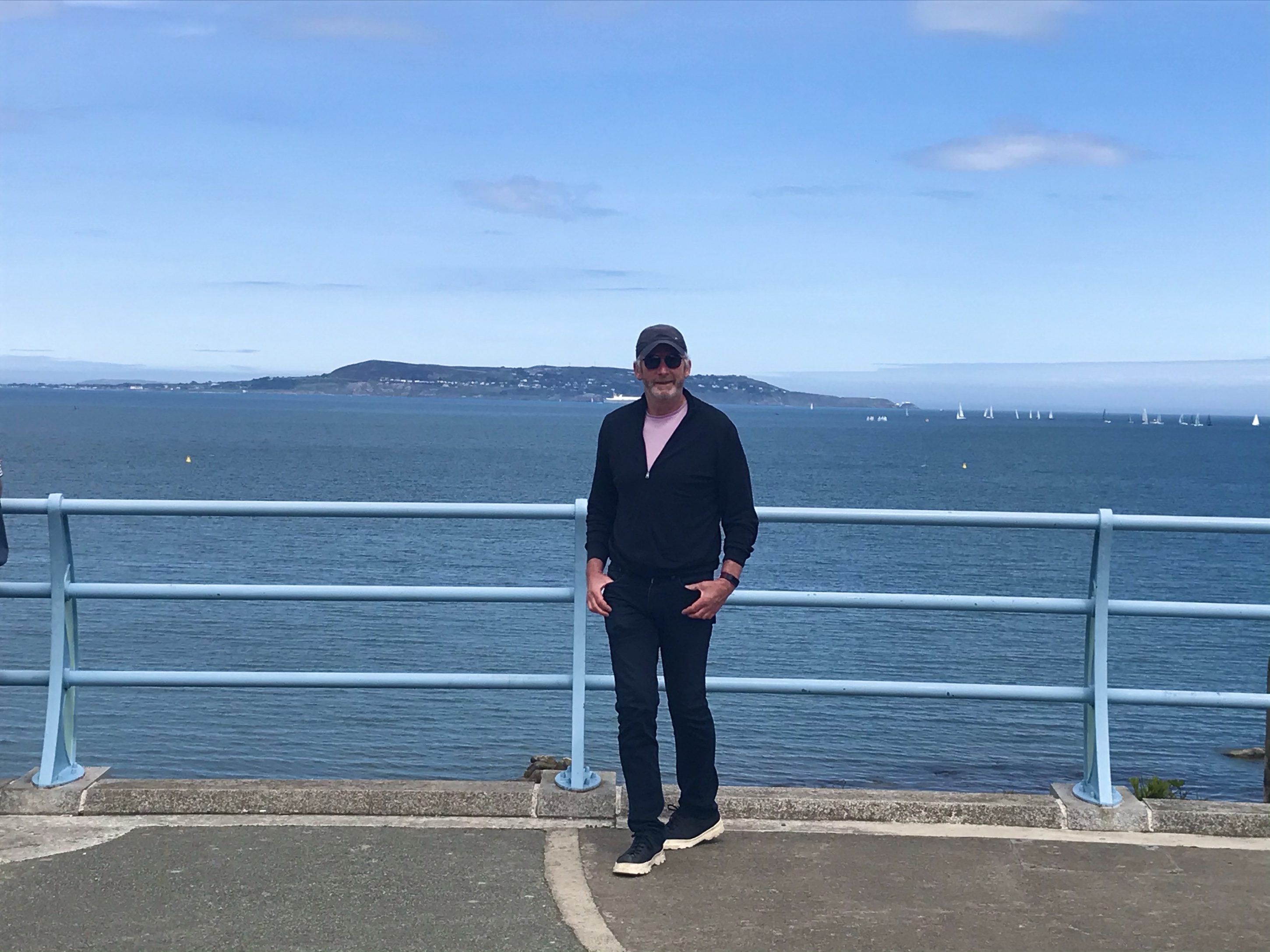
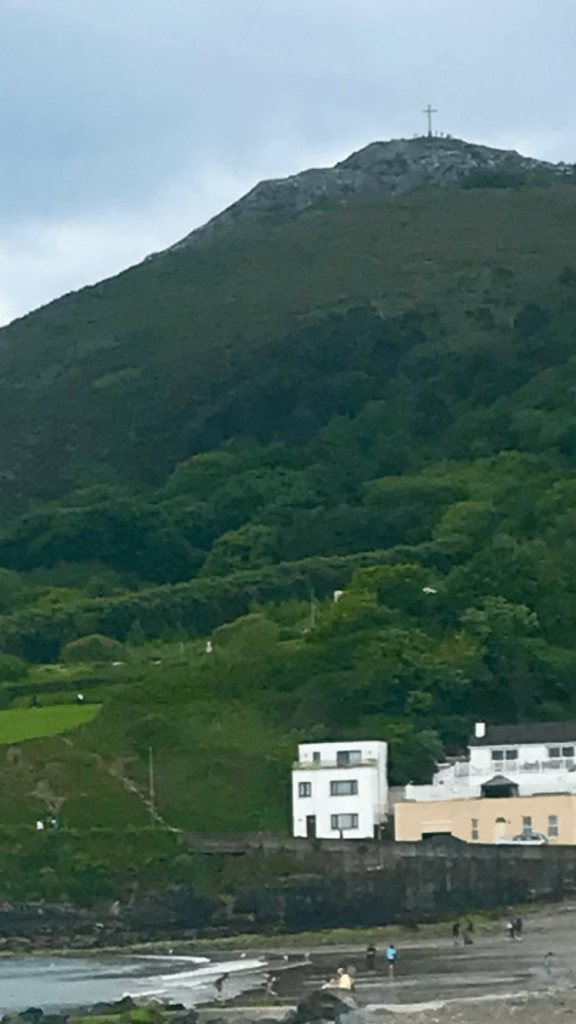
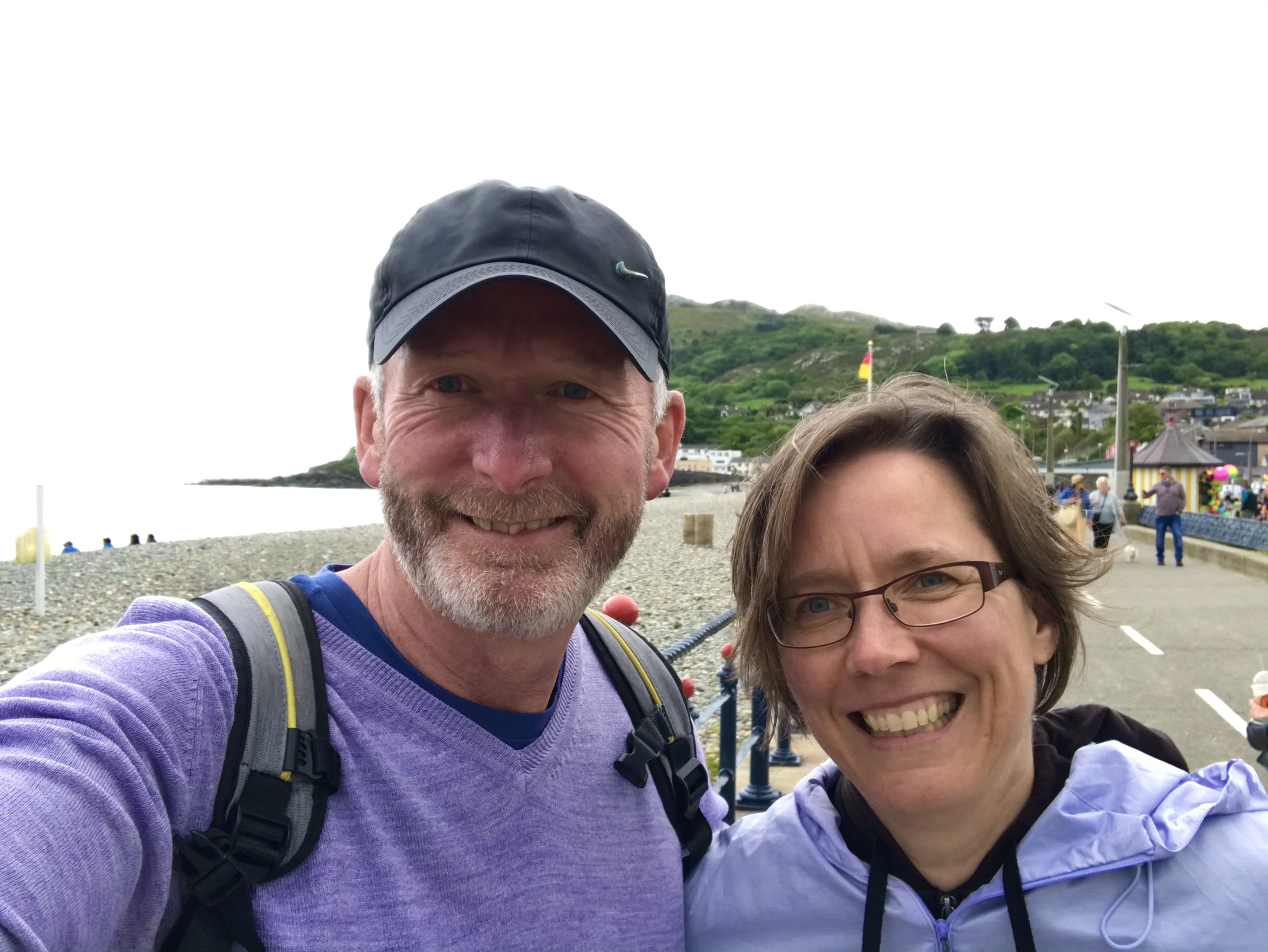
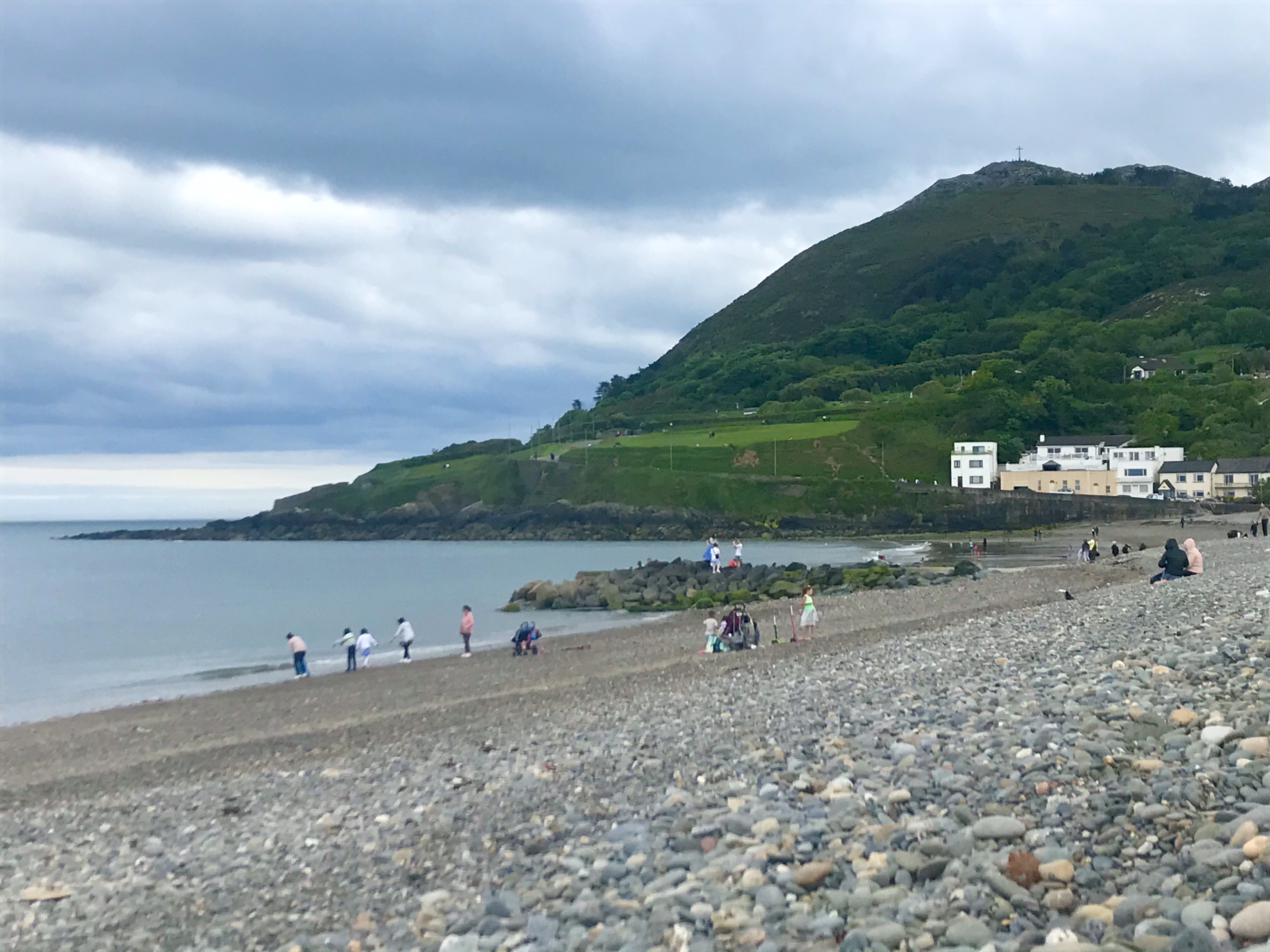
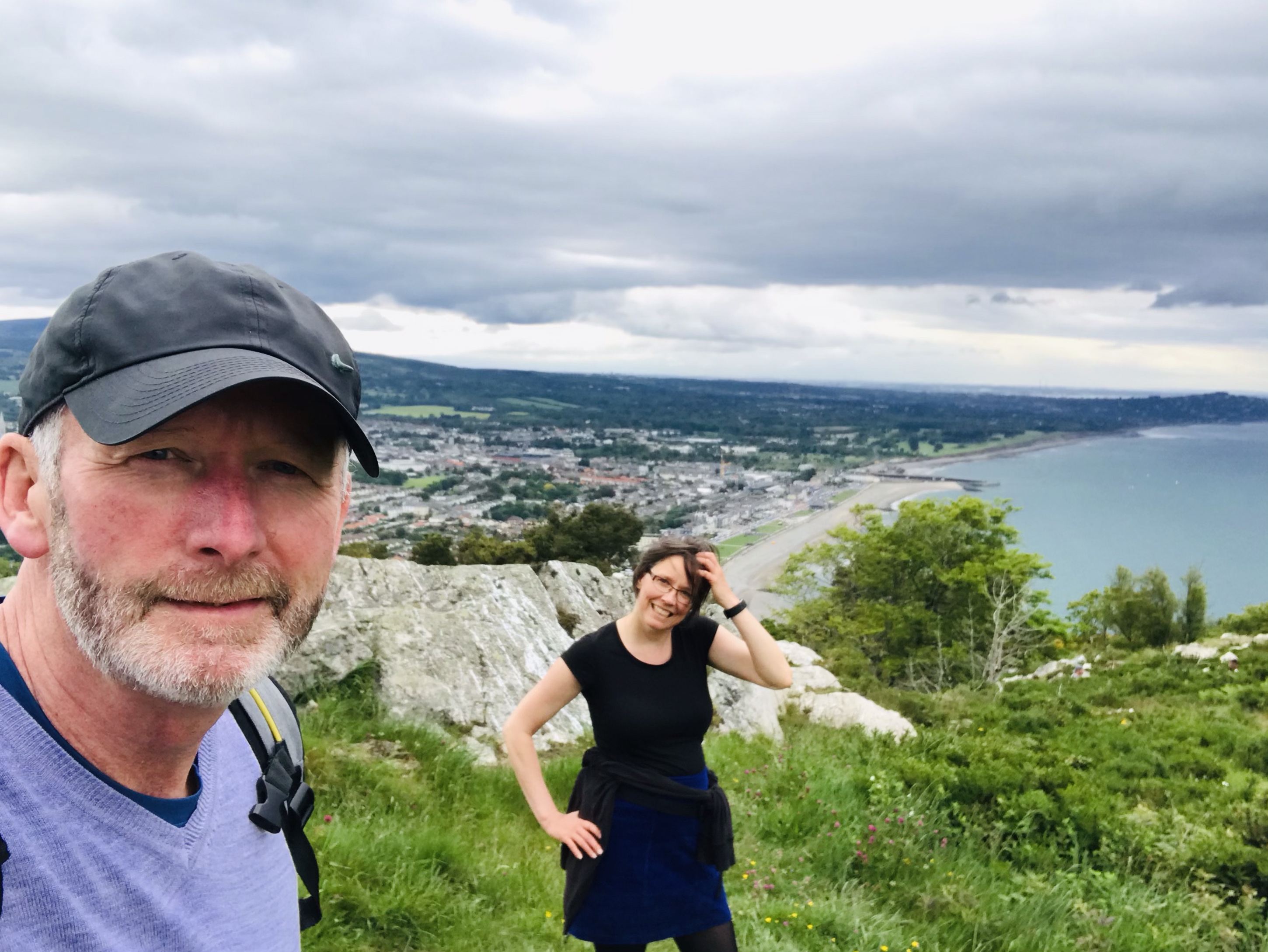
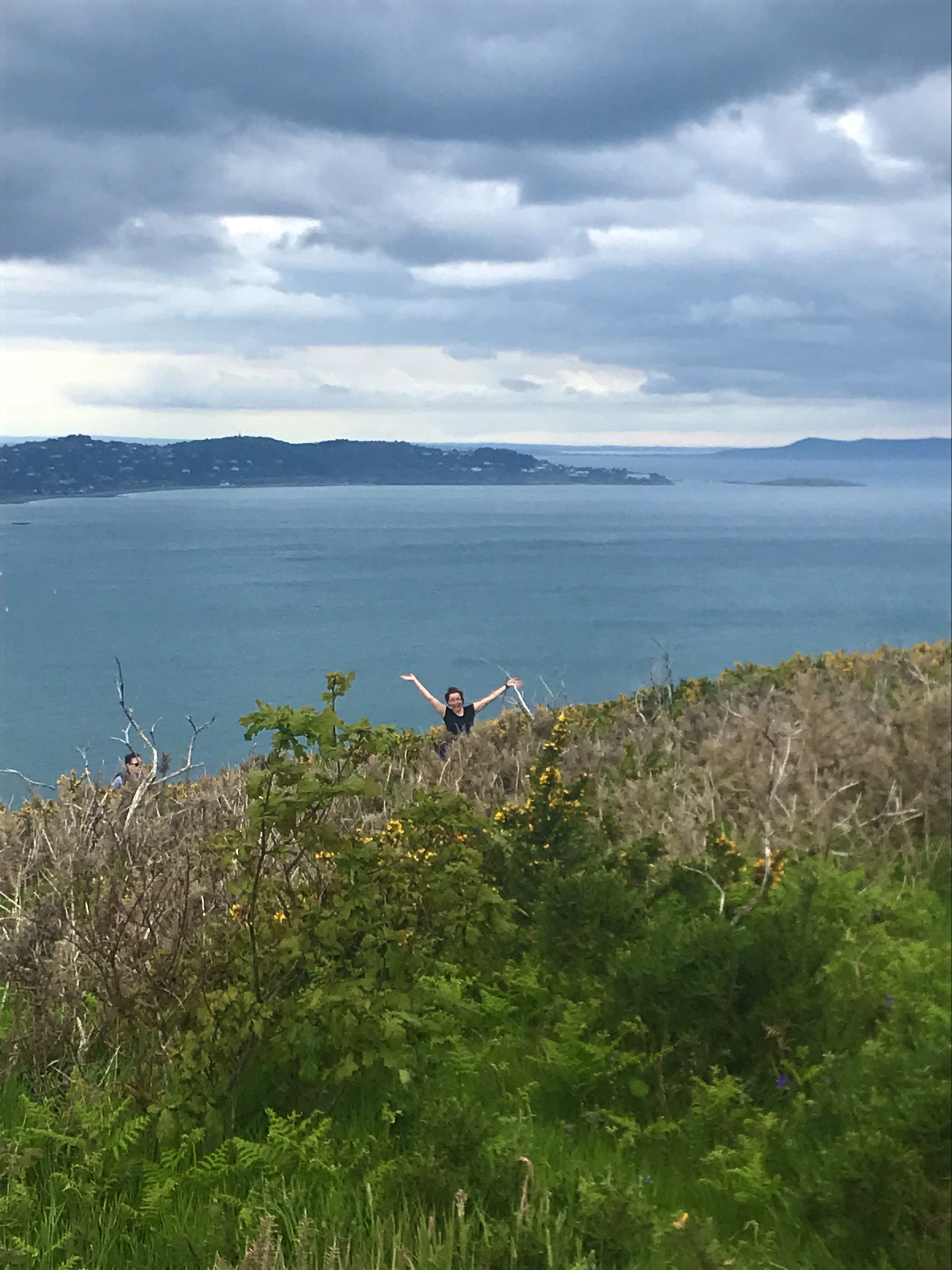
Yesterday we ventured out again, taking the local commuter train down the coast to Bray—the town where Aongus and I met over five years ago—and this time we hiked to the top of Bray Head.
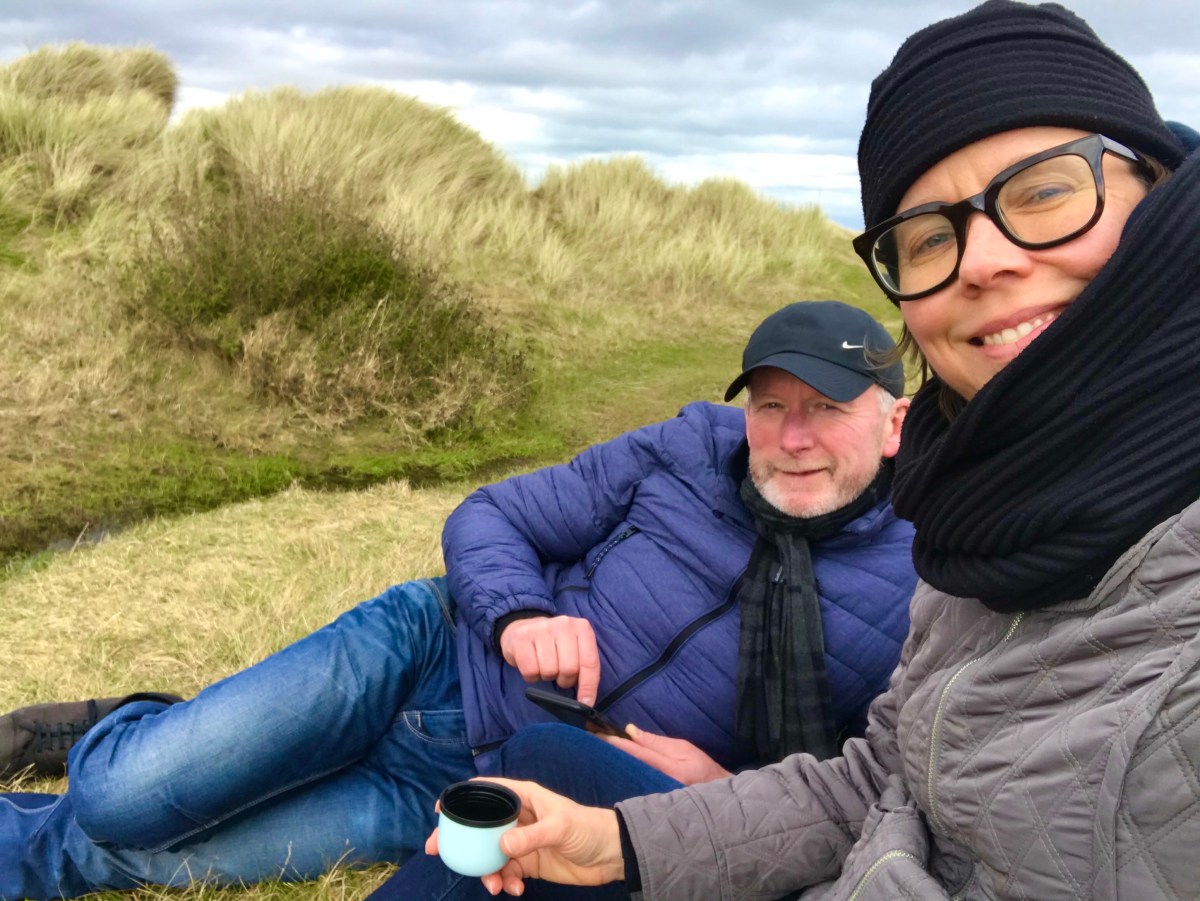
We enjoyed snacks along the boardwalk of this Victorian period seaside resort town before hiking to the “Eagles Nest” at the top. It is behind Aongus’s head. I zoomed way in so you can see the tiny cross in the distance.
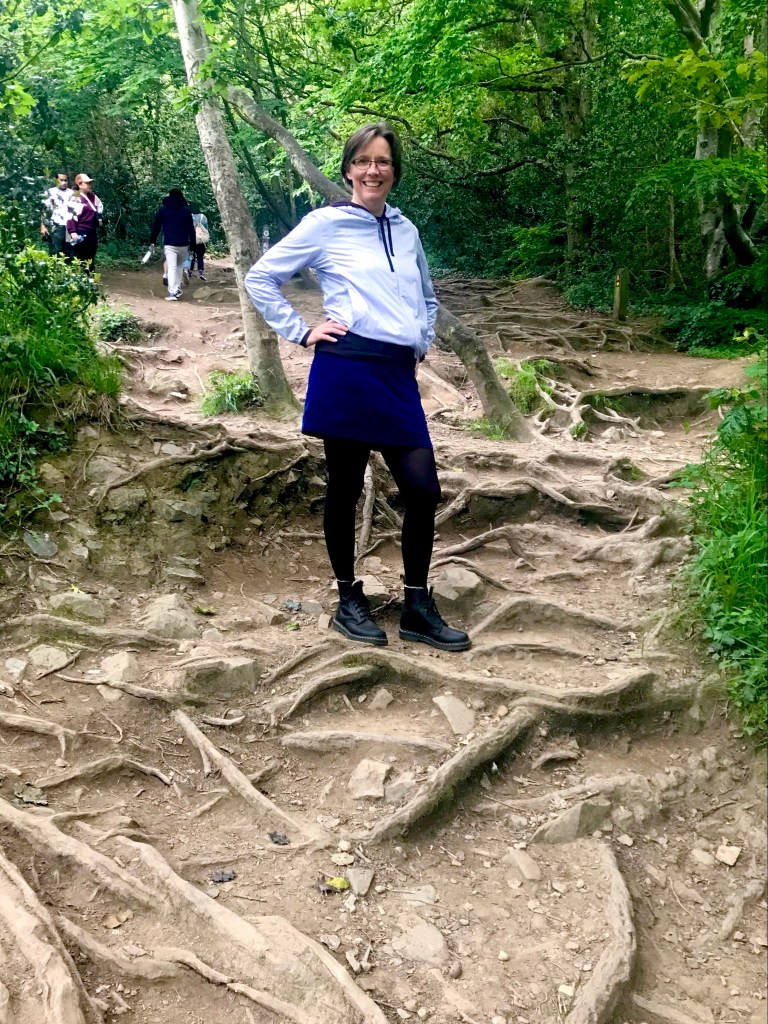
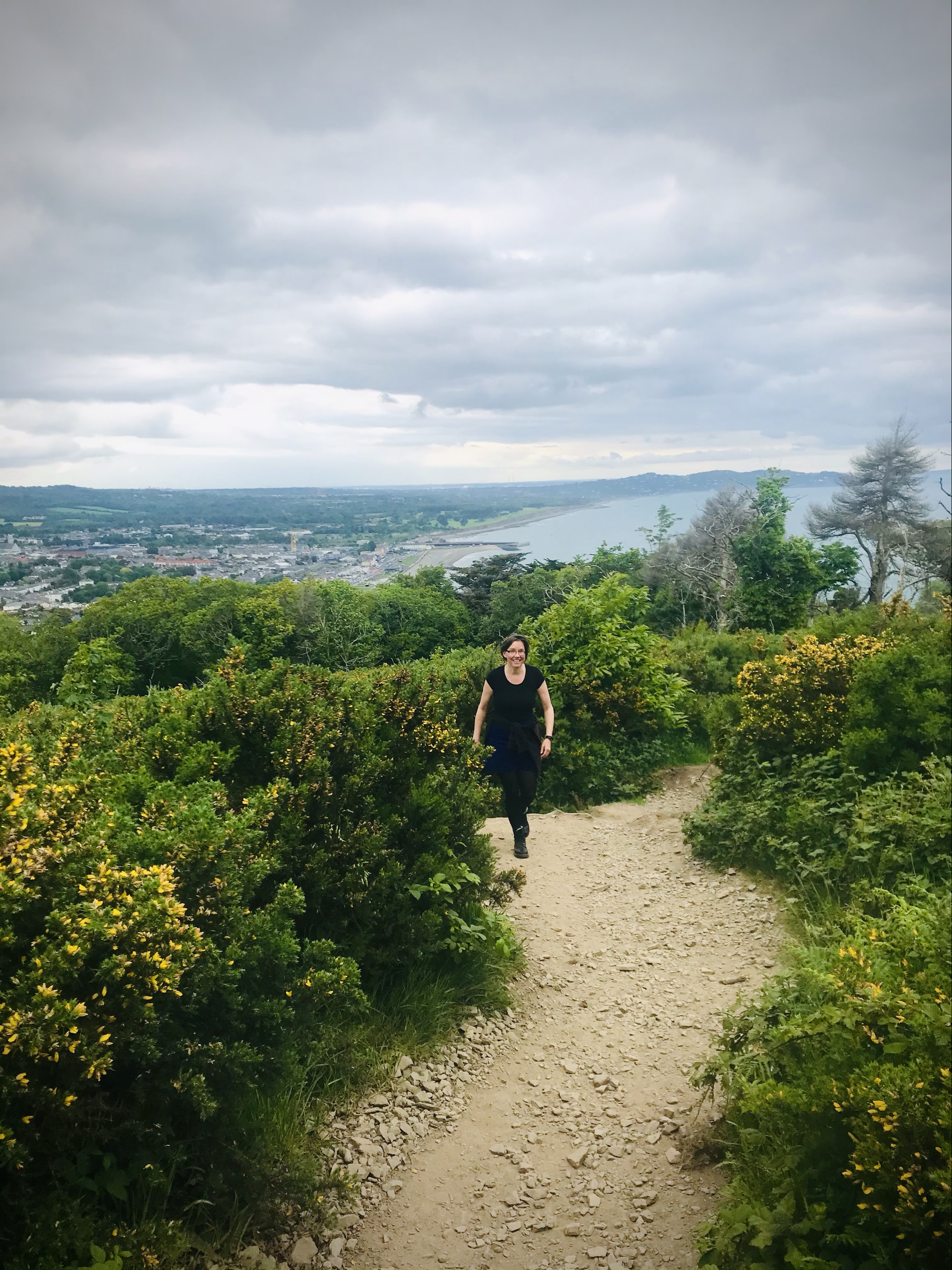
I thought I’d been to the summit before, but I’m now sure I remembered wrong. It’s a surprisingly steep and rugged path. Back in the 50s and 60s, there was a chair lift, seen as necessary since it’s so steep.
We chose the climb since part of the Bray to Greystones cliff walk had collapsed, and that favorite path wasn’t an option yesterday.
There’s a spectacular view from the summit, and I’m glad we’ve had that experience. It’s not likely I’ll have it again!
I can’t wait to get fit again. The gym opens tomorrow and I’ll be in the pool bright and early!
Although tomorrow is a bank holiday here, Aongus and I working so we can take off Friday for a new adventure on wheels! We’re going to re-live a favorite itinerary from last summer. Stay tuned!
Something was about to change here in Dublin on the night of March 11th. I knew this, and thus felt hesitation as well as excitement for an interesting day as I headed into work on the 12th.
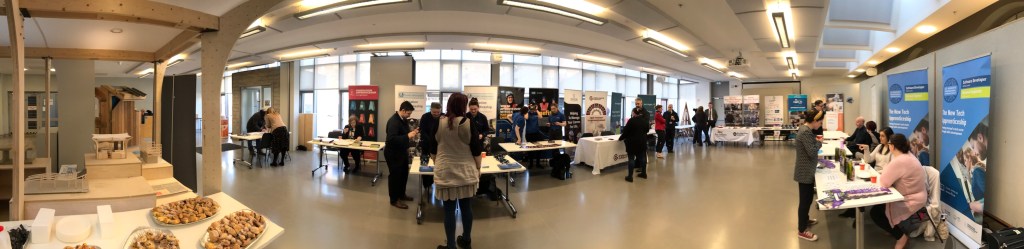
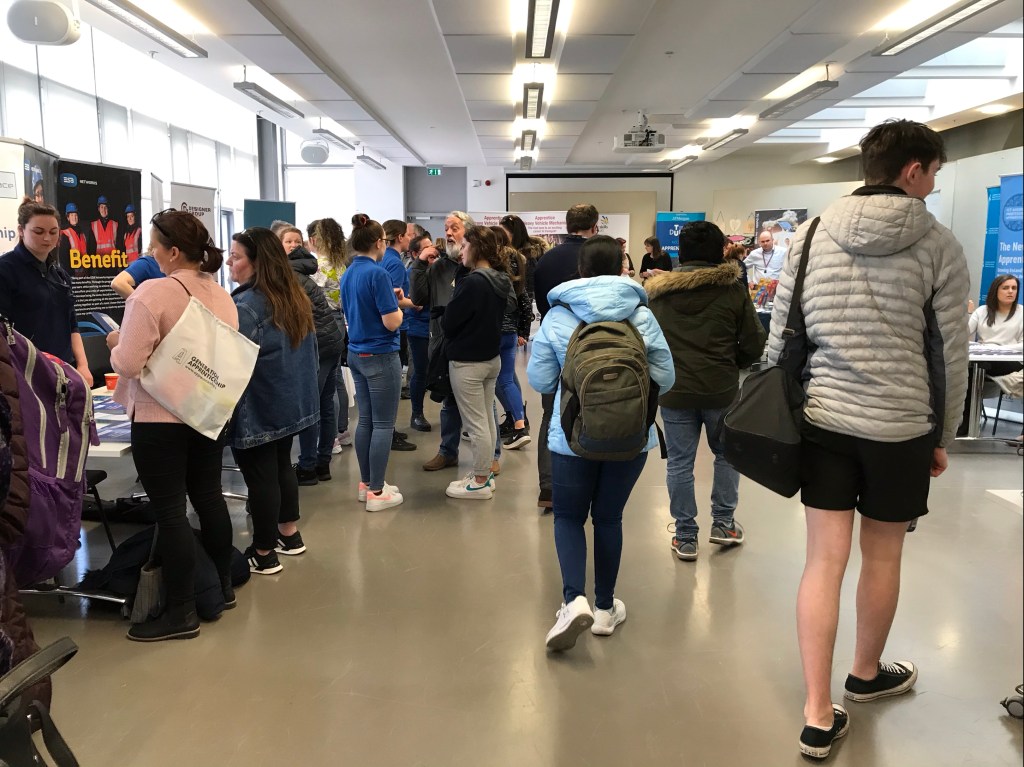
You see, TU Dublin had an Open Day planned to show female high school students about our apprenticeship courses. My colleagues and I had put a lot of work into planning this, although we anticipated things could change due to coronavirus. Later this day, life was to shift decisively about our world here in Dublin.
The Last Day ‘Open’ at TU Dublin
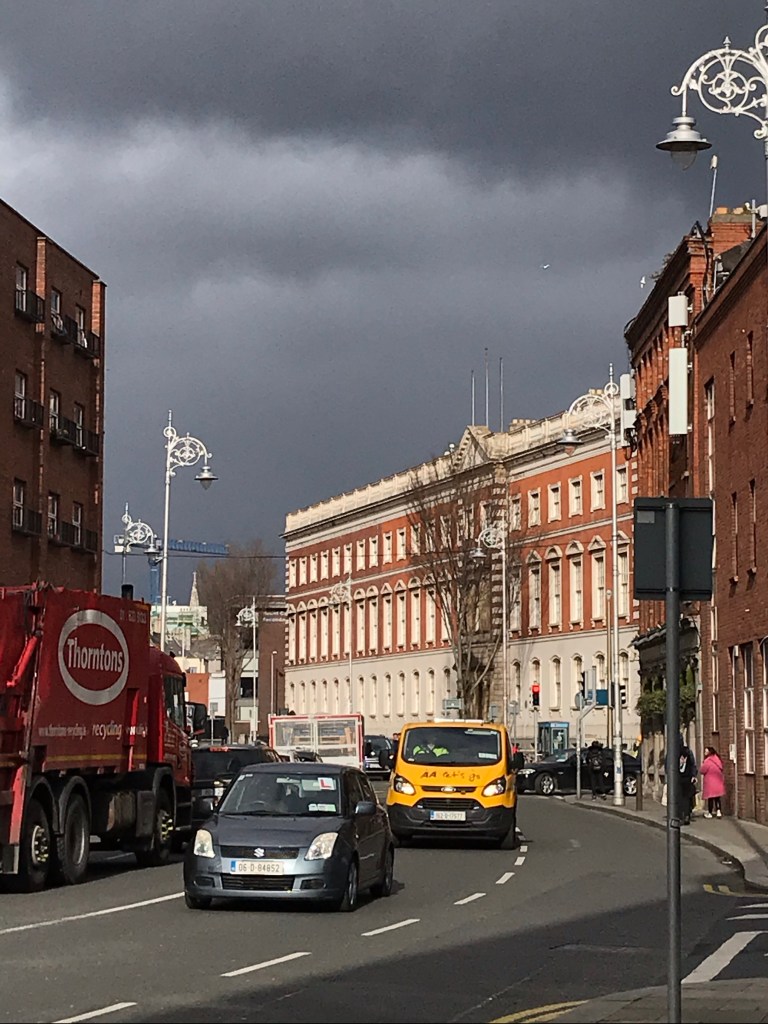
A glimpse of Bolton Street with drama in the sky.
We waited anxiously for word from the university about closures. In the meantime, we took care. Although plans went ahead and during this Open Day, the new norms of hand sanitizer and social distancing appeared. Wee conscientiously worked to hold intimate conversations about life plans at a two arm’s length–not an easy feat in a loud and active space like the lobby of Linenhall, home of the TU’s Dublin School of Architecture.
Attendance on this Open Day was higher than one would expect given the uncertainty of life, but not as high as the past year. Only a portion of those who reserved places made it to D2 that day. It was well worth my own four-block walk into work to meet girls from as far as Wicklow who’d ventured up to meet us.
Setting up for the day.
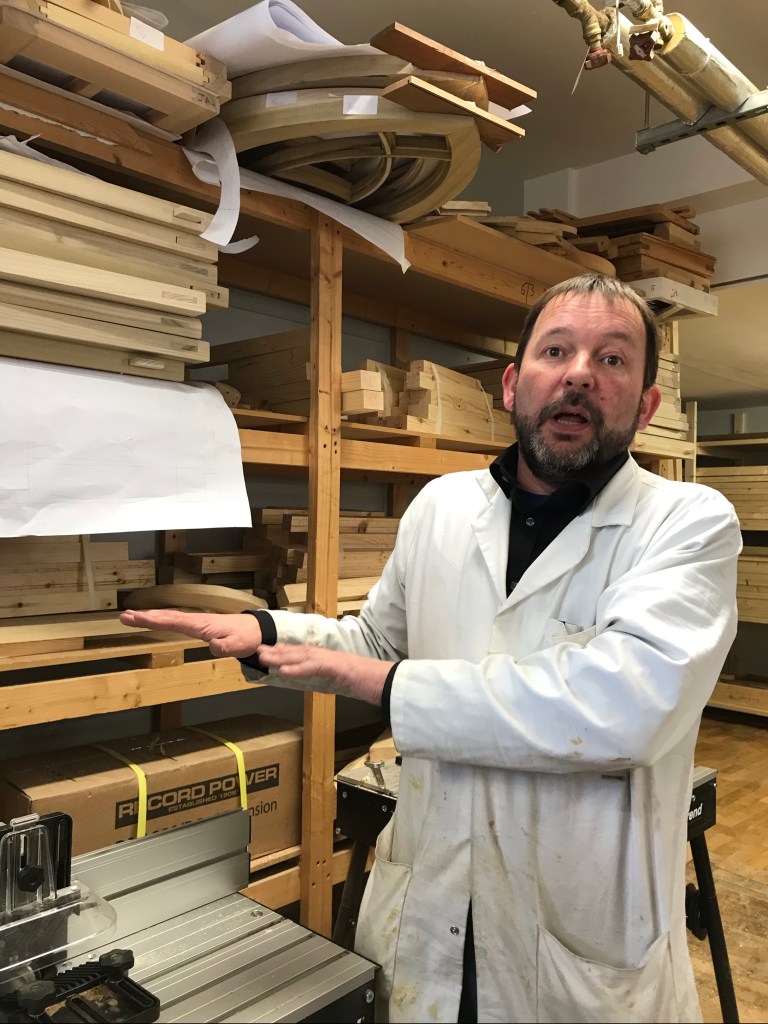
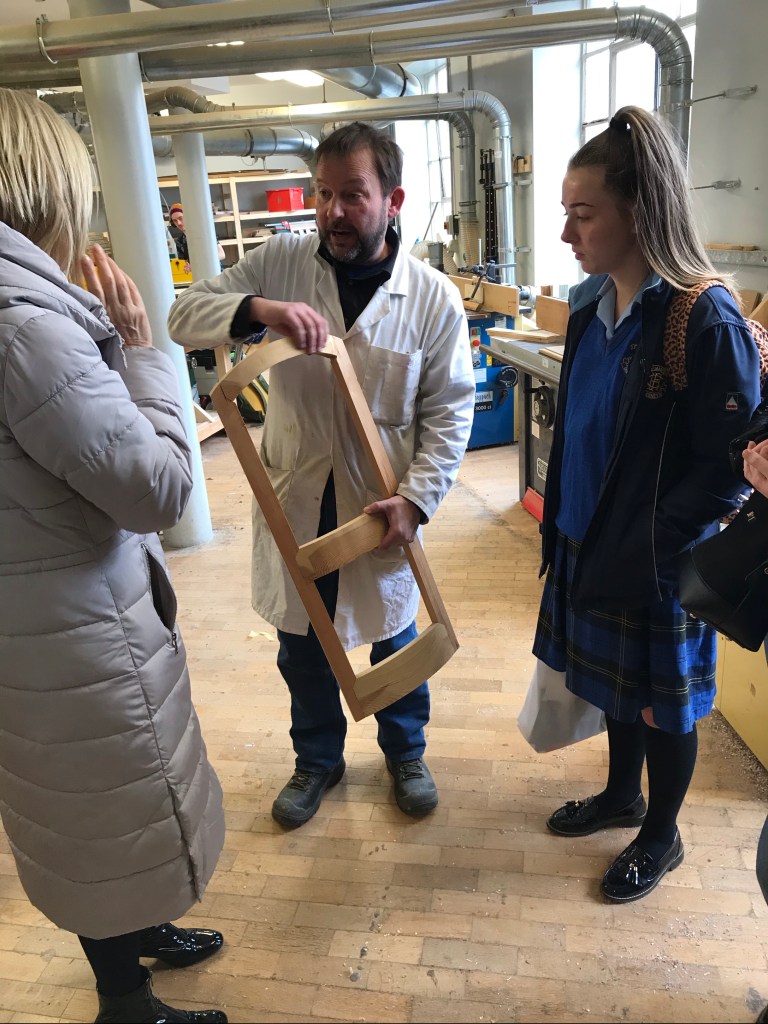
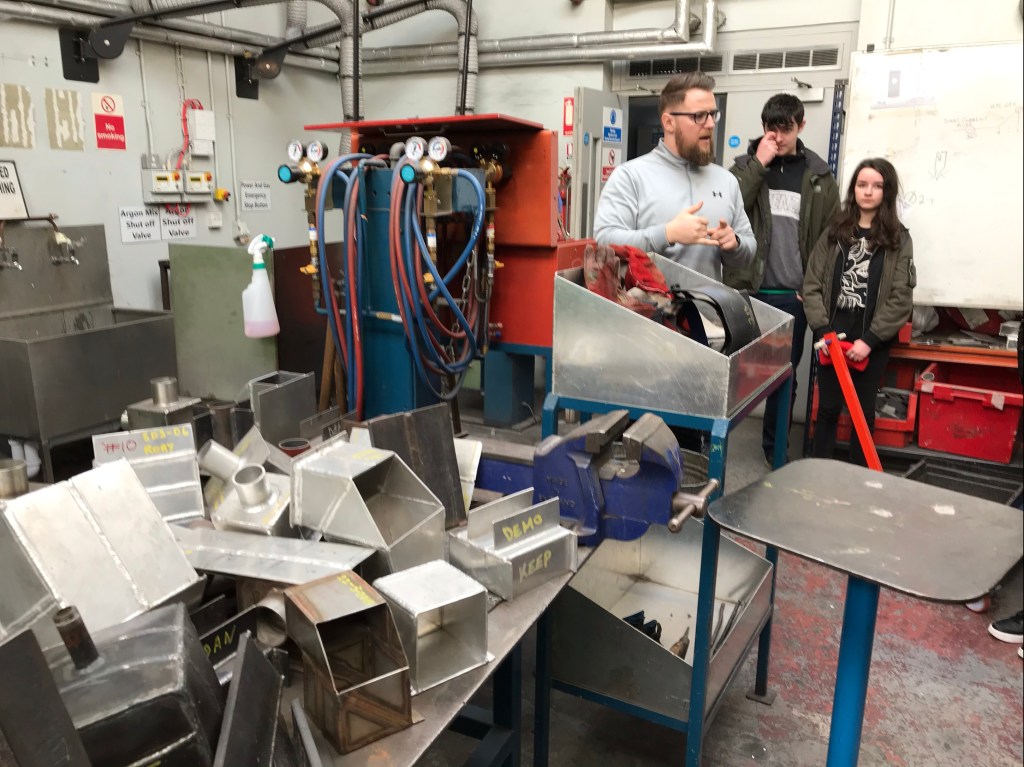
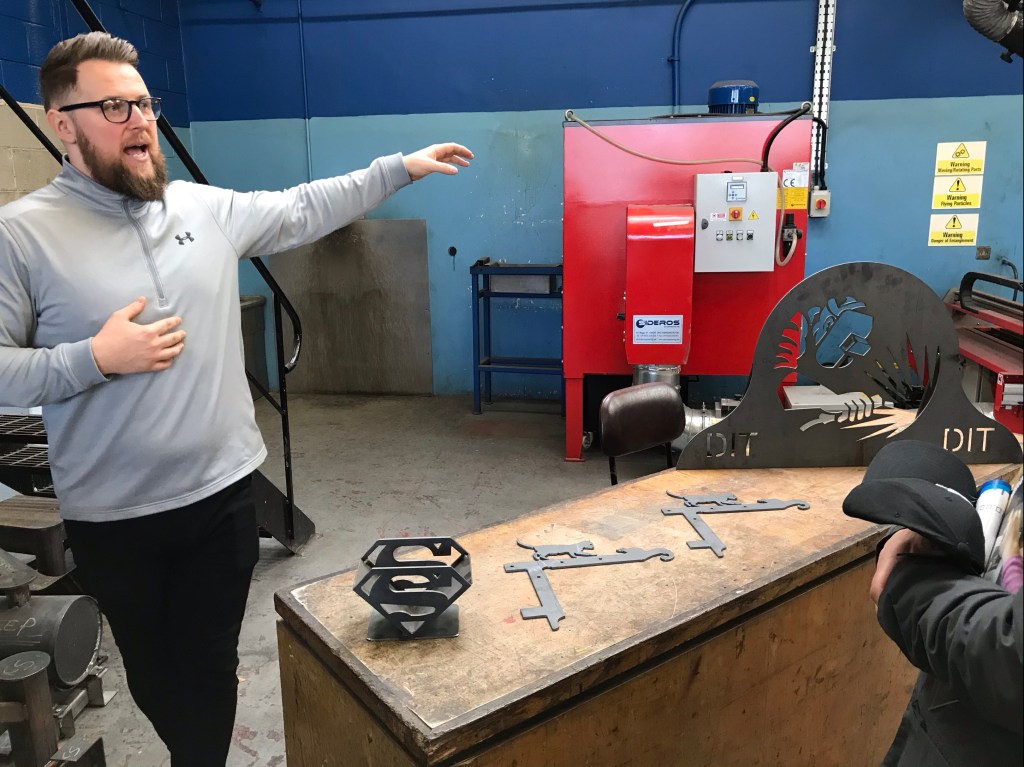
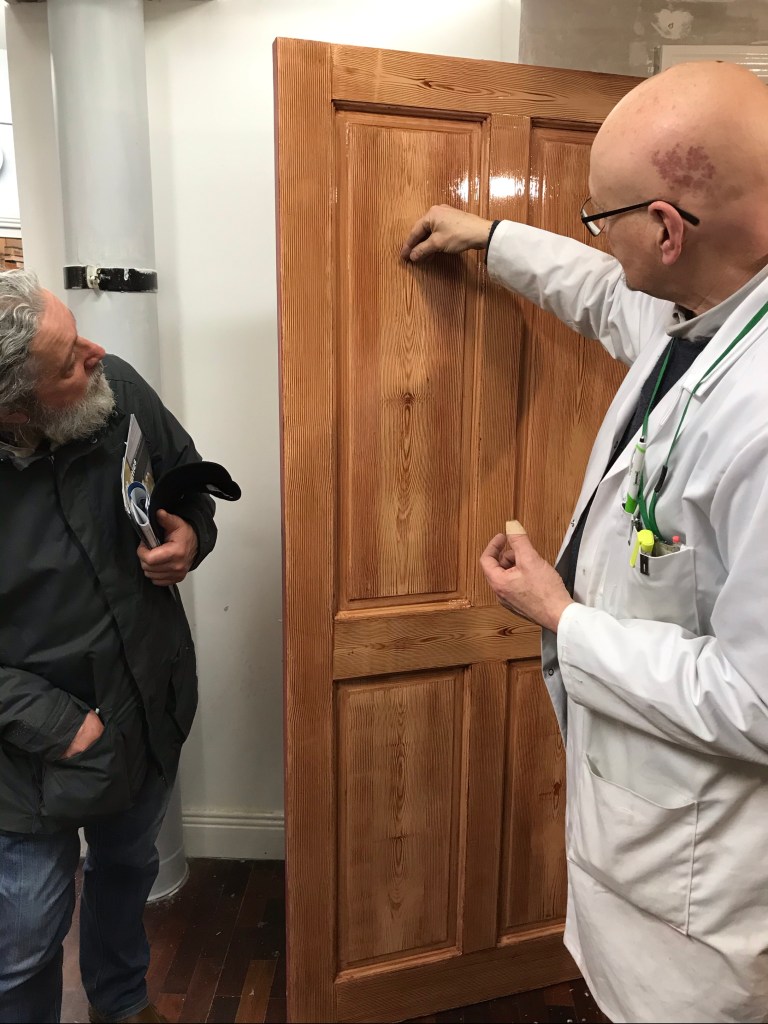
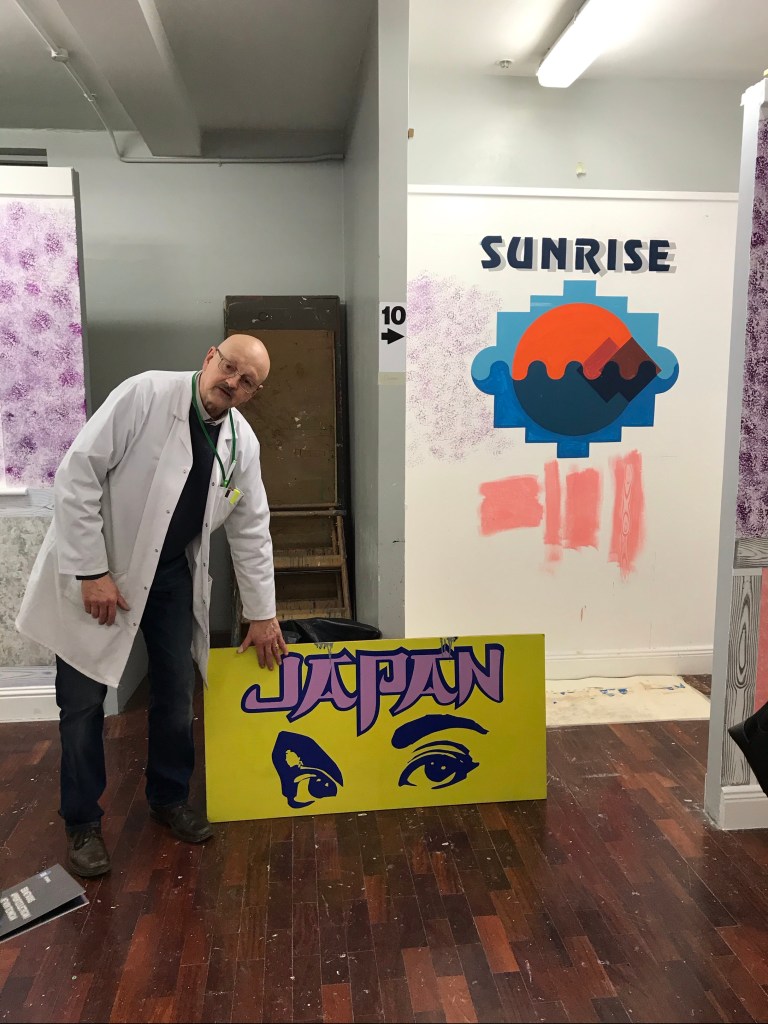
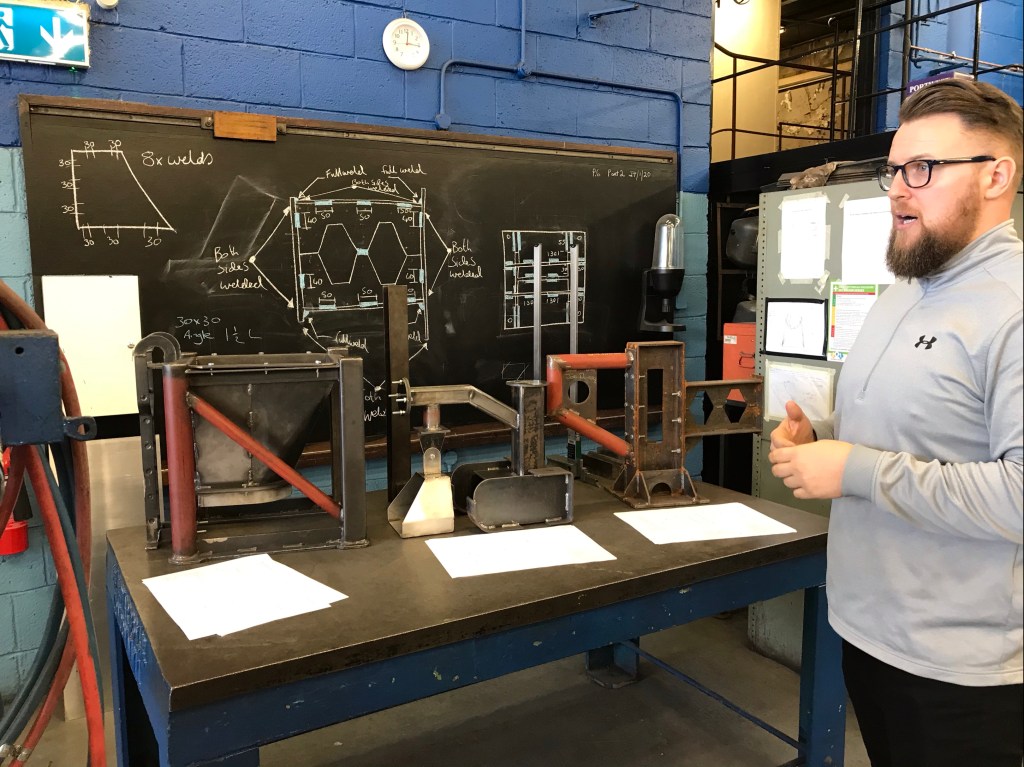
I provided tours of the facilities–bricklaying, plumbing, carpentry, metal fabrication, painting and decorating, laser cutting and 3D printing, automated fabrication–at Linenhall and Bolton Street where apprentices learn. Those taking our sampler program, “Access to Apprenticeship” get to use to all these workshops, and to complete a small project in each to help them determine which to specialize in by completing a full course.
At the end of the event we heard that campus buildings would close that night at 18:00; after this, classes would meet only online.
The BIM modules we offer in my program did indeed meet that night, all online, thanks to the collaborative working platform my colleagues use to teach BIM. Kevin Furlong, Barry McAuley, and Emma Hays took it all in stride and kept on delivering! I was truly impressed.
Working it out during Covid-19
I already worked half time on research, so I actually labored from home 50% of my working hours, pre-Covid. For me, work life after the 12th of March looked pretty similar to before–lots and lots and lots of time at my laptop. There was less variety, though, and much less human contact.
I missed feeling creative. I wasn’t able to blog, as I didn’t feel reason to celebrate during a time of fer and hardship.
I got work done, but not with my normal level of zest.
The first two weekends after the campus shut down, we weren’t yet asked to isolate (we never officially ‘locked down’) but the government was asking us to keep our distance from others.
My household has one other person, Aongus, and this fact has kept me sane during isolation. I’m glad I haven’t had to go through this pandemic living alone. That said, my guy has much higher exposure to the outside world than I do, and could inadvertently drag Covid-19 home at any time.
As you probably know, Aongus and I really enjoy our weekends. We love getting out, exploring the world, getting exercise, fresh air and sunlight. In fact, not feeling pangs of guilt for taking weekend off is a major reason I moved to Europe from the USA. You’ll recall that Aongus and I made the most of every minute in London during my two-year fellowship there. We had plans to make the most of our precious weekends together in Dublin upon our return.
A Sunday at Greystones Beach
Sliding into a new normal, we had a couple weeks to adjust to freedoms and habits that were slipping away. We were still allowed to drive and explore, but were required to stay away from others. Our gym was still open during this time, as well, though we were distancing.
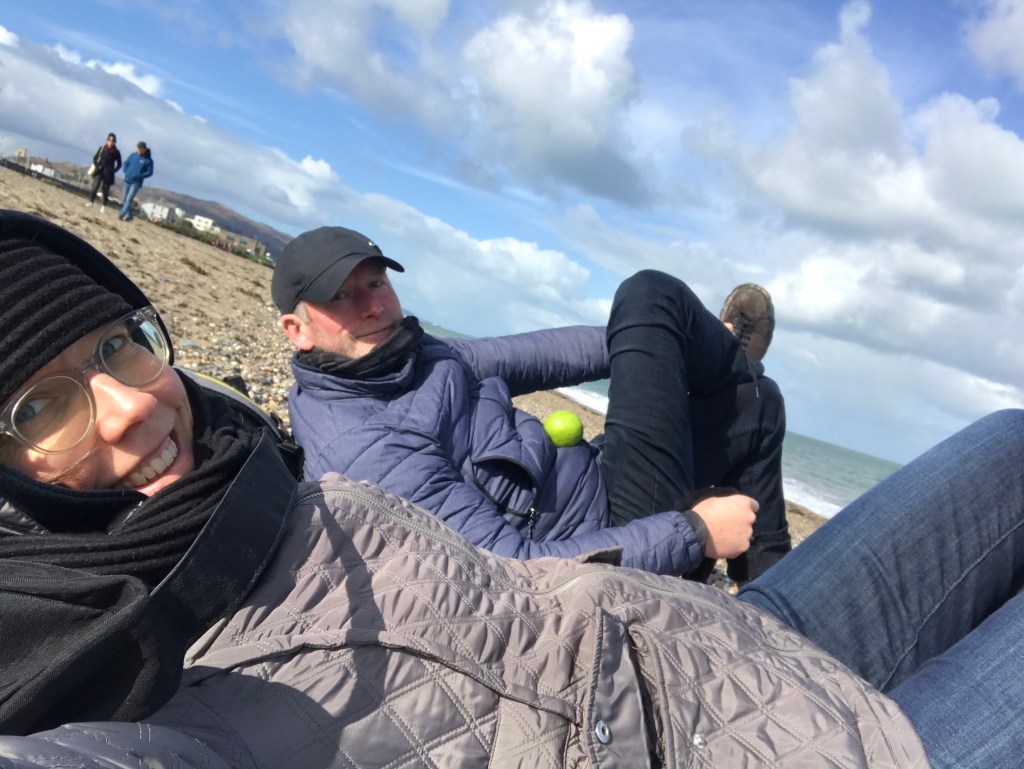
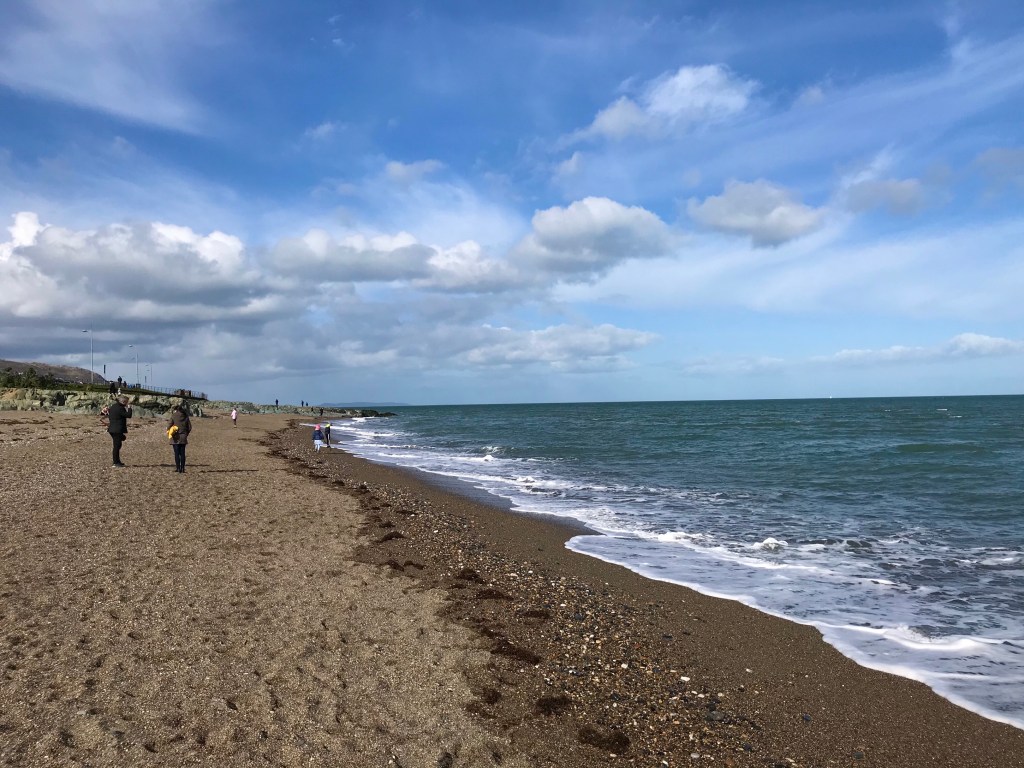
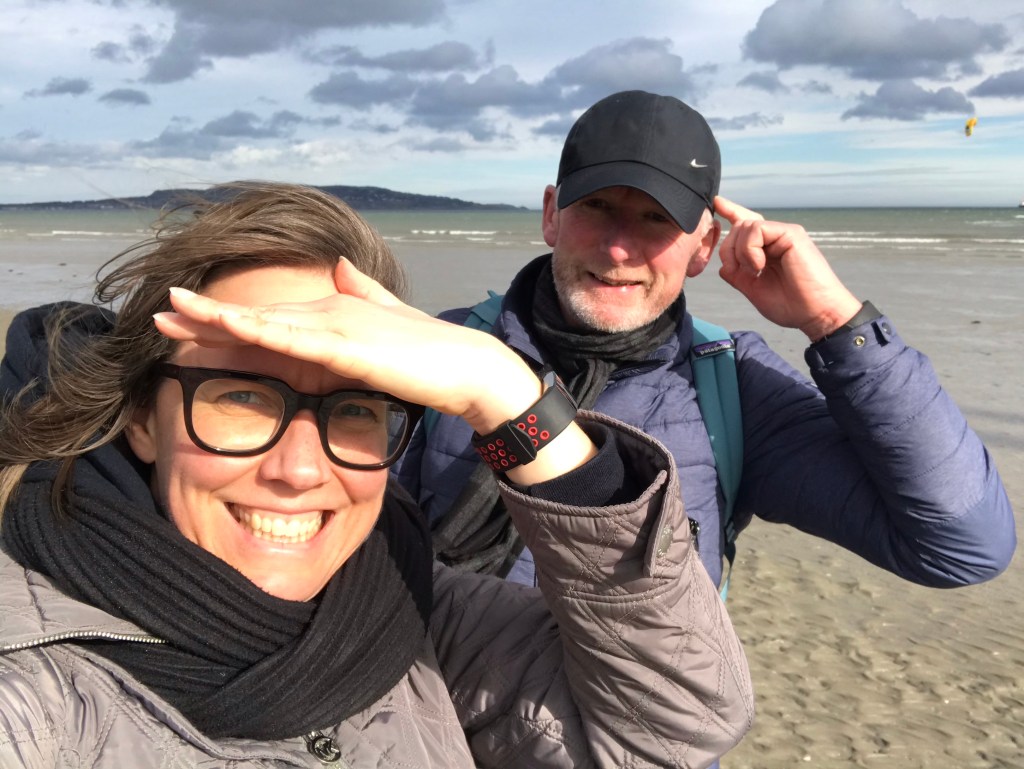
On Sunday, March 15, Aongus and I drove out to Greystones, where we were able to distant from others on the beach. We enjoyed the solitude in the cool winter breeze off the Irish Sea.
And we learned that lunches and loos were few and far between. From this day forward, we packed sandwiches whenever we ventured out, and planned ahead for long period of loo-less-ness.
The difficulty finding these that day told me that things were going to change more radically. We drove to some favorite spots hoping for lunch, but couldn’t stop because they were packed with people.
We did, however, find joy in simple pleasures: an apple, the sunshine, and loving company.
Holi-day at Bull Island Marshes & Dollymount Strand
St. Patrick’s Day was a holiday, so we made another trip trip to the sea, still pre-lockdown (to use the phrase lightly–we’ve never officially ‘locked down’ in Ireland to the degree of many other European countries).
Although Dublin’s St. Patrick’s Day Parade had been cancelled, and tourists discouraged from coming, we residents were still allowed out, but asked to keep our distance.
Aongus and I headed out to Bull Island, by car, as was typical for us before coronavirus. Walking and Dublin Bikes were our other main forms of transportation, and where they didn’t bring us, a bus or car would. “Back then”, we would never have dreamed of cycling to Bull Island or Dollymount Strand; they seemed so very far away.
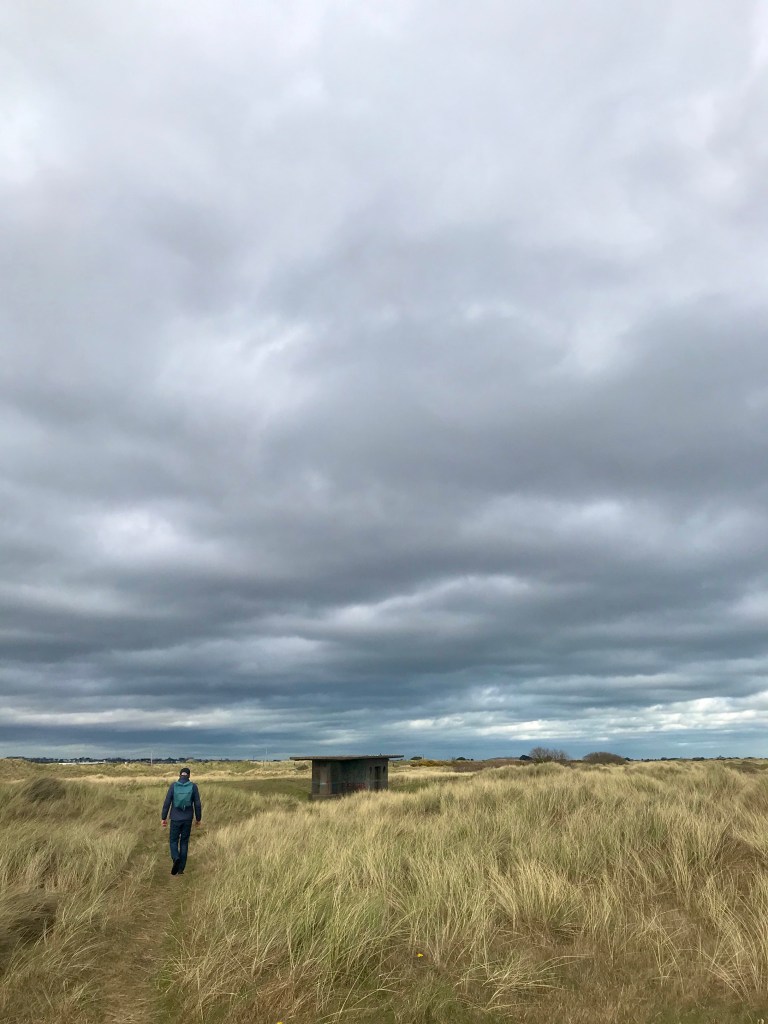
Bull Island is a favorite among Dubliners though, and when we arrived the beach looked far too crowded to allow the distance I required, so we instead explored the marshes.
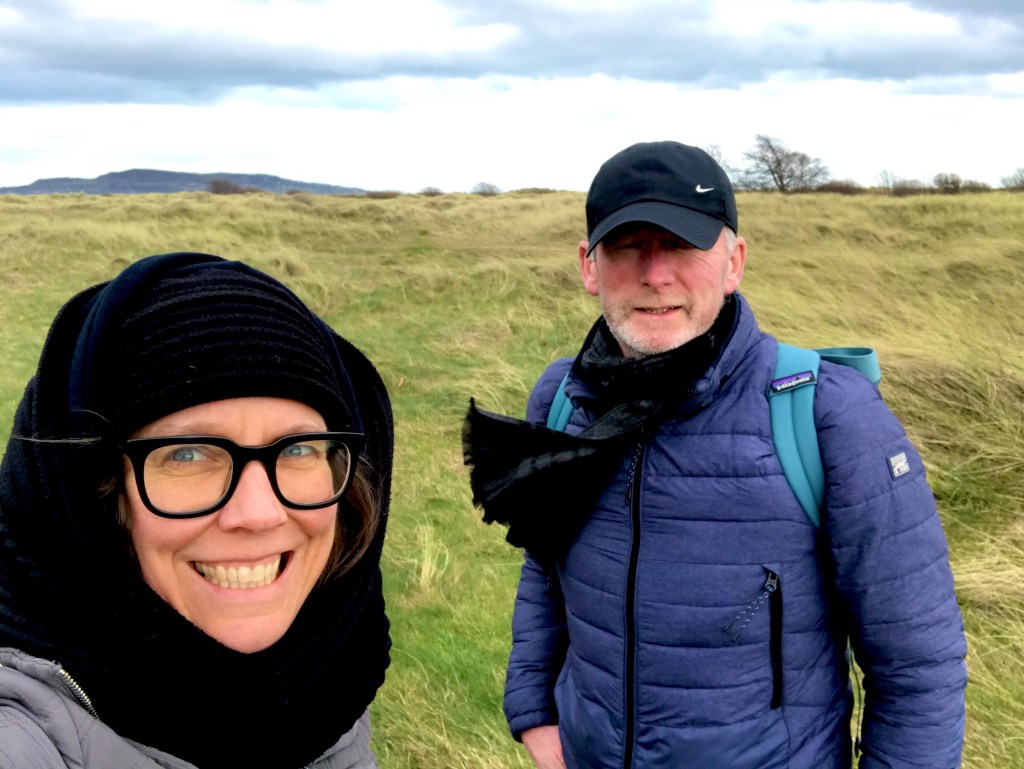
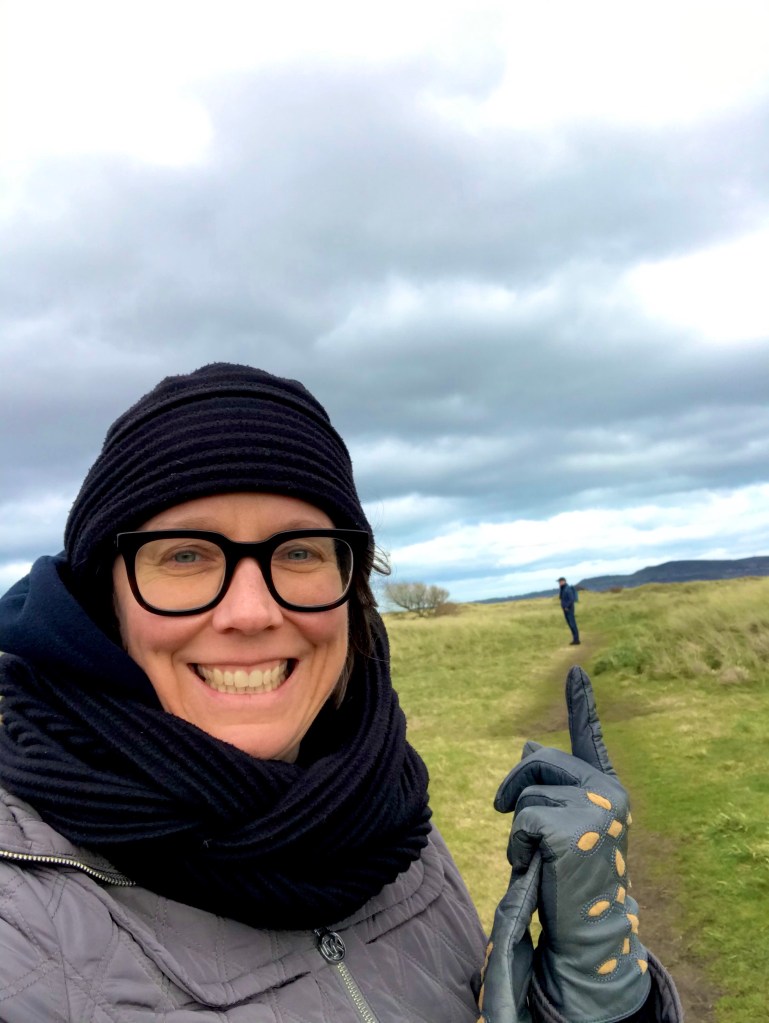
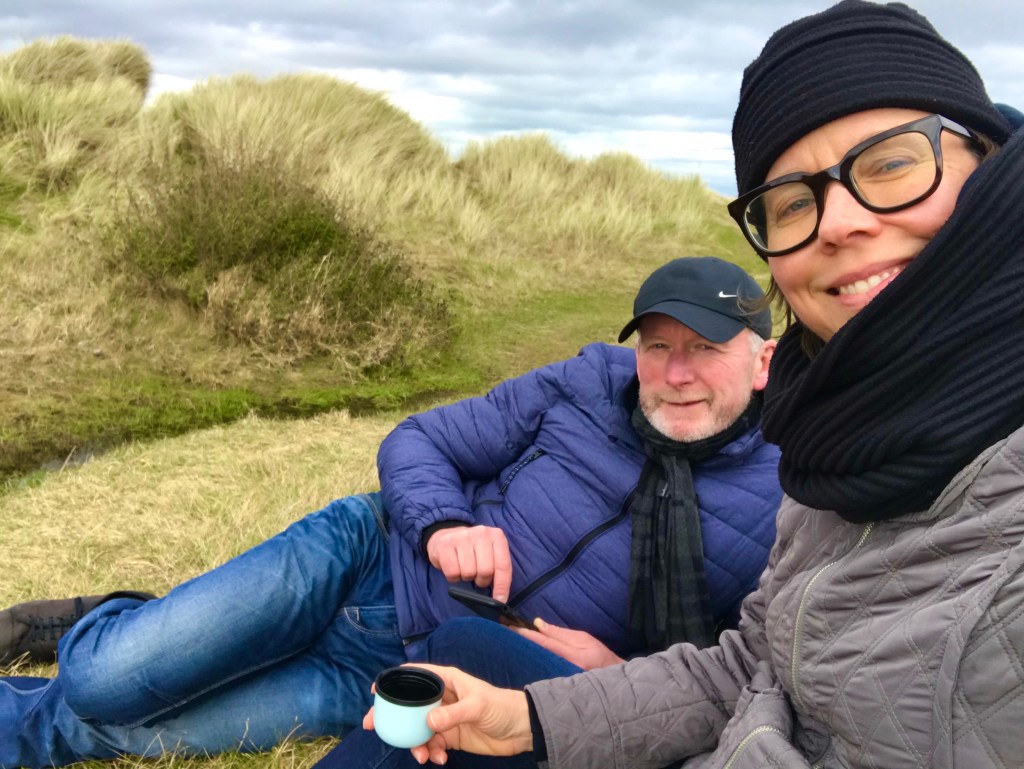
My colleague Damon Berry had recommended that I check them out, and this was the first time I latched onto the idea. Aongus and I had a nice picnic in the dunes.
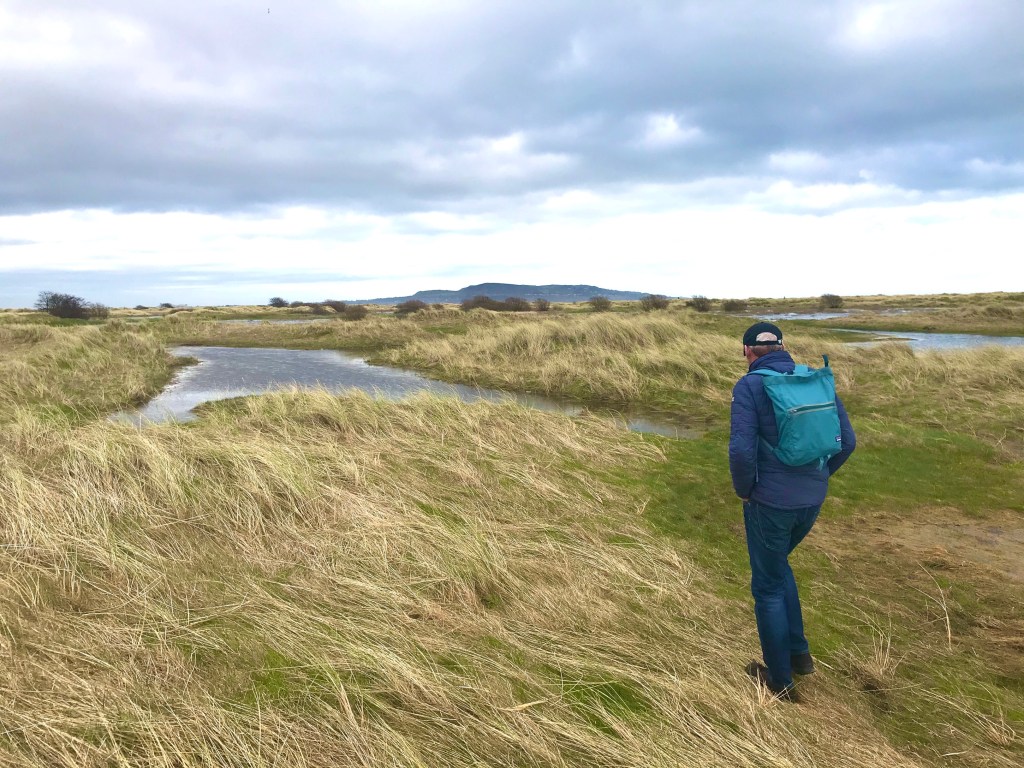
Of course, we hoped to find passage across to the beach by way of the dunes, but the waterways prevented that. Nevertheless, we enjoyed discovering a tranquil strip of Bull Island where few people venture.
By the late afternoon, the beach had cleared out (it was the bottleneck along the wall that had presented the problem passing others) and we were able to visit the strand, which is called Dollymount.
As you can see, Dublin is quite chilly during March, but any opportunity to go outside, walk, and soak in the sunshine is prized.
Isolation begins
The lifestyle we had known was quickly sliding away. Soon after our visit to Bull Island, the period of isolation began. Aongus and I essentially hibernated for weeks. I was able to keep working from home. He, as a construction site project manager, was able to do some limited amount of work from home and was allowed on site, alone, occasionally, to do essential work, or check for security.
As we have a range of grocery stores (Fresh Market, Lidl, two Centras and a Daybreak) within 1-4 blocks of our flat and the food supply chains serving Dublin never let us down, we were able to source food easily and have learned many new recipes with what we can find in these stores.
That 2km radius we were allowed to travel from home for the purpose of exercise kept us sane, and we looked forward to weekends, hoping and praying for sunshine.
During my February trip to Vienna for the MCAA General Assembly, I had the chance to look around the city center as well as some sectors not far from the center.
Vienna is an architect’s dreamland, full of beautiful spaces and artifacts old and new. In fact, the architect/urbanist/painter/historian Camillo Sitte documented many of the world’s most successful plazas in his quest to define what makes a public space beautiful. Many of his favorites plazas are located in Vienna. I often referenced his book “The Art of Building Cities”, published in 1945, when I was an architecture student and later an architecture professor.
Although I actually only had six hours to explore Vienna after the Assembly concluded, I took in plenty of sites. Below, I’ve posted my slide shows of spectacular architecture.
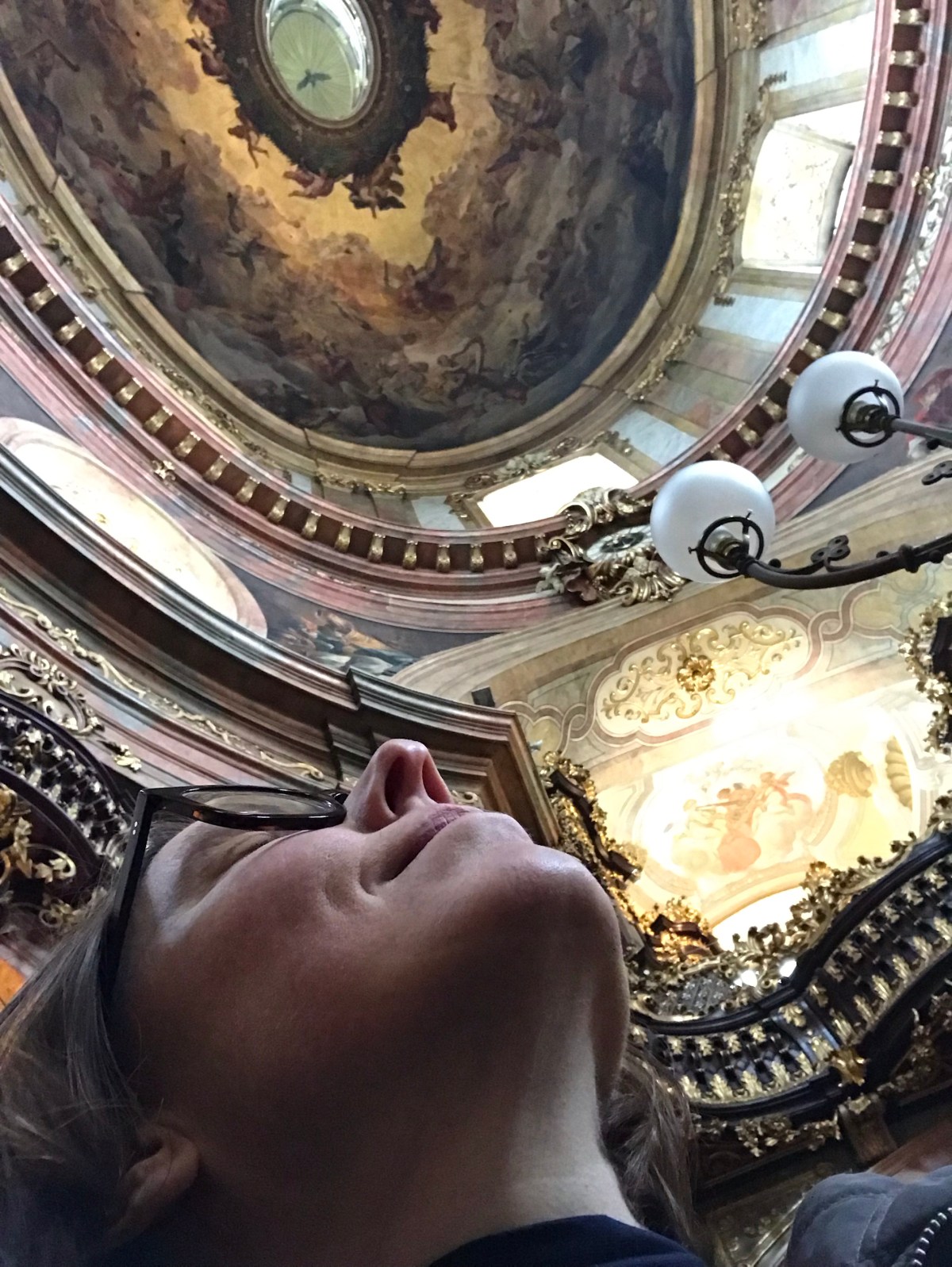
The slide shows start in Alservorstadt, with the Votive Church (Votivkirche), Hotel Regina, and University of Vienna. The slides proceed downtown and show visits to two more churches (Stephansdom and Der Graben), concluding with the Globe Museum. In other posts, I share photos from Hundertwasser and Otto Wagner ‘s Austria Post Headquarters or “Osterr Postparkasse” (blog forthcoming).
We’ve had a lovely St. Patrick’s weekend here in central London.
Yesterday, we visited the National Portrait Gallery to see “Only Human” by photographer Martin Parr. After lunch at Chipotle, some gelato and hot chocolate to honour my dad, and a quick break at The Courthouse Hotel, we got to the Photographers’ Gallery for the last hour (for free entry!) to view a show I’d found don Time Out and another to boot.
We ended Saturday at Backyard Comedy with four hilarious comedians.
Our Art Fund pass and memberships with Tate and Backyard are really paying off!
We learned a lot this weekend about being British, thanks in no small part to Martin Parr. Here’s a selection of photos from yesterday:
Thanks fo the ideas, Time Out!
Martin Parr!
Grayson Perry and family
Piccadilly Circus
Piccadilly Circus
Piccadilly Circus
Gelato and hot chocolate in honour of my dad.
Protests left and right yesterday
Today, we breakfasted beside Whitechapel Gallery, walked to the Tower of London, took the boat down to Embankment and walked to Tate Britain. We visited two photographers’ exhibitions–seeing the second half of photojournalist Don McCullin’s show (we hadn’t allotted enough time in our first visit). Then we took a double decker bus over to Trafalgar Square, enjoyed lunch at Thai Spice, and took in the last hour of the city-sponsored St. Patrick’s Day music festival.
While it feels surreal to sing Irish Republican songs in Trafalgar Square, particularly because it’s not considered entirely kosher to sing such songs in Dublin these days, we truly felt our love for Ireland by singing along–without having to love London any less!
Ireland’s Call by Phil Coulter
Come the day and come the hour
Come the power and the glory
We have come to answer Our Country’s call
From the four proud provinces of Ireland
CHORUS
Ireland, Ireland
Together standing tall
Shoulder to shoulder
We’ll answer Ireland’s call
From the mighty Glens of Antrim
From the rugged hills of Galway
From the walls of Limerick And Dublin Bay
From the four proud provinces of Ireland
CHORUS
Hearts of steel, and heads unbowing
Vowing never to be broken
We will fight, until We can fight no more
From the four proud provinces of Ireland
Aongus and I were making the most of our last day together for a while. I’m heading home to Virginia help my Dad who hasn’t been well.
We ended the day at the Blind Beggar, site of a notorious gang murder long ago (see the plaque for further explanation). I’d not been there before, despite it being just blocks from our London home.









































 Ireland by Chance